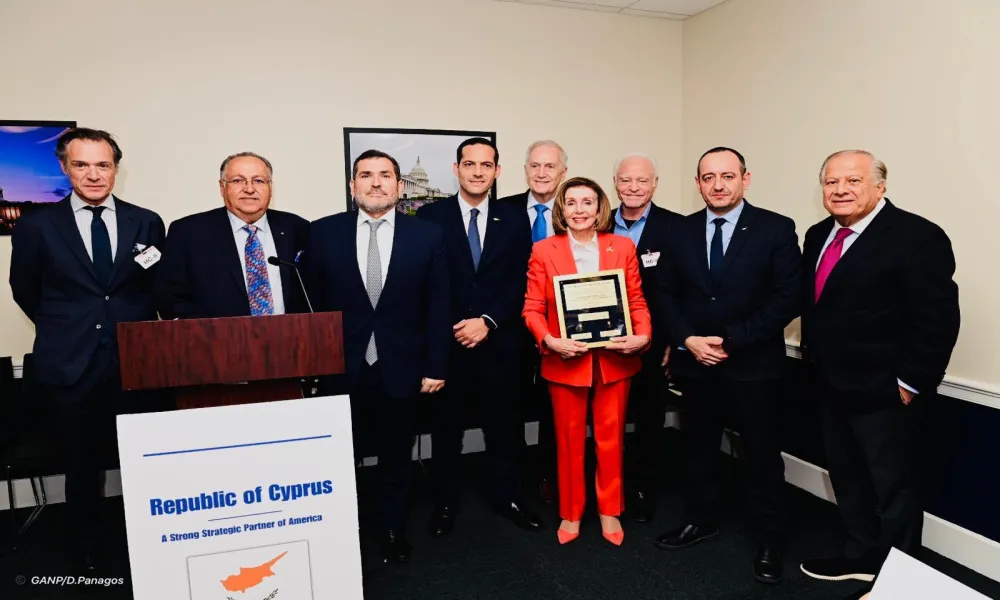

Cyprus has strengthened its international reach and deepened ties with the United States as part of a broader strategy to boost security, energy cooperation and diplomacy, Government Spokesman Konstantinos Letymbiotis said on Wednesday.
Speaking at the 41st annual conference of the International Coordinating Committee – Justice for Cyprus (PSEKA), Letymbiotis said Nicosia was “strengthening every factor of national power” to better defend its sovereignty and pursue reunification.
“The map has not changed. The reach of the Republic of Cyprus has,” he said, pointing to closer US cooperation in defence, energy, law enforcement and technology under a Strategic Dialogue framework.
He cited President Nikos Christodoulides’ White House visit as recognition of Cyprus as a “trusted partner” in the eastern Mediterranean, and said efforts to turn political alignment into practical cooperation were already yielding results.
Partnerships with US firms including NVIDIA and Tenstorrent are helping upgrade Cyprus’ computing and artificial intelligence capabilities, while Plug and Play is expanding its innovation presence on the island, he said.
Letymbiotis also highlighted the role of the Cypriot-American community in maintaining bipartisan support in Congress and keeping the Cyprus issue on Washington’s agenda.
On foreign policy, he said Cyprus was expanding its regional and international footprint, including a strategic partnership with India and participation in initiatives such as the India–Middle East–Europe Economic Corridor (IMEC).
He pointed to the island’s role in regional cooperation and humanitarian efforts, including the Amalthea maritime corridor, and closer ties with countries in the Middle East and Europe.
Cyprus is also positioning itself as an energy hub, with US companies ExxonMobil and Chevron active in its exclusive economic zone and a “3+1” energy ministerial with Greece, Israel and the United States taking place this week.
Letymbiotis said a resilient economy underpins the strategy, noting growth of 3.8 percent in 2025 and 3 percent in the first quarter of 2026, alongside falling unemployment and public debt below 60 percent of GDP.
Cyprus has also returned to investment grade after 13 years and introduced tax reforms aimed at boosting competitiveness, he said.
Despite the progress, Letymbiotis stressed that reunification remains the government’s central goal, more than five decades after the island was divided in 1974.
“After 52 years of occupation… time does not legalise occupation,” he said.
He reaffirmed support for renewed UN-led efforts to restart negotiations from where they left off in Crans-Montana, on the basis of a bizonal, bicommunal federation with a single sovereignty, citizenship and international personality.
“Partition has no place in the future of Cyprus. Two-state proposals have no basis in international law,” he said.
Letymbiotis urged continued diplomacy and engagement, and said a reunited Cyprus could become a model of stability and cooperation in the region.
“We are committed to diplomacy, dialogue and a solution,” he said.