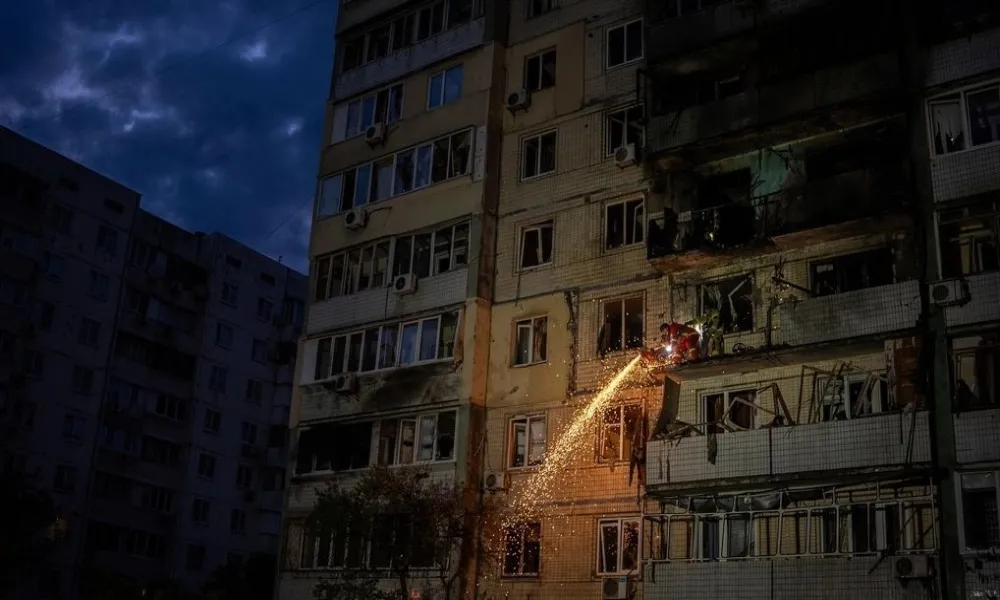

Kyiv endured 11 continuous hours of bombardment on Thursday morning as Russia launched a massive attack involving 74 missiles, including 24 ballistic missiles, and 496 drones of various types, killing at least 17 civilians and injuring dozens more.
The death toll may rise further, as rescue crews continue to search through rubble for additional victims.
In the Desnianskyi district, six of the nine floors of an apartment building collapsed following a direct strike.
In the Darnytskyi district, residents became trapped during secondary explosions that hit another building, while in the Holosiivskyi district a fire broke out on the roof of a 16-storey residential tower.
“The enemy deliberately targeted residential areas and killed civilians,” Tymur Tkachenko, head of Kyiv's military administration, wrote on Telegram, adding that two children were among those injured.
Infrastructure also hit
An ambulance station in the Shevchenkivskyi district was also struck, injuring five healthcare workers, one of whom was reported to be in critical condition, according to Mayor Vitali Klitschko.
During the attack, civilians crowded into metro stations seeking shelter, scenes reminiscent of the first weeks of Russia's invasion in February 2022.
The Ukrainian Navy said it intercepted a significant number of the incoming missiles and drones.
Ukrainian President Volodymyr Zelensky had warned from Dublin on Wednesday of an impending large-scale attack, stating that “Putin has been preparing this for a long time” and urging citizens to remain in shelters.
He returned to the Ukrainian capital early Thursday morning.
Retaliation and escalation
Russia's Defence Ministry described the attack as retaliation for Ukrainian strikes against Russian infrastructure, insisting that military facilities, airfields and energy infrastructure had been targeted.
On the same night, Ukrainian forces struck one of Russia's largest oil refineries in the Nizhny Novgorod region east of Moscow, while a railway bridge in occupied Luhansk was also hit.
The Kremlin announced that President Vladimir Putin had been briefed by Russia's top military commander and said Moscow would continue to “increase pressure” on Ukraine.
In June, a Russian bombardment involving 656 drones and 73 missiles killed 23 people.
Earlier in the same month, Russian strikes also hit the Kyiv Pechersk Lavra, the historic monastery complex listed as a UNESCO World Heritage Site, prompting international condemnation.
The Institute for the Study of War noted on Wednesday that Russia's spring-summer offensive of 2026 has failed to achieve significant operational results, with the pace of Russian advances during June representing only a fraction of what was recorded in June 2025.
Nevertheless, aerial attacks against urban centres continue with undiminished intensity, targeting both infrastructure and civilian morale.
Ukrainian Foreign Minister Andrii Sybiha, who was visiting Japan, issued an urgent appeal to Western partners for faster decisions on strengthening Ukraine's air defence systems.
He rejected Russian claims that the strikes constituted legitimate retaliation, describing them instead as a direct violation of Article 51 of the United Nations Charter.