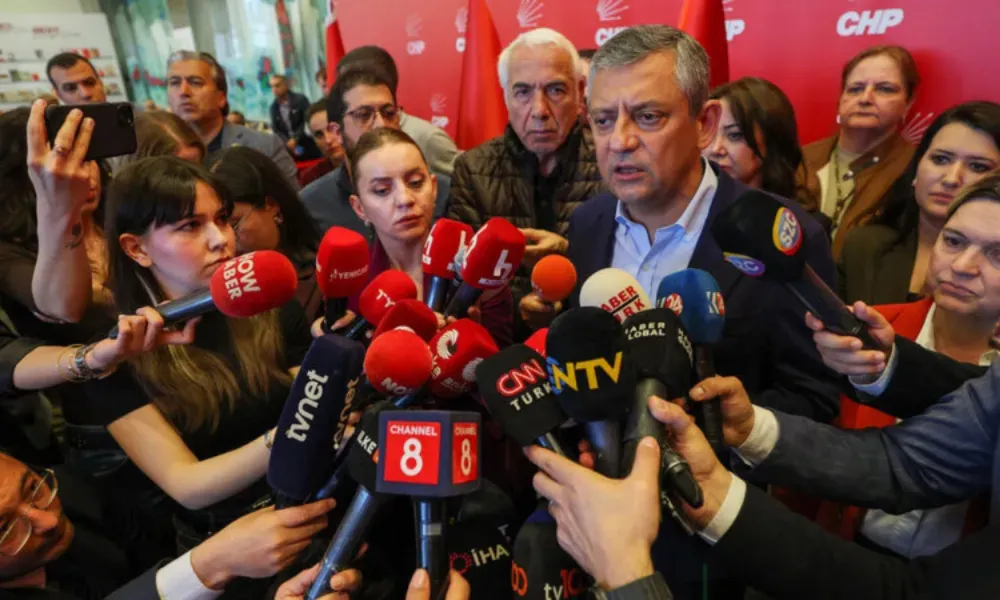

Özgür Özel’s roadmap is more complex than a straightforward break with the Republican People’s Party (CHP).
The visible part is the creation of a new party. The less visible part is an effort to preserve enough strength inside the CHP to prevent Kemal Kılıçdaroğlu from gaining uncontested control of everything beyond the headquarters, legal identity and official seal.
The strategy was discussed during closed-door meetings in Ankara. Özel first met members of the Party Assembly and Central Executive Board from his elected leadership period, then gathered supportive deputies at a hotel in Çankaya.
The parliamentary meeting became the new party’s founding workshop. Deputies discussed the founders’ list, collective resignations, the programme and the division of responsibilities between those leaving immediately and those remaining inside the CHP temporarily.
Zeynel Emre, spokesperson for Özel’s elected leadership, said the application would be submitted to the Interior Ministry within days. The name and logo have been chosen, and a preliminary agreement has been reached for a headquarters building, with rental payments expected to begin in October.
The name remains secret. Politicians, journalists and voters increasingly refer to the movement simply as the “Yeni Parti,” or New Party. The label may prove temporary, but it already suggests a promise to leave behind judicial paralysis and the disappointments associated with the old opposition order.
Founders to resign together
Deputies selected as founders are expected to resign from the CHP en masse and sign the documents establishing the new organisation.
Estimates range from about 70 to 95 founding deputies. Most of the CHP’s 135 MPs are eventually expected to move, making the new party the largest opposition force in parliament.
The final figure reflects three calculations. The new party must immediately secure main-opposition status; its founders’ list must be broad enough to demonstrate that it is not merely a personal vehicle; and sufficient supporters must remain inside the CHP to preserve Özel’s influence there.
Twenty deputies are enough to form a parliamentary group, but Özel has promised a much larger presence. Deputies from different regions and political traditions are expected to give the new organisation visibility and institutional capacity.
Yet Özel does not intend to take every supporter with him on the first day. Some will remain inside the CHP as part of a political insurance policy operating on two tracks.
Why some supporters will remain
Özel’s camp wants enough friendly MPs to remain in the CHP group to determine who succeeds him as parliamentary leader.
Kılıçdaroğlu was returned to the party chairmanship by the court, but control of the parliamentary group depends on the deputies who remain CHP members. If most continue to support Özel, they could elect a figure close to him as the next group leader.
Kılıçdaroğlu would then control the headquarters, central administration and legal personality, while an Özel-aligned politician continued to speak for the CHP group in parliament.
The arithmetic does not require Özel’s camp to retain a majority of the original 135 deputies, only a majority among those remaining. If 90 leave and 45 stay, for example, 23 Özel-aligned MPs could determine the next group leader.
Such an arrangement would make it harder for Kılıçdaroğlu to portray the split as a clean division between loyalists and defectors. He might possess the party name and headquarters, but deputies speaking from the CHP benches could still challenge his claim to represent its democratic will.
The Party Assembly and the court
A similar calculation applies to the CHP Party Assembly. Özel’s camp does not want every supportive official to depart immediately. Some are expected to remain, or avoid steps that would eliminate their membership claims, so that the elected leadership preserves a presence inside the party’s governing structures.
The exact composition of the legally recognised Party Assembly remains disputed because of earlier resignations, the court’s restoration of pre-2023 bodies and competing interpretations of the party charter. The strategic objective, however, is clear: Özel’s supporters do not want to surrender every institutional position from which they might influence a future restoration.
The appeal against the absolute-nullity ruling is before the Third Civil Chamber of the Court of Cassation. The case reached the court shortly before the judicial recess ending Aug. 31. A decision is unlikely before September, while October or later remains possible.
If the Court of Cassation reverses the ruling that reinstated Kılıçdaroğlu, the legal basis of the takeover would collapse. A strong Özel-aligned presence in the Party Assembly could then help restore the elected leadership, convene the necessary bodies and prevent Kılıçdaroğlu’s administration from controlling the transition.
The new party is therefore being built not necessarily as an irreversible divorce from the CHP, but as a protected political home during an uncertain legal interregnum.
A party and a lifeboat
Özel’s strategy resembles a political lifeboat still tied to the mother ship.
If the Court of Cassation upholds the annulment, the new party becomes permanent. Özel and his supporters would have an organisation through which to contest elections, sustain Ekrem İmamoğlu’s presidential campaign and preserve the coalition created during the 2024 local elections.
If the ruling is overturned, Özel could return to the CHP, seek a merger, negotiate cooperation between the two organisations or continue building the new party as a broader successor to the reformist wing.
The project is emerging from within the CHP, but not necessarily against it. Its founders continue to present themselves as representatives of its social-democratic tradition, Atatürk’s principles and the electoral legitimacy produced by the 2023 congress and 2024 local elections.
This explains Özel’s insistence that the movement is not changing its ideological “shirt.” It is, in his phrase, putting on a “shirt of fire.” The target is not the CHP’s historical identity, but the political and judicial environment that has made continued activity under Kılıçdaroğlu increasingly untenable.
Two stages of establishment
The new organisation will be established in two distinct stages.
Its official and technical establishment will take place when the founding members sign the required documents and submit them to the Interior Ministry, most probably on July 27. From that moment, it will legally exist as a political party.
Its political establishment will unfold throughout August and September as citizens join, provincial and district organisations are formed and the party completes its nationwide structure.
This is what Özel means when he says the technical establishment will be carried out by the deputies, while the political establishment will be achieved “with the people.” He is not merely referring to a later launch ceremony. He is distinguishing between registering a party on paper and turning it into a functioning national movement with members, local organisations and an active political presence across Türkiye.
During this period, the leadership will accelerate membership registration, establish provincial and district branches, allocate organisational responsibilities and determine how mayors, councillors and local political networks will relate to the new structure.
Özel has discouraged supporters from pressing mayors and municipal councillors into immediate resignations. Local administrations must continue delivering services and should not be destabilised by an uncontrolled race to demonstrate political loyalty. That caution is particularly important because Istanbul, Ankara and other opposition-run municipalities remain the movement’s strongest administrative, political and electoral assets.
By the end of this process, the party will no longer be merely a legal entity founded by a group of deputies. In Özel’s formulation, it will have become a political organisation established together with the people and rooted across the country.
Can the strategy work?
The two-track plan is tactically sophisticated but politically risky.
Maintaining forces in both parties preserves flexibility, but it could expose Özel to accusations that he is trying to control two organisations at once. Kılıçdaroğlu’s supporters already accuse the departing faction of trying to tear the largest possible piece from the CHP.
Özel’s answer is that remaining trapped in an endless legal and internal struggle would serve President Recep Tayyip Erdoğan far more effectively. The new party prevents paralysis, while the remaining CHP contingent prevents Kılıçdaroğlu from claiming total institutional victory.
Maintaining discipline across the two camps will nevertheless be difficult. Deputies staying in the CHP will face pressure from Kılıçdaroğlu’s administration and suspicion from some Özel supporters. Those joining the new party may resent colleagues who retain influential CHP positions while acting as part of the same movement.
The arrangement can work only if the division of labour is understood as temporary coordination rather than opportunism.
Once the resignations are submitted, parliament’s hierarchy will change immediately. The new organisation is expected to become the largest opposition group, affecting speaking time, committee representation and negotiations.
It could also become central to any debate over early elections. Parliament can renew presidential and parliamentary elections with 360 votes, a threshold the governing alliance does not possess alone. A new party controlling perhaps 80 to 95 deputies would therefore become an important actor in any attempt to bring elections forward.
This creates a paradox. Erdoğan may benefit from an opposition split, but the new party could also become one of the blocs whose support he needs for an early election that would allow him to seek another presidential term.
Not quite a divorce
Özel’s project is simultaneously a new beginning, an emergency shelter, an opposition realignment and a hedge against future court decisions.
He is trying to achieve four objectives at once: establish the largest opposition party in parliament, preserve control of the residual CHP group, retain influence in the Party Assembly and keep open the possibility of restoring the elected leadership if the Court of Cassation overturns the ruling.
Few political operations can sustain such complexity indefinitely. Eventually, the new party must decide whether it is a temporary vehicle, a permanent successor to the CHP reformists or a broader movement seeking to replace the CHP as Türkiye’s principal centre-left force.
For now, Özel is refusing to choose between departure and return. He is leaving the CHP without completely abandoning it, building a new party without surrendering his claims over the old one and shifting the opposition’s parliamentary centre of gravity while keeping a political garrison behind.
The official name remains secret. The Turkish public has already given it one.
Whether the “New Party” becomes a temporary shelter or the vehicle of Türkiye’s next governing coalition will depend not only on how many deputies sign its founding documents, but also on whether Özel can transform a sophisticated parliamentary manoeuvre into a convincing national project.