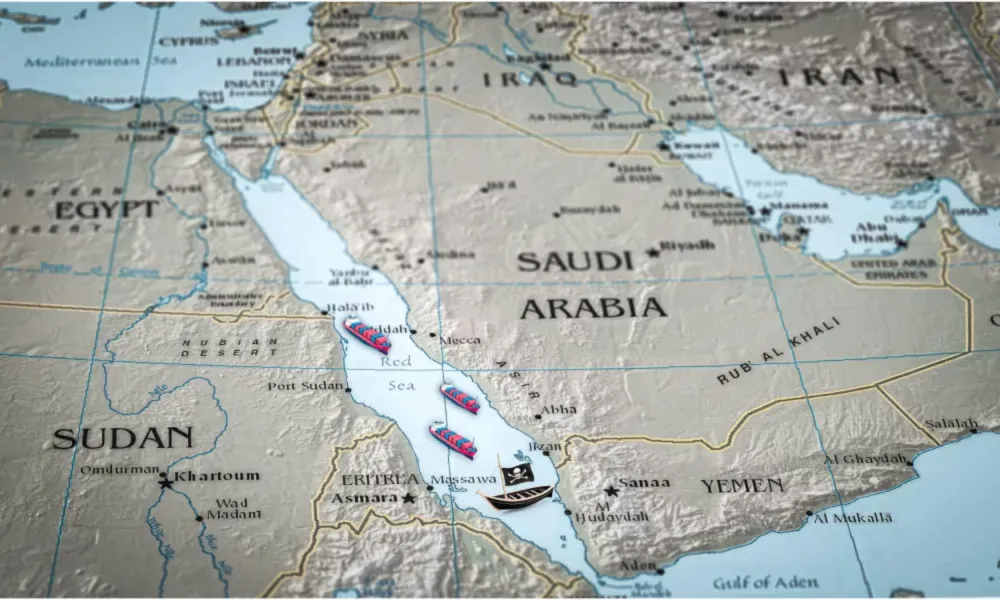

Commercial shipping through both the Bab el-Mandeb Strait and the Strait of Hormuz remained at low levels, according to data published by maritime analytics firm Kpler, as Houthi attacks against Saudi Arabia and wider regional tensions continued to affect shipping activity.
Traffic through the Bab el-Mandeb Strait declined on Sunday after Yemen's Iran-aligned Houthi movement attacked Saudi oil infrastructure along the kingdom's Red Sea coast.
At the same time, vessel movements through the Strait of Hormuz on the opposite side of the Arabian Peninsula also remained subdued.
According to Kpler, only 11 cargo vessels transited the Bab el-Mandeb on Sunday, the lowest number recorded in months.
Shipping in the Red Sea has faced increasing disruption since the Houthis, formally known as Ansar Allah, began enforcing what they describe as a naval blockade of Saudi Arabia, opening a new front in the ongoing US-Iran conflict and contributing to the effective closure of the Strait of Hormuz.
Of the vessels that passed through Bab el-Mandeb on Sunday, seven were oil tankers, three of which entered the Red Sea.
Two were very large crude carriers (VLCCs) bound for the Saudi port of Yanbu to load crude oil, while the third was linked to Russia, according to Kpler data.
Among the four vessels departing the Red Sea was the VLCC New Explorer, carrying 2 million barrels of oil from Saudi Arabia and the United Arab Emirates to the Chinese port of Ningbo.
Another tanker was transporting 750,000 barrels of Saudi crude to Pakistan.
According to Reuters, this was the third Chinese-linked tanker to leave the Red Sea through the Bab el-Mandeb Strait. The vessel's manager, Associated Maritime Hong Kong, did not immediately respond to requests for comment.
According to Yahya Saree, spokesperson for the Houthis' military wing, the group targeted facilities operated by Saudi oil giant Aramco in Jizan and Yanbu on Saturday.
Hormuz traffic remains low
Fewer than 10 commercial vessels per day transited the Strait of Hormuz during the previous three days, despite the suspension of hostilities between the United States and Iran, according to Kpler.
On Sunday, seven vessels passed through the strait, including three Iranian-linked petroleum product tankers exiting the Gulf.
On Saturday, only three vessels transited the waterway, all with their vessel-tracking transponders switched off.
Those ships included:
- A large crude tanker heading to Qatar to load oil.
- A liquefied natural gas (LNG) tanker bound for Ruwais in the United Arab Emirates.
- A tanker carrying naphtha from Qatar to Japan.
On Friday, seven vessels crossed the strait, most of them departing the Gulf, including two VLCCs loaded with crude oil in Iraq and the United Arab Emirates, as well as a fuel tanker.