
US President Donald Trump, Chinese President Xi Jinping and Russian President Vladimir Putin issued a joint declaration on Thursday that a nuclear war “cannot be won and must never be fought”. The three leaders met in Shenzhen for their first trilateral summit, on the sidelines of the APEC summit, and talked for about 90 minutes. The pledge comes as the latest independent data show the number of warheads available for military use is rising again, even though the overall global total is falling.
The global inventory in figures
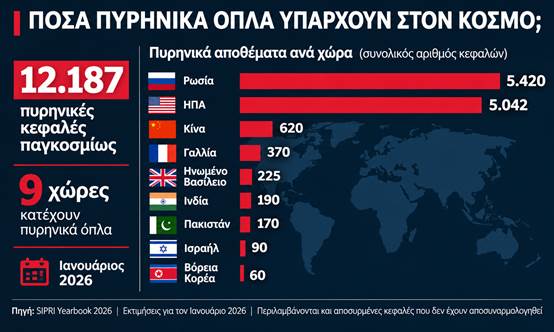
According to the SIPRI Yearbook 2026, published in June by the Stockholm International Peace Research Institute (SIPRI), nine states held an estimated 12,187 nuclear warheads in January 2026.
The figures break down as follows:
- 9,745 warheads were in military stockpiles for potential use
- 4,012 warheads were deployed on missiles or aircraft, or at bases with operational forces
- 5,733 warheads in military stockpiles were held in central storage
- The rest of the global inventory consists of older, retired warheads that are awaiting dismantlement
Russia and the United States
Russia has the largest total arsenal, with about 5,420 warheads, followed by the United States with 5,042.
Together the two countries hold around 10,462 warheads, or almost 86% of the global inventory. SIPRI calculates their combined share of usable military stockpiles at about 83%. It says this share is shrinking slightly as other arsenals grow.
SIPRI estimates that Russia had 1,796 deployed warheads and a military stockpile of 4,400. The United States had 1,770 deployed and a military stockpile of 3,700.
The other seven nuclear-armed states
China is in third place with about 620 warheads, up from 600 a year earlier. Its arsenal remains far smaller than those of Russia and the United States, but SIPRI describes it as the fastest-growing. The institute estimates that China’s deployed warheads rose to about 34, from 24 in 2025. It assesses that China’s arsenal could pass 1,000 warheads by 2030.
The remaining arsenals, according to SIPRI estimates:
- France: 370 warheads, of which 280 are deployed
- United Kingdom: 225 warheads, of which 120 are deployed
- India: 190 warheads, of which 12 are deployed
- Pakistan: 170 warheads
- Israel: 90 warheads
- North Korea: 60 warheads
SIPRI notes that China and India may now occasionally deploy a small number of warheads on missiles in peacetime. Both countries had previously kept warheads separate from delivery systems under normal conditions.
Warheads on high alert
SIPRI estimates that between 2,100 and 2,200 deployed warheads were kept on high operational alert in early 2026, mostly on ballistic missiles.
Almost all of them belong to Russia or the United States. France and the UK hold smaller numbers.
The global inventory fell from about 12,241 warheads in early 2025 to 12,187 in early 2026. SIPRI attributes the decline mainly to the dismantlement of retired weapons.
Over the same period, military stockpiles grew by about 130 warheads and deployed warheads by about 100. SIPRI expects the long post-Cold War decline in global numbers to reverse, as dismantlement slows and deployments speed up.
All nine states modernising
According to SIPRI, all nine nuclear-armed states continued to modernise their arsenals. Most of them deployed new nuclear-armed or nuclear-capable weapon systems during the year.
Several countries also changed their policies:
- In March 2026, French President Emmanuel Macron announced that he had ordered an increase in the number of French warheads, and that France would no longer publicly disclose the size of its arsenal
- The UK no longer publishes the size of its arsenal, and SIPRI expects its stockpile to grow
- SIPRI reports that construction intensified in 2025 at an Israeli site near Dimona
Hans M. Kristensen, Associate Senior Fellow at SIPRI’s Weapons of Mass Destruction Programme, said: “By reaching for nuclear solutions, states are creating new risks and fuelling arms-race dynamics.”
Limits of the available data
The figures are expert estimates, not confirmed government data, because many states do not disclose the true size of their arsenals.
The estimates for North Korea and Israel are particularly uncertain. Israel maintains a policy of official ambiguity about whether it has nuclear weapons. SIPRI also reports that North Korea is producing fissile material at a faster rate.
New START and the arms control framework
The New START treaty between the United States and Russia expired in February 2026, and no successor agreement has been reached. SIPRI says this adds uncertainty about future US and Russian force levels. It also leaves no binding limits on the two largest strategic arsenals.
The question after Shenzhen is whether the political commitment will be followed by specific, verifiable agreements to limit nuclear arsenals.
With information from SIPRI Yearbook 2026