
The provisional death toll from last week’s migration crisis in Ceuta has risen to 75, according to figures presented by Spanish Interior Minister Fernando Grande-Marlaska during an emergency meeting of EU interior ministers.
At least 72,000 migrants entered the Spanish enclave irregularly, with approximately 70,000 already returning to Morocco. Madrid said there had been no onward movement towards mainland Spain or other EU member states.
EU ministers express solidarity with Spain
EU interior ministers expressed strong support for Spain following an emergency video conference that lasted approximately two and a half hours.
“The EU is united and ready to support Spain and protect our external borders from illegal migration,” the Council said in a statement summarising the meeting.
Member states and Schengen-associated countries praised the “immediate and effective response” of the Spanish authorities, while expressing sorrow over the loss of life during attempted crossings.
The ministers stressed that protecting the EU’s external borders is a shared European responsibility. They agreed on the need to combat smuggling networks, accelerate returns, strengthen border protection and deepen cooperation with third countries.
They also supported stronger early-warning systems through improved intelligence sharing and monitoring of social media for signs of possible mass movements. Better coordination during crises was identified as necessary to counter disinformation and foreign information manipulation.
Jim O’Callaghan, Ireland’s Minister for Justice, Home Affairs and Migration and chair of the Council meeting, said migration required a common European response.
Spain says Schengen was never at risk
Grande-Marlaska described the talks as constructive, saying EU countries had recognised Madrid’s handling of the crisis.
He insisted that the Schengen area had not been endangered because Ceuta, a Spanish enclave in North Africa, is not covered by the agreement.
“At no point was the Schengen area put at risk during this crisis,” he said at a press conference in Madrid. “The Schengen area was never in danger, not even to the slightest degree.”
The minister also said Spanish intelligence services had received no warning of the impending mass arrivals.
“There was no report, no warning,” he said, adding that Spain had nevertheless been prepared to respond immediately.
Maritime barrier installed off Ceuta
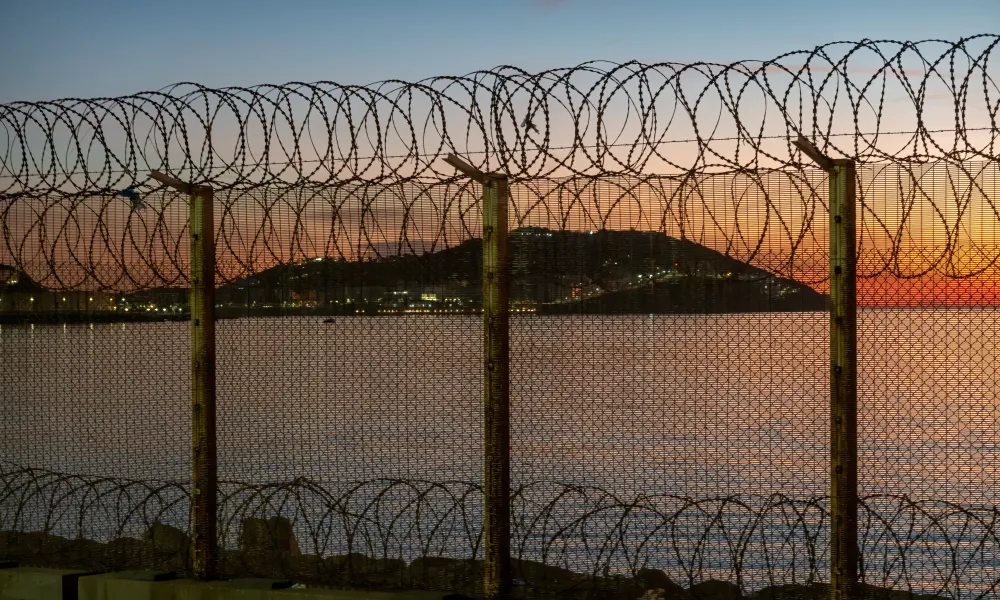
Madrid moved quickly to install a maritime barrier off Ceuta’s coast following a Spanish Supreme Court ruling in July.
The court found that migrants who reached Spanish territory by swimming could not be returned immediately unless such a barrier was in place.
The latest figures mark a sharp increase from the Spanish government’s previous estimate of 50,000 irregular arrivals, almost all of whom Madrid said had subsequently returned to Morocco.
Brunner separates crisis from naturalisation decision
European Commissioner for Internal Affairs and Migration Magnus Brunner said the EU did not see a direct connection between the events in Ceuta and Spain’s recent large-scale naturalisation of irregular migrants from Latin America.
He added, however, that Spain’s decision was not regarded as a positive signal by the rest of the European Union.
France strengthens border controls
French Interior Minister Laurent Nuñez, who disclosed the revised death toll, said all ministers participating in the meeting had praised the Spanish government’s response.
He also announced that France would strengthen controls along its border with Italy in coordination with the Italian authorities.
Source: AMNA