
By Kritonas Kapsalis
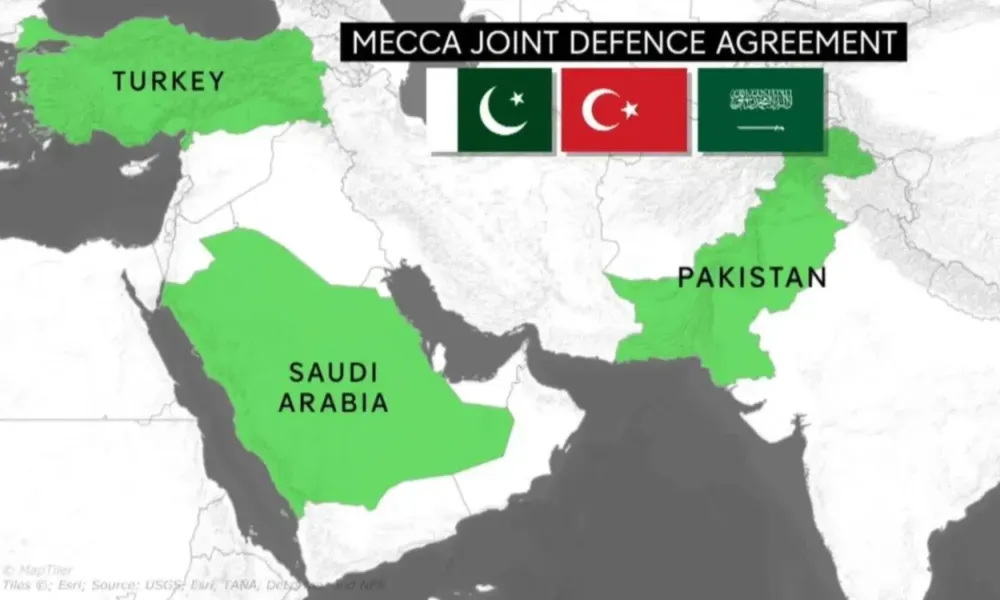
The mutual defence agreement signed in Mecca on 7 August by Turkey, Saudi Arabia and Pakistan can easily be described with a dramatic headline: the creation of an "Islamic NATO."
The reality is more complex.
The Middle East is not yet witnessing the emergence of a NATO-style alliance. What may be taking shape, however, could prove even more significant: an initial serious attempt to establish a regional security system with less dependence on the United States and with Turkey playing a central role.
The agreement brings together three very different but complementary powers: Saudi Arabia, with its economic and energy strength; Turkey, with its large military, defence industry and strategic geographic position; and Pakistan, the only Muslim-majority country possessing nuclear weapons.
It is precisely this combination that gives the Mecca Pact greater geopolitical significance than a conventional military cooperation agreement.
The critical clause
The most important element is the principle of collective defence.
Based on what has been made public, an attack against one member state is to be treated as an attack against all.
The wording inevitably recalls Article 5 of NATO.
There is, however, an important reservation: the full text of the agreement has not yet been released. As a result, the exact mechanism for triggering mutual assistance, the geographic scope of the obligations and whether an integrated joint military command is envisaged remain unknown.
For that reason, it would be premature to conclude that a NATO-like alliance has already been created.
Nonetheless, the political significance of the commitment is already substantial.
Saudi Arabia is seeking to reduce its near-total dependence on the American security umbrella. Turkey gains an institutional strategic foothold in the Gulf. Pakistan, meanwhile, elevates its position from a significant Asian military power to a key actor in Middle Eastern security.
The agreement also reflects growing doubts within Gulf states about whether the American military presence alone is sufficient to guarantee their security.
Turkey sees the map changing
For Ankara, there is another dimension.
Turkey sees a new geopolitical and energy landscape emerging around it.
From India and the Persian Gulf to the Mediterranean and Europe, new trade corridors, energy connections, subsea cables and security partnerships are taking shape.
In many of these initiatives, Turkey is not at the centre.
That represents a strategic problem for Ankara.
For years, Turkey has argued that its geography makes it the natural energy and trade hub linking Asia, the Middle East and Europe.
The development of alternative routes through the Gulf, Israel, Cyprus and Greece challenges precisely that assumption.
Saudi Arabia's role is therefore crucial.
Riyadh is a key component of the proposed India-Middle East-Europe Economic Corridor (IMEC).
The rapprochement between Ankara and Riyadh provides Turkey with a new political tool through which it can exert influence over a project from which it initially appeared largely excluded.
In other words, Turkey is seeking to ensure that no new regional map is drawn without its participation.
The second geography: Greece, Cyprus and Israel
It is here that the Mecca Pact intersects with the Eastern Mediterranean.
Over the past 15 years, a network of cooperation has emerged linking Greece, the Republic of Cyprus and Israel.
What began largely as an energy partnership gradually expanded to encompass defence cooperation, joint military exercises, technology initiatives and electricity interconnections.
Greece, Cyprus and Israel have already agreed to strengthen joint air and naval exercises in the Eastern Mediterranean during 2026.
This has created two geopolitical geographies which are not necessarily hostile but are undoubtedly competitive.
On one side stands the emerging axis of:
- Turkey
- Saudi Arabia
- Pakistan
On the other is an already established framework connecting:
- Israel
- Cyprus
- Greece
with significant links to the European Union, the United States, and potentially India through IMEC.
It is therefore no coincidence that Israeli analyses following the agreement have already begun discussing the possibility of closer cooperation between Israel, India, Greece and Cyprus.
Pakistan changes the equation
The most sensitive aspect of the agreement is Pakistan.
The presence of a nuclear power within a collective defence mechanism inevitably raises questions about the real depth of the security guarantees involved.
This does not mean Pakistan's nuclear arsenal automatically becomes available to Turkey or Saudi Arabia.
Nothing made public so far justifies such a conclusion.
However, strategic ambiguity possesses deterrent value in itself.
For Turkey, relations with Pakistan did not begin with this agreement.
Extensive military cooperation and collaboration within the defence industry already exist.
The new pact places that relationship within a broader political framework.
What about Egypt?
Perhaps the most important unanswered question concerns Egypt.
In June, the foreign ministers of Turkey, Egypt, Pakistan and Saudi Arabia met within the R4 format, agreeing to continue coordinating on regional security issues.
Egypt, however, ultimately did not sign the Mecca Pact.
This holds particular significance for Cyprus and Greece.
If Cairo were eventually to join a broader grouping centred on Turkey, Saudi Arabia and Pakistan, the geopolitical balance in the Eastern Mediterranean would shift considerably.
As long as Egypt remains outside the arrangement, it retains a significant degree of strategic autonomy and preserves its special relationships with Greece and Cyprus.
What it means for Cyprus
For Nicosia, it would be a mistake to treat the agreement as a new military threat directed against the Republic of Cyprus.
There is currently no evidence that would justify such a conclusion.
There is, however, a clear geopolitical challenge.
A Turkey that enjoys closer relations with Saudi Arabia, strategic cooperation with Pakistan, influence in Syria and improving ties with Egypt acquires a much greater ability to shape regional balances.
For Cyprus, this means energy policy can no longer be viewed separately from foreign policy and security considerations.
Natural gas reserves, electricity interconnections, subsea cables, maritime routes and trade corridors are now different dimensions of the same geopolitical equation.
The deeper message of Mecca
The Mecca Pact suggests that the Middle East and Eastern Mediterranean are moving away from a system dominated by American primacy and towards a far more complex framework with multiple centres of power.
Saudi Arabia no longer wishes to depend exclusively on Washington, particularly after what it sees as Washington's failure to contain Iran and adequately protect Gulf states.
Turkey no longer accepts the role of NATO's southeastern flank.
Pakistan seeks a broader geopolitical role.
Israel is searching for deeper regional partnerships.
India is becoming increasingly interested in both the Middle East and the Mediterranean, with Greece and Cyprus positioned at the western gateway of this emerging geography.
For this reason, the Mecca Pact should neither be underestimated nor exaggerated.
It did not transform the balance of power overnight.
It did, however, alter the range of possible future balances.
And that is precisely what Ankara appears to understand.
Turkey sees that the future map of the Middle East and Eastern Mediterranean will not be shaped solely by natural gas reserves or exclusive economic zones.
It will be determined by who controls trade and energy corridors, who can protect them militarily and, above all, who possesses the alliances necessary to participate in drawing them.
The Mecca Pact is Turkey's attempt to ensure that when that map is eventually drawn, Ankara is not standing on the sidelines but sitting at the table where the lines are being shaped.