
Relations between Russia, Germany and the wider European community are deteriorating rapidly following Germany's formal attribution of responsibility to Moscow for the attempted attack on Leipzig/Halle Airport in early August.
Beyond the diplomatic confrontation that followed, the incident has reignited a broader European debate about Russian hybrid threats, the security of critical infrastructure and the need to maintain support for Ukraine. Already strained since the start of Russia's invasion of Ukraine, relations between Europe and Russia are now escalating in a manner increasingly reminiscent of a Cold War atmosphere.
What began with the detection of drones near Leipzig/Halle Airport on 4 August has, within a matter of weeks, evolved into an issue with both European Union and NATO dimensions. The German government has formally stated that it considers Russia responsible for the attempted attack, citing findings from investigations conducted by German security and intelligence services. Moscow, however, categorically rejects the allegations, describing them as politically motivated claims unsupported by evidence and based on what it characterises as fabricated or planted incriminating material.
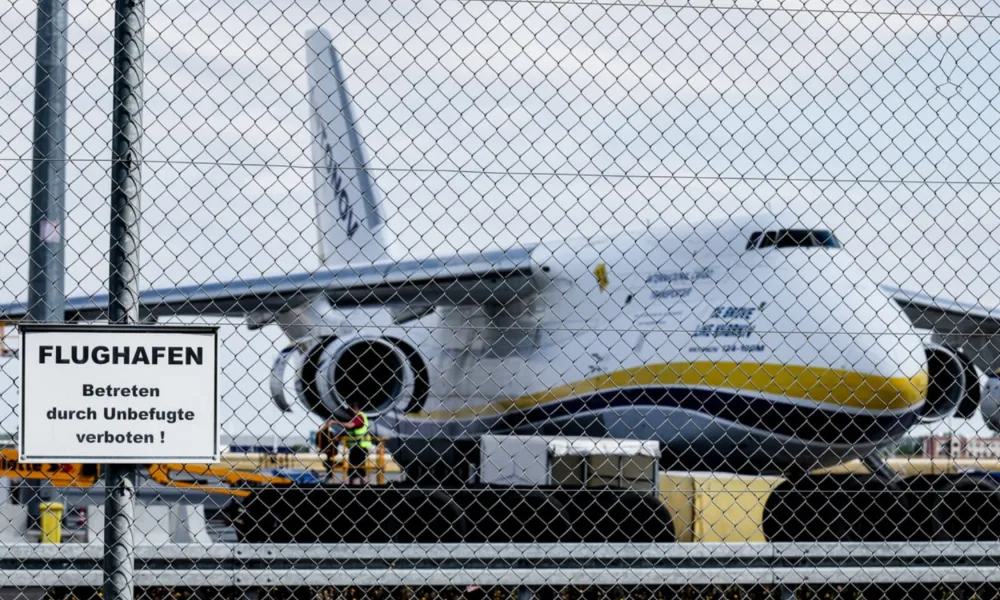
According to German authorities, a drone carrying an explosive device was discovered on 4 August near a Ukrainian Antonov cargo aircraft at Leipzig Airport. Investigators also believe it is possible that a second drone struck a cargo aircraft. According sources, the explosive device failed to detonate because of a fault in the detonator. Leipzig/Halle Airport is one of Europe's most important air freight hubs and also holds significant strategic value because of activities linked to NATO and the transportation of supplies to Ukraine.
What the investigation indicates
German Interior Minister Alexander Dobrindt said that the drone's configuration, components, triggering mechanism and overall operational profile exhibit similarities to other operations that Germany associates with Russia. At the same time, German media outlets citing investigative findings reported that two suspects have been identified.
The first is reportedly a man of Russian origin holding a Latvian passport and believed to have coordinated the operation. The second is said to be a Belarusian national who also holds a Russian passport. According to the reports, DNA evidence recovered from a drone, explosive material and communications equipment contributed to progress in the investigation.
Despite Germany's clear attribution of responsibility, not all of the evidence on which Berlin based its conclusions has been made public. This has become one of Moscow's principal arguments, with the Russian side maintaining that the accusations are not supported by sufficient proof. The German government did not stop at public accusations. Berlin also announced the closure of the Russian Consulate in Bonn and the Russian House cultural centre in Berlin, while summoning the Russian ambassador for explanations. In addition, Germany signalled plans to pursue new sanctions at EU level, stricter measures targeting Russia's so-called shadow fleet, and possible additional restrictions affecting Russian nationals.
Growing concern across Europe
Since Russia's invasion of Ukraine in 2022, European governments have repeatedly accused Moscow of involvement in sabotage, cyberattacks, disinformation campaigns and interference with critical infrastructure.
EU foreign policy chief Kaja Kallas said the case bears the hallmarks of "state-sponsored terrorism", while revealing that work is under way on hundreds of new listings of individuals and organisations for European sanctions regimes. The European External Action Service summoned the Russian ambassador to Brussels, while similar diplomatic steps were taken by France, Belgium and the Netherlands.
In Paris, French Foreign Minister Jean-Noël Barrot announced that he had summoned the Russian chargé d'affaires and expressed support for additional European sanctions. Among the countries publicly expressing solidarity with Germany was Cyprus. Foreign Minister Constantinos Kombos stressed that threats against critical infrastructure concern all of Europe and require a coordinated response.
European Commission President Ursula von der Leyen and NATO Secretary General Mark Rutte linked the incident to broader concerns within Western capitals regarding efforts that they believe are intended to undermine support for Ukraine. Both reiterated that assistance to Kyiv would continue. The United States also backed Germany. US Ambassador to NATO Matthew Whitaker said Washington stands in solidarity with Germany and its allies against attempts to create chaos and instability.
Moscow's response
Russia rejects all allegations concerning the incident. President Vladimir Putin questioned the evidence presented by Germany and described Berlin's measures as mistaken and harmful to German-Russian relations. The Russian Foreign Ministry summoned Germany's chargé d'affaires in Moscow, while ministry spokesperson Maria Zakharova denounced what she called "anti-Russian actions" and warned of retaliatory measures. Even stronger language came from former Russian president Dmitry Medvedev, who issued threats directed at Germany amid the escalating dispute.