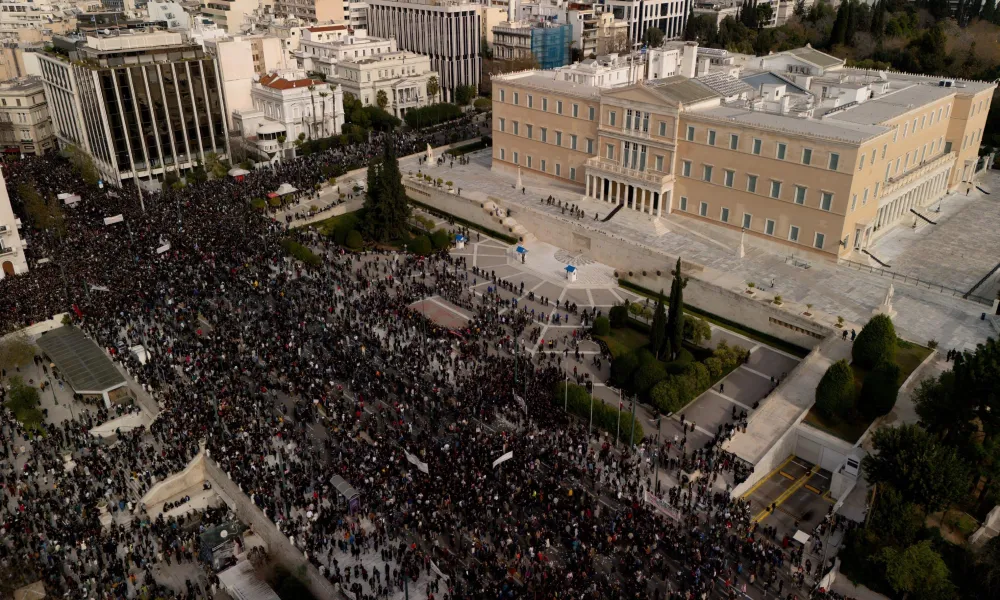

Greece is facing widespread strike action on Wednesday, 21 October, with students, university students, teachers, hospital doctors and public-sector employees staging protests and work stoppages across the country.
Large demonstrations are being held in several Greek cities, with education, healthcare and the public sector at the centre of the mobilisation. Trade unions say rising living costs, low wages, staff shortages and chronic underfunding of essential public services are among their main concerns.
In Athens, the main rally involving teachers, school students and university students is scheduled for noon at the Propylaea, while a separate demonstration in Thessaloniki is set to begin at 11:30am at the Venizelos Statue. Similar protests are taking place in Patras and other cities.
The demonstrations are expected to disrupt schools, public services and traffic, particularly in the centres of major urban areas.
Education, healthcare and the public sector at the forefront
In education, the Greek Teachers' Federation (DOE) has called a 24-hour strike, while the Federation of Secondary Education Teachers (OLME) is holding a nationwide work stoppage from 11am to 2pm, with local unions allowed to extend the action.
Teachers are demanding:
- Meaningful wage increases.
- The filling of vacant posts.
- Improved school infrastructure.
- Increased funding for public education.
Particular emphasis has been placed on staffing shortages, with OLME claiming there are approximately 15,000 teaching vacancies, despite the school year having already begun.
Students and university students are also participating in the demonstrations, protesting over educational conditions, shortages in schools and universities, and the rising cost of studying and living.
At the same time, the public-sector union ADEDY is holding a work stoppage from 11am until the end of the workday, covering employees across government services.
In the healthcare sector, the Federation of Hospital Doctors' Associations of Greece (OENGE) has launched a 24-hour strike, demanding higher pay and the recruitment of permanent staff for public hospitals.
Hospital doctors argue that understaffing and growing pressure on public health facilities have created serious problems for both working conditions and patient care.
Wave of social unrest across Europe
The Greek protests come at a time when social discontent is surfacing across several European countries.
In France, demonstrations that began with student demands for better educational conditions have expanded into broader protests over the cost of living, public services and government economic policies.
Last weekend, demonstrations in cities including Paris, Marseille and Lyon were accompanied by serious unrest, clashes with police and extensive property damage. The French government acknowledged shortcomings in its response and strengthened security measures.
Similar tensions have emerged in Belgium, where students have protested against rising education costs and reforms they argue restrict access to higher education. Clashes have been reported in Brussels and Liège.
In Portugal, protests have focused largely on the housing crisis, with thousands demonstrating against soaring rents and the shortage of affordable housing. Rallies have taken place in Lisbon and Porto, while unions continue to push for wage increases and stronger state intervention.
The situation is also tense in Albania, where anti-government protests involving students and university students continue. Demonstrators have criticised corruption, inadequate funding for education and deteriorating living conditions.
Repeated clashes with police have been reported in Tirana, while the protests have taken on a broader political dimension, including demands directed at the government of Prime Minister Edi Rama.
Cost of living and public services emerge as common themes
Although the protests across Europe have different origins and objectives, several common concerns are increasingly evident.
Rising living costs, housing pressures, strained household budgets and dissatisfaction with the state of public education and healthcare have emerged as central drivers of social unrest.
Young people have played a prominent role in many of the demonstrations, voicing concerns about employment prospects, economic independence and access to essential social goods.
The strike action in Greece forms part of this broader European climate of social pressure, although there is no indication that the protests in different countries are part of a coordinated movement.
The fact that similar demands are being raised simultaneously in multiple European societies nevertheless highlights the common economic and social challenges facing citizens across the continent.
For the Greek government, Wednesday's demonstrations represent another test as unions continue to seek concrete commitments on public education, healthcare, wages and measures to address the rising cost of living.