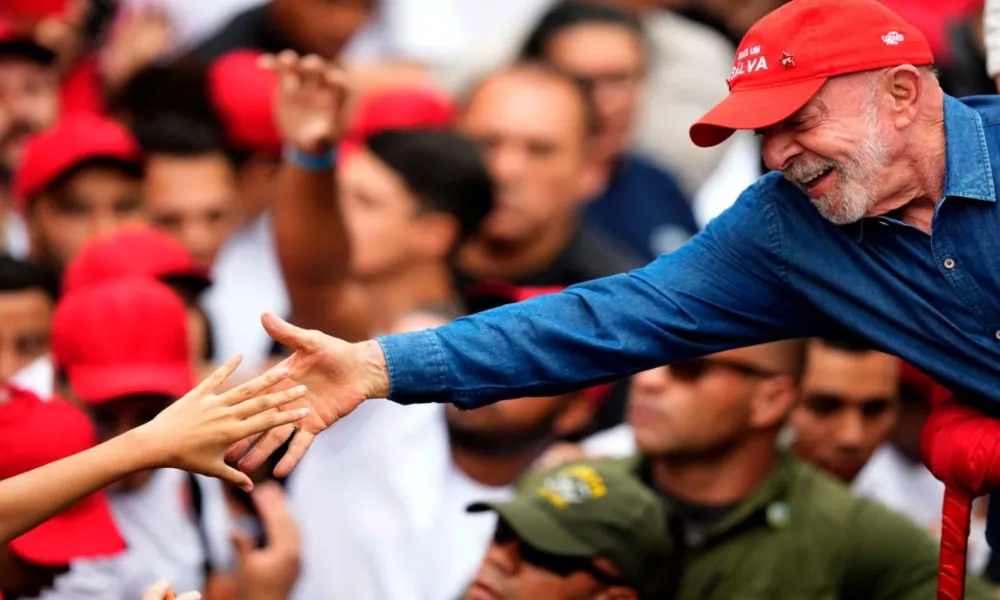

Brazil's centre-left president Luiz Inácio Lula da Silva won re-election on Sunday, securing an unprecedented fourth term in office despite expectations in some quarters that he would be defeated.
His victory, however, was immediately challenged by conservative rival Flávio Bolsonaro, who refused to accept the outcome and announced plans to seek the annulment of the election.
Brazil therefore avoided a shift to the right similar to political developments seen in countries such as Argentina, Chile and Colombia, remaining one of the few progressive strongholds in Latin America.
With 51.79% of the vote (64.25 million votes) against 48.21% (59.82 million votes) for Bolsonaro, the veteran politician, now nearly 81 years old, defied forecasts that had predicted his defeat.
In the first round of voting, it had been Bolsonaro, son of former far-right president Jair Bolsonaro (2019-2022), who finished ahead.
"The Brazilian people went to vote because we managed to convince them that their vote was important in order to guarantee democracy," Lula said in his first remarks after the result was announced in São Paulo.
Former president Jair Bolsonaro is currently serving a 27-year sentence under house arrest after being convicted of attempting to remain in power through a coup following his defeat to Lula in the 2022 election.
Allegations of a "fraud"
Lula's fourth term is expected to come with limited room for manoeuvre, given the strong performance of right-wing forces in legislative elections held three weeks ago.
Flávio Bolsonaro declared that he would seek "the annulment of the election" following his defeat.
"It is impossible to recognise these elections," he said in Brasília.
According to Bolsonaro, "many things remain to be clarified" following a legal dispute that resulted in voting being extended by two hours on election day.
Brazil remains deeply divided and polarised, and a court dispute created additional confusion on polling day.
A Supreme Court judge ordered voting to be extended by two hours after Lula's campaign filed a legal challenge alleging that voters were being prevented from reaching polling stations because bus services had been suspended in several cities, particularly in Lula strongholds in Brazil's northeast.
Bolsonaro described the development as a "dirty trick" and a "fraud", saying the manner in which voting was conducted was "unacceptable".
He repeated that "many things remain to be clarified" regarding the unprecedented extension of voting hours.
A historic victory
This marks the first time since the end of Brazil's military dictatorship (1964-1985) that a candidate has overturned a first-round deficit to win in the presidential runoff.
Videos circulated on social media showed Lula celebrating with a raised clenched fist while wearing red star-shaped glasses.
Following the announcement of the result, supporters erupted in celebration, particularly along Paulista Avenue in São Paulo and in central Rio de Janeiro, where fireworks lit up the sky.
"I am very emotional. This is a historic victory for President Lula. The people mobilised, they united," Mariana Andrade, a 33-year-old lawyer, told AFP in Rio.
"It is surreal, stronger even than football. My team lost this week, but there is no comparison. This is about our lives. Everyone united behind this cause," said merchant Paulo Nascimento, 41, in Brasília.
From poverty to a fourth presidency
For Lula personally, re-election represents the latest chapter in an extraordinary political journey.
Already the longest-serving democratically elected president in Brazilian history, he will be among the oldest world leaders by the end of his fourth term in 2030, when he will be 85 years old.
By then, he will have accumulated a total of 16 years in office, adding to his previous presidency from 2003 to 2010.
He has survived both the political wear and tear of time and public frustration toward the Workers' Party (PT), which became associated with several corruption scandals in the 2000s.
Lula himself spent 580 days in prison between 2018 and 2019 following a corruption conviction that was later overturned on procedural grounds.
Throughout the campaign, he emphasised Brazil's national sovereignty and criticised commercial and diplomatic pressure from Washington.
Meta controversy and social media regulation
In the final stages of the campaign, technology giant Meta, the parent company of Facebook, Instagram and WhatsApp, became a focus of criticism from Lula's allies.
Lula's campaign accused the company of interfering in the election and attempting to influence voters in favour of Bolsonaro.
Speaking after his victory, Lula pledged to pursue regulation of social media platforms.
Meta categorically denied attempting to influence the election but acknowledged that "technical problems" may have affected the Brazilian centre-left campaign's activity on its platforms.
Bolsonaro refuses to concede
Bolsonaro reiterated on Sunday that he would seek "the annulment of the election".
"It is impossible to recognise these elections," he said in Brasília, again pointing to the legal dispute and the two-hour extension of voting as grounds for challenging the process.
Lula: Brazilians voted to defend democracy
Following his victory, Lula argued that Brazilians had voted in order to "guarantee democracy".
"The Brazilian people went to vote because we managed to convince them that voting was very important to guarantee democracy," he said in his first post-election statement.
He also argued that voters had defeated what he described as interference through social media platforms and reiterated his commitment to introducing regulation for online networks.
Source: AFP/APE-MPE