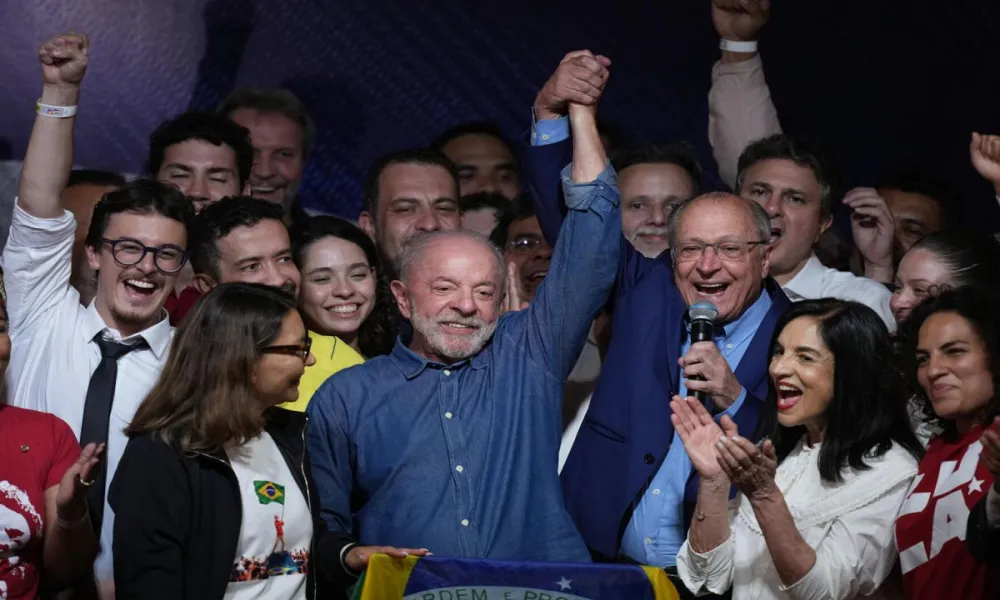

Against the backdrop of economic uncertainty, voter frustration and an apparent rightward shift in Brazilian politics, Luiz Inácio Lula da Silva, 80, staged a remarkable comeback in the second round of Brazil's presidential election.
After finishing behind Flávio Bolsonaro, son of former president Jair Bolsonaro, in the first round on 4 October, Lula reversed the momentum and emerged victorious on 25 October with 51.8% of the vote, compared with 48.2% for his opponent.
International media and political analysts point to five key factors behind the turnaround.
Higher turnout changed the race
One of the most significant factors was voter mobilisation.
Analysts cited by international outlets argue that turnout in the second round exceeded expectations and disproportionately benefited Lula. His campaign succeeded in energising groups that had either stayed home in the first round or remained undecided, particularly younger voters and women.
Digital outreach also played a role. Lula's team expanded its presence on social media and messaging platforms such as WhatsApp, helping him reach voters in segments of society where the right had previously enjoyed stronger support.
The result was a broader electoral coalition than the one that had emerged in the first round.
Stability versus uncertainty
A second explanation lies in the way Lula framed the election.
Rather than presenting himself simply as an agent of change, he cast the race as a choice between maintaining social protections and risking uncertainty under a new administration.
Throughout the campaign, Lula repeatedly highlighted his record on poverty reduction, social programmes, workers' rights and inequality, arguing that many of those gains could be jeopardised by a change in direction.
For many voters concerned about living costs but wary of major political disruption, the promise of continuity appears to have outweighed demands for change.
The Trump factor
Analysts have also interpreted Lula's victory as a setback for the broader pro-Trump political current that has gained influence in parts of Latin America in recent years.
Flávio Bolsonaro campaigned as a conservative aligned with many of the positions associated with US President Donald Trump, particularly on foreign policy and cultural issues.
Lula, by contrast, argued for a more independent international role for Brazil and warned against excessive alignment with Washington.
As a result, the election took on geopolitical significance beyond Brazil's borders, becoming a test of competing political models in the region.
A historic second-round comeback
The scale of Lula's recovery has drawn particular attention.
After polling 45% in the first round compared with Bolsonaro's 47%, Lula added more than 10 million votes in the three weeks between the ballots, while his rival increased his total by a much smaller margin.
The result makes Lula the first candidate in modern Brazilian history to trail after the first round and still go on to win the presidency in the runoff.
The outcome also illustrated the limitations of election forecasting in a race where turnout and late voter decisions proved decisive.
Victory, but not a mandate without obstacles
Despite the presidency, Lula faces a challenging political landscape.
Conservative parties and Bolsonaro allies retain considerable influence in Congress, meaning the president will need to negotiate extensively to pass legislation.
Economic pressures, public debt concerns and budget constraints are also expected to limit the government's room for manoeuvre.
Political analysts therefore caution against interpreting Lula's victory as a broad rejection of Brazil's right wing. Instead, they see it as evidence of an electorate that remains deeply divided.
Bolsonaro contests the result
The election's aftermath has been marked by controversy.
Flávio Bolsonaro has indicated that he will seek to challenge the outcome, arguing that a decision to extend voting hours by two hours in some areas affected the result.
However, election data cited by international media suggest that fewer than 35,000 ballots were cast during the extended period, far below Lula's winning margin of approximately 4.4 million votes.
Most analysts therefore regard the chances of overturning the result through legal action as remote.
A divided nation awaits Lula's fourth term
Lula's victory represents both a personal political triumph and a significant moment for Latin America.
Yet the election also underlined the deep divisions that continue to shape Brazilian society. While he succeeded in overcoming a first-round defeat and defying expectations, governing may prove even more difficult than winning.
His fourth term begins with a conservative Congress, sceptical markets and an opposition unwilling to concede defeat quietly.
For many observers, that means Lula's latest victory may be historic, but it could also become the most challenging chapter of his political career.