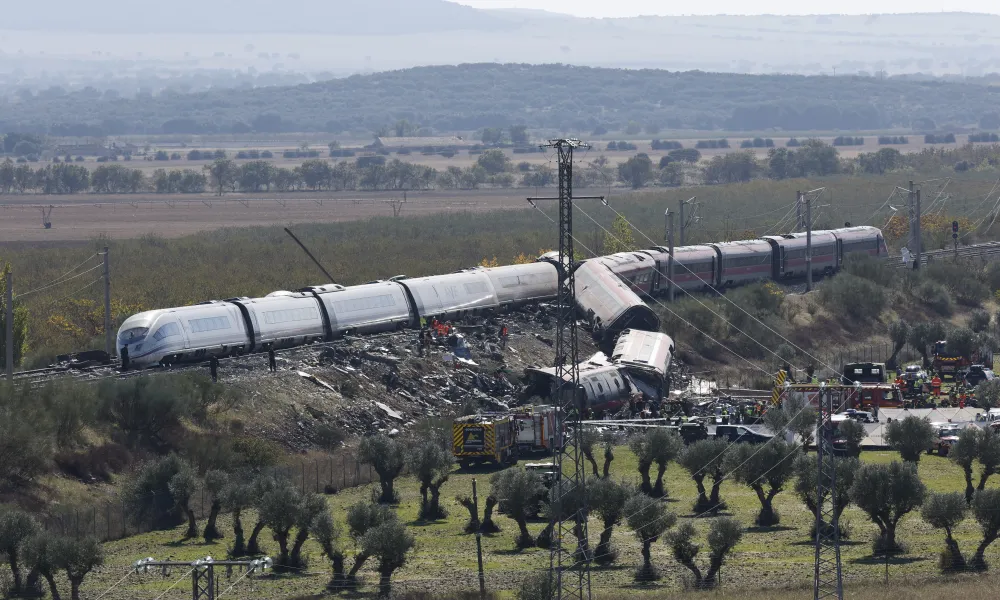

A train involved in Wednesday's catastrophic rail collision in Spain was travelling at approximately 160km/h, and possibly as fast as 200km/h, when it struck another train that had been stopped on the tracks, according to a preliminary investigation into the disaster.
The crash, which has claimed the lives of at least 69 people, is the deadliest rail accident in Spain since 2013.
Dozens still missing
Spain's Civil Guard has received reports of 64 missing persons following the collision.
Authorities have so far carried out 49 post-mortem examinations and formally identified five victims - three women and two men - according to Esther Padilla, a spokesperson for the regional government of Castile-La Mancha, speaking to broadcaster TVE.
Officials have not yet established whether some of those reported missing are among the unidentified victims.
Questions over safety procedures
The tragedy has reignited debate over rail safety and maintenance across Spain, which operates Europe's largest rail network.
According to Spanish Transport Minister Óscar Puente, the collision occurred after six trains automatically stopped due to a failure in the signalling system.
Following the malfunction, traffic management was transferred to the control centre in Madrid.
A short time later, a train operated by state-owned rail company Renfe was authorised to proceed, despite the fact that an Iryo train remained stationary on the same line.
Audio recordings of communications between the control centre and train drivers, obtained by Spanish newspaper El País, reportedly show that a controller gave the Renfe train permission to continue at normal speed.
Puente said this instruction contradicted established safety protocols, which limit trains to 40km/h under such circumstances.
Sequence of errors
Investigators have also raised concerns over the order in which trains were instructed to move.
The Renfe train, carrying 379 passengers and seven crew members, was cleared to restart its journey before the Iryo train, which had 147 passengers and five crew members on board.
According to protocol, the stationary Iryo train should have been given priority to move first.
In its preliminary findings, the Independent Administrative Authority for the Technical Investigation of Accidents and Incidents (AITAT) stated that:
"The sequence of malfunctions, instructions and actions ultimately led to the collision, as there were no safety barriers in place."
Speed under investigation
AITAT estimated that the Renfe train was travelling at between 160km/h and 200km/h when the collision occurred.
However, investigators said they would not be able to determine the precise speed until data is extracted from the train's black box.
Survivor describes devastation
Sebastián Herrero, who was travelling on the Iryo train, described the aftermath as horrifying.
"The scene was shocking. You could see carriages that were completely burned out, as if they had exploded. People were emerging in a terrible state, while others began carrying bodies out and placing them right there beside where we were standing."
The accident follows another rail incident involving the same operators on the same line earlier this year, adding to concerns about operational safety and oversight within Spain's railway system.
Source: ANA-MPA