The Cyprus issue has entered a phase of renewed diplomatic activity after a prolonged period of stagnation. Yet this movement does not point to the beginning of a genuine solution process. Rather, it reflects a preparatory stage in which the parties are recalibrating their positions ahead of a new initiative expected to be launched by António Guterres after June. The most striking feature of this phase is the increase in statements and diplomatic contacts, while trust continues to lag behind.
There is, however, a broader strategic context shaping this moment. Guterres’ term is nearing its end, with a handover scheduled for December. It cannot be ruled out that he is seeking to make one final effort on Cyprus. The question is increasingly unavoidable: if nothing substantial changes on the island, what exactly will be passed on to his successor? A frozen file, or a framework with at least some prospect of movement?
Recent diplomatic activity suggests that groundwork is indeed being laid. Guterres has maintained steady engagement, including contacts with Tufan Erhürman in New York, discussions with Recep Tayyip Erdoğan in Ankara, and meetings with Nikos Christodoulides in Brussels. Earlier, his personal envoy María Ángela Holguín Cuéllar had paused her shuttle diplomacy with the intention of returning after the Greek Cypriot EU presidency.
This sequence points to a deliberate effort to synchronize political timing with diplomatic opportunity. Yet the public discourse emerging from the Greek Cypriot side does little to clarify what is substantively at stake. Much of it appears oriented toward domestic audiences, with emphasis on symbolic themes, anniversaries and rhetorical positioning, rather than concrete proposals.
At the same time, exchanges between Christodoulides and Erhürman continue to reflect familiar patterns of accusation and counter-accusation, including recurring tensions over developments in the buffer zone. The persistence of this “blame game” underscores the gap between diplomatic choreography and political reality.
Turkish Cypriot leader Erhürman has warned against precisely this dynamic. He has argued that introducing new claims in public settings, outside formal negotiation channels and in the absence of the other party, risks “poisoning the atmosphere.” According to him, positions that are not even raised during direct meetings are increasingly being aired through the media, raising a fundamental question about intent: whether such statements are meant to facilitate a solution or provoke a reaction.
Recent remarks by his undersecretary Mehmet Dana reinforce this assessment. Dana described as “provocative” statements by Christodoulides, particularly regarding both the Cyprus issue and plans to station French troops on the island. He argued that agreements with third parties that ignore Turkish Cypriots, one of the island’s two equal founding partners, are inconsistent with the island’s legal status and undermine the conditions necessary for a solution.
Dana also criticized what he described as rhetoric detached from the facts, including repeated accusations against Türkiye as a guarantor power, warning that such language damages trust. He rejected Christodoulides’ insistence on participating in negotiations in a “dual capacity,” stressing that under the United Nations framework, the process is conducted between two leaders, not between a state and a community.
He further emphasized that there is currently no formal negotiation process underway. The UN’s good offices mission remains leader-centric, and any suggestion that a process has already begun risks obscuring the reality that meaningful progress on confidence-building measures has yet to be achieved.
This divergence between narrative and structure is central to understanding the current phase. According to the Turkish Cypriot side, it is well established that Guterres intends to launch a new initiative in July, depending on developments in the interim. This timeline is linked to concrete political milestones, including elections on the Greek Cypriot side and the conclusion of their rotating presidency of the Council of the European Union at the end of June.
In this context, claims that a process is already underway are viewed as premature, and potentially as an attempt to shift attention away from the absence of substantive preparatory work.
More broadly, there is limited evidence of a genuine push toward confidence-building measures, despite their consistent emphasis by both the United Nations and the European Union. Initiatives such as new crossing points, trade cooperation or infrastructure projects remain largely underdeveloped. Even the modest agreement expected on the supply of recycled water from the bicommunal Nicosia wastewater treatment plant, an issue pending since 2011, underscores how incremental progress has been.
EU’s Nicosia move: Diplomacy or security architecture?
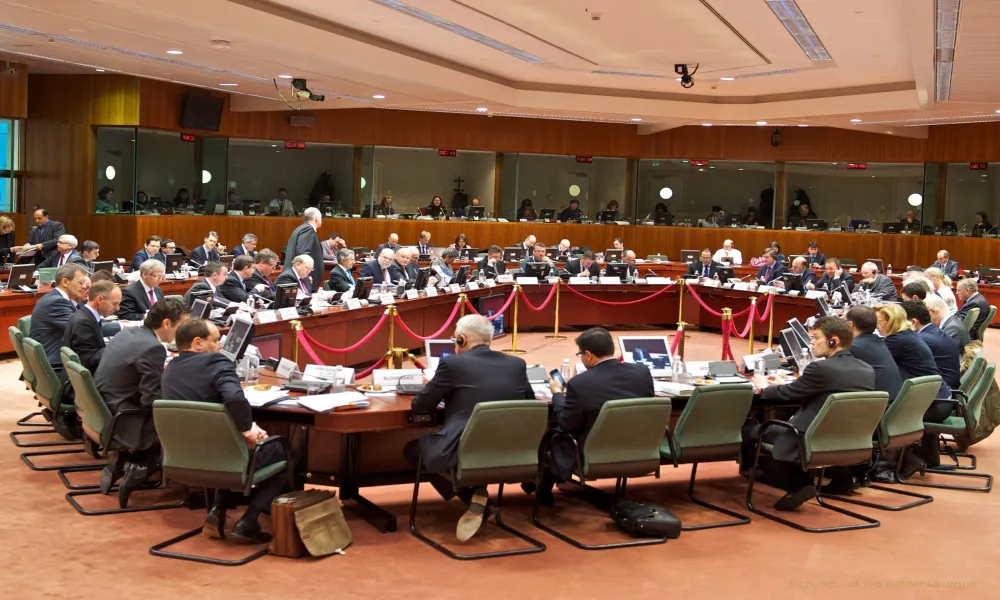
The latest European Union summit marks a turning point in the evolving role of Cyprus. The meeting in southern Nicosia was not merely a diplomatic gathering; it reflected Europe’s shifting geopolitical reflexes and its effort to construct a new security and defense architecture. In this context, Cyprus is gradually being repositioned from a “problem to be solved” into a platform where broader strategic ambitions are tested.
European Union efforts to achieve strategic autonomy have gained urgency amid transatlantic frictions, NATO coordination challenges and a more volatile global environment. As Europe seeks to enhance its defense capacity and act independently in crises, it requires geographical anchors. Cyprus, with its proximity to the Eastern Mediterranean, energy routes and regional conflict zones, is becoming one such anchor.
The renewed emphasis on Article 42.7 of the Treaty on European Union reflects this shift. However, compared with Article 5 of the NATO Treaty, the EU framework still lacks institutional depth and operational capability. This gap suggests that what is being tested in Cyprus is not a fully formed security system, but an evolving and incomplete one.
The France agreement and the shifting balance
One of the most tangible steps in this transformation is the defense arrangement developed with France under the leadership of Emmanuel Macron. While framed as a cooperation agreement, it effectively allows for a more sustained presence of French military elements on the island.
This development is significant not only in military terms but also in its legal and political implications. The 1960 Treaty of Guarantee established a delicate balance involving Türkiye, Greece and the United Kingdom. From Ankara’s perspective, the introduction of permanent or semi-permanent military presences by additional actors risks undermining that balance.
The concern is not cooperation per se, but its evolving nature. Temporary deployments linked to specific crises differ fundamentally from institutionalized and enduring military presence. The France agreement, along with similar initiatives, blurs this distinction and raises questions about a gradual redefinition of the island’s status.
Türkiye’s response: Preserving the balance
These developments are closely monitored in Ankara. Recep Tayyip Erdoğan has emphasized that any foreign military presence on the island must remain temporary. At the same time, Türkiye has reinforced its own posture on the ground.
The deployment of F-16s, increased naval patrols and strengthened air defense systems in northern Cyprus signal not only a defensive reaction but also an effort to preserve the existing balance. Ankara’s concern is clear: expanding military partnerships by the Greek Cypriot administration could evolve into a broader security architecture that excludes Türkiye.
Such a shift would not only deepen the political divide on the island but also carry long-term strategic implications for the Eastern Mediterranean.
July window: A test, not a beginning
Within this geopolitical context, the planned 5+1 meeting in July appears less as the start of a solution process and more as a test of intentions. The format may clarify positions, but without clear commitments, it risks becoming another procedural exercise.
A possible “resumption of talks” remains a declared objective of Christodoulides, yet without timelines or binding commitments, it may do little more than explain how the current impasse emerged, especially given that as recently as 2017, the parties were described as being “five minutes” from a solution.
The core issues remain unresolved. The dismantling of previously agreed frameworks, including the six-point Guterres framework, has eroded negotiating ground, particularly on security arrangements. Without clarity on political equality and implementation mechanisms, it is difficult to see how a broader conference could succeed.
No solution without inclusivity
The central problem in Cyprus today is not simply the absence of a solution, but the absence of inclusivity. Europe’s security ambitions, the France agreement and expanding regional alignments are increasing the island’s strategic importance. Yet within a framework that excludes Turkish Cypriots, these developments risk generating new tensions rather than resolving existing ones.
July may mark a turning point. But the direction of that turning point will depend not on the number of statements issued, but on whether those statements are inclusive, realistic and grounded in political equality.
A sustainable solution in Cyprus can only emerge from a framework where all parties are meaningfully represented. Anything less risks becoming yet another repetition of the past.