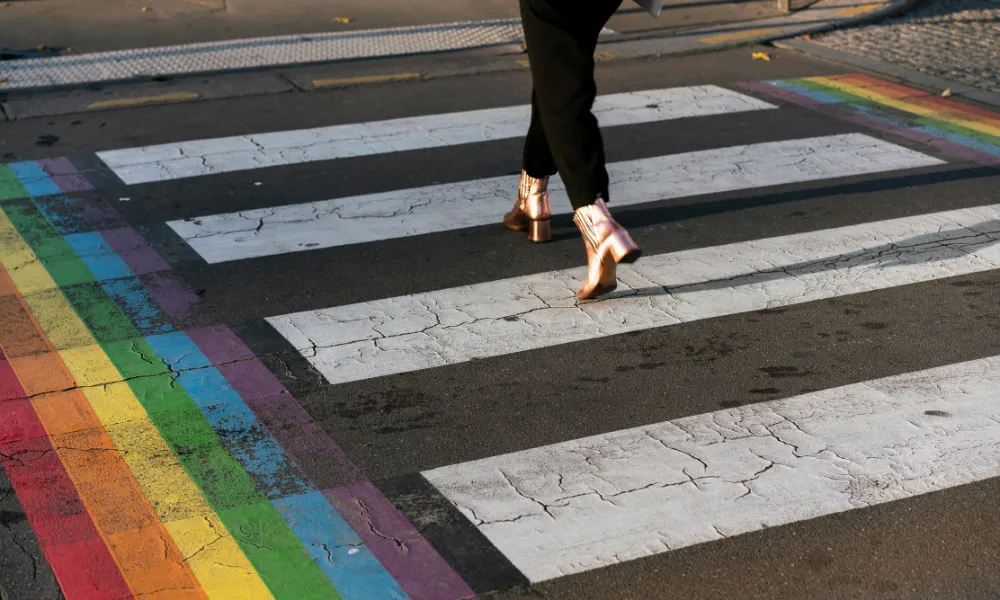
This year Cyprus Pride calls us with a slogan that turns an insult on its head: “Take the Road, Your Own Proud Road.” But a road is only truly yours if you can actually travel it - walk it, roll it, cross it at your own pace. At a Pride march, every body has its own rhythm; and yet, for years, our communities designed the road without counting in every body.
Because there is a truth we forget: disabled people are part of the LGBTQI+ community. Lesbians who are blind, trans people who use wheelchairs, queer people with neurodevelopmental or psychosocial disabilities - people at a crossroads where sexuality, gender identity and disability intersect. And yet they are too often rendered invisible on both sides.
We need to shift our perspective. The exclusion disabled people experience is not created by their bodies, but by society. It is not the wheelchair that stops someone from entering our venue; it is the steps we built. As our Manifesto puts it, “even the pavement cannot be taken for granted when you have been designed out of the world.” But no one was designed out of the world - the world was designed without counting them in, and whatever was designed that way can be redesigned. This makes accessibility not a “favour” but a right, as the UN Convention recognises. And we are not talking about a small minority: according to the WHO, around 1.3 billion people - one in six - live with some form of disability.
It is no coincidence that the queer and disability movements speak the same language. The term “crip” was inspired by the way “queer” turned a slur into a banner - just as “hit the road” becomes a claim. “We are not separate groups with separate grievances,” the Manifesto says; “we are movements that share the same language of exclusion - and the same need for a world with room for everyone.”
But beware a trap: “inspiration porn,” the tendency to present disabled people as “inspirational” or as “heroes” simply for living. This turns them into objects that make others feel good, rather than equal subjects with rights.
In practice, a road with room for everyone means: accessible venues checked by disabled people themselves; accessible toilets; wheelchair spaces with good sightlines; shade, water, quiet rest areas; sign language interpretation and audio description; surtitling; image descriptions and subtitles on social media; maps warning about stairs, sounds and lights; and a route that holds every pace. None of this is a luxury.
The slogan “Nothing about us without us” is the lesson: accessibility is designed with disabled people and by them. Because, as we say this year, freedom is indivisible — and the road belongs to everyone, or it is not democracy. So let us hit the road, truly, all of us together. A road is proud only when it has room for every body that wants to take it.