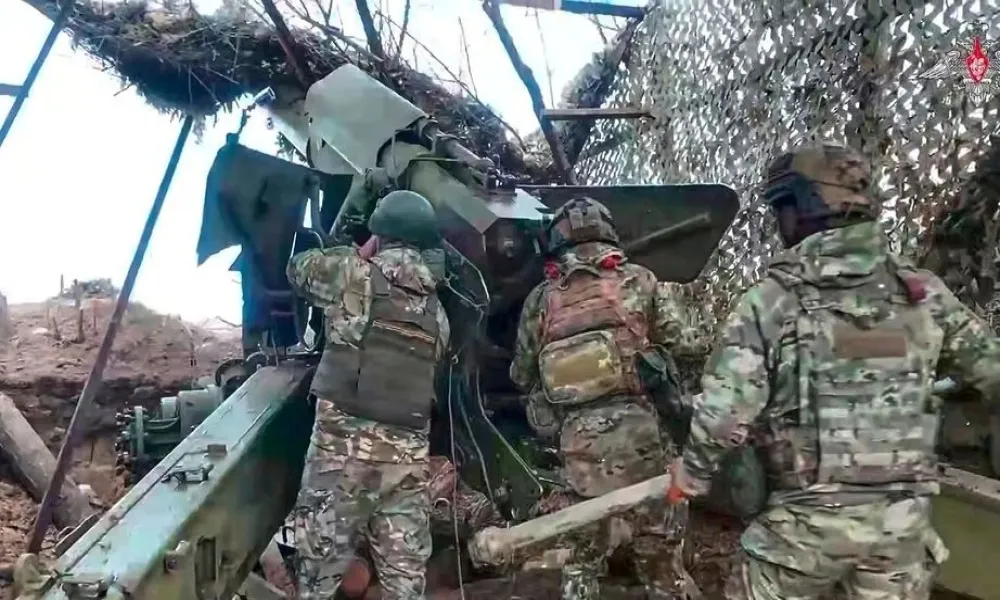

Many people still measure this war the conventional way: how many villages were captured, how many kilometres the front line has moved, how many tanks were destroyed. The most important shift, however, is not on the map. It is in the structure of the war itself.
Europe is no longer simply sending weapons to Ukraine. It is transferring technology, production capacity, expertise and critical components. Ukraine is gradually becoming a European hub for military innovation. This means the war no longer depends on how many shells are sitting in German or French warehouses. Production has become continuous, and above all, decentralised.
Dozens of private Ukrainian companies, working alongside European firms, are designing, developing and producing drones, missiles, artificial intelligence software, guidance systems and electronic warfare capabilities.
The Russian dictator prepared for a 20th-century war of industrial attrition. He finds himself instead facing a 21st-century war of technological adaptation, and he has reached a strategic dead end. A factory can be bombed. A decentralised network of hundreds of private companies innovating simultaneously across multiple countries cannot.
Russia continues to produce more steel. Ukraine is beginning to produce innovation faster, and that innovation is starting to be worth more than sheer production volume.
This may be Putin's greatest strategic miscalculation. He launched the war to prevent Ukraine from integrating into the Western security architecture. He ended up creating, within Ukraine itself, one of the most significant laboratories for military and technological innovation in Europe.
The point is not that "Europe is giving more weapons." It is that Europe has begun to "Ukrainianise" its defence industry while simultaneously "Europeanising" Ukraine's. If this process continues, it represents a structural shift that may prove far more consequential than any single military success on the front line.
Paradoxically, one of the most significant strategic developments of the war was produced by the American President's own policy. The suspension of US military aid, and his initial conviction that Ukraine would be forced to surrender, produced precisely the opposite result.
Europe realised it could no longer rely exclusively on the United States. Rather than simply substituting for American support, it accelerated a deeper strategic transformation: investing in the development of Ukraine's defence industry, transferring know-how, supplying critical technological components and building a far closer European-Ukrainian defence partnership.
The unbearable pressure applied to Ukraine did not ultimately bring about its collapse. On the contrary, it acted as a catalyst for the greatest acceleration of Ukraine's military and technological self-reliance since the war began.
In other words, a policy aimed at limiting Ukraine's capabilities ended up accelerating Europe's strategic awakening and the construction of a sophisticated, Ukrainian defence industry.
The longer the war continues, the more it strengthens the very developments the Russian dictator set out to prevent. The war is beginning to produce, systematically, the opposite of its intended strategic outcomes. And that is why, regardless of individual battles, the war's strategic conclusion has already begun to take shape.
Aris Georgiou is a diplomat who worked at the Embassy of Cyprus in Moscow