
By Christos Pourgourides
“In light of my finding that criminal offences have been committed by a number of politically exposed and non-exposed individuals, and my recommendation that criminal prosecutions be brought against those persons, the obvious question arises: On the basis of what facts do ‘some people’ conclude that my report exonerates and absolves everyone and everything?”
So asks former Supreme Court judge Andreas Paschalides, who, as the criminal investigator in the case involving the video featuring associates of the President, more widely known as VideoGate, faced intense criticism following the submission of his report.
The Presidential Palace's "parrots"
The criticism, as often happens in this country, was sweeping, unsubstantiated and full of insinuations.
However, the “some people” referred to by Mr Paschalides are none other than the President's close associates, who confidentially "informed" their media parrots that the criminal investigator's report exonerated the President's associates.
I should remind readers that the criminal investigator's report, the term “finding” being unfortunate since only a coroner reaches findings concerning the causes of death, was delivered to the President on 20 July. The report was not made public and, therefore, only those who appointed the criminal investigator knew its contents.
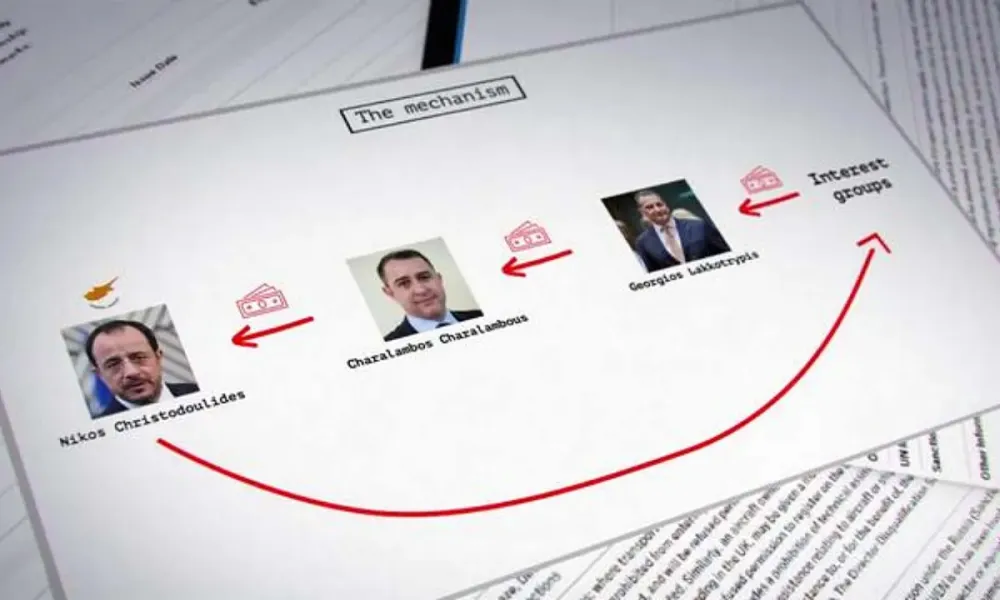
The mechanisms of the Presidential Palace, misinformation and distortion of facts were immediately set in motion.
In his report, as he informed us through the statement now under discussion, the criminal investigator records that the investigation found no evidence establishing offences under the Criminal Code, but did identify evidence supporting offences under the provisions of the Council of Europe Convention on the Fight Against Corruption.
The parrots were only given the information concerning the absence of offences under the Criminal Code.
And then, quite understandably, citizens began to react.
Because they saw and heard the conversations of the President's associates, conversations that resemble scenes from a film starring underworld figures.
What is legal does not make an act that is clearly immoral right and acceptable. Behaviour can be utterly unacceptable without violating any provision of the Criminal Code. And as long as the culture is cultivated that where there is no criminal offence there is no problem, even if the behaviour is disgraceful, corruption will continue to gallop.
The President's expectations
When he appointed the criminal investigator, the President apparently expected, following advice from a lawyer friend specialising in criminal law, that no evidence would be found establishing violations of the Criminal Code.
In that way, not only would he emerge unscathed, but he would come out on top and demand apologies from us.
From both his critics in Cyprus and the “enemies” of our people abroad who, with the help of Russian intelligence services, supposedly manufactured the video.
The problem, however, is that his adviser forgot about the Council of Europe Convention.
The legal and the immoral
I will never tire of repeating that appointing criminal investigators to examine the possibility of criminal offences arising from conduct that reeks of corruption amounts, in essence, to an attempt at concealment rather than a genuine investigation of possible wrongdoing.
What is legal does not make an act that is clearly immoral right and acceptable.
Behaviour can be utterly unacceptable without violating any provision of the Criminal Code.
And as long as people are encouraged to believe that where there is no criminal offence there is no problem, even if the behaviour is reprehensible, corruption will continue to flourish.
Changing the culture
One of the most important ways of changing the culture that breeds corruption is through the conduct of politicians and the state.
Politicians, for citizens, just as parents are for children, serve as role models whose actions and behaviour symbolise values, principles and beliefs.
For example, whether politicians are consistent or inconsistent, honest or dishonest, their behaviour radiates outwards and shapes the corresponding culture among citizens.
In Cyprus, the foremost political figure, the one whose conduct symbolises values, principles and beliefs above all others, is the President of the Republic.
When the controversial video emerged, instead of publicly expressing outrage and kicking out of his circle the associates and friends who participated in the “conspiracy”, and who now, bearing the stamp of the criminal investigator, are considered by some to be suspects in corruption offences, the President attempted to attribute the video to Russian hybrid warfare.
All of you readers who applauded that behaviour at the time, what do you say now?
Or rather, watch the video again and, hand on heart, answer this question: do the conversations of the President's associates resemble a mafia state, yes or no?
And the Archbishop
There is something else to be said about the individuals whose behaviour shapes social culture.
In our country, one such important figure is the Archbishop.
The predecessor of the current Archbishop publicly stated that, during a meeting with the predecessor of Nikos Christodoulides, he told him: “We should all stop stealing.”
A heavy, very heavy statement from an Archbishop.
Yet the current Archbishop has not uttered a single word about the enormous problem of corruption.
On the Cyprus issue, which lies outside the Church's role, he makes public statements at every opportunity.
On corruption, however, which is the child of immorality and the sister of greed, matters that are quintessentially religious in nature, the Church and its Primate remain silent.
The behaviour and mentality of every individual are shaped to some extent by character and personal values, of course, but to a much greater extent by the environment in which one is born, raised, educated, works and lives.
When those who hold political and religious power not only fail to crush corruption ruthlessly but instead encourage it through their own examples of scandal and impunity, the mentality of corruption spreads throughout society.
Contempt and rejection
As our people wisely say, “the fish rots from the head.”
Regardless of what fate awaits the criminal investigator's findings in the courts, if they ever reach that stage, what was recorded in the video demanded very different measures from those that were adopted.
Justice will probably never punish the protagonists of the video.
However, contempt, rejection and exclusion from political life are the minimum punishment they deserve.
Both for them and for those who tried, and continue trying, to shield them.
There is no immunity from that punishment.
Whether it is imposed depends solely on us, the citizens.