
The nearly three-hour meeting on Wednesday between Turkish Cypriot leader Tufan Erhürman and Greek Cypriot leader Nikos Christodoulides failed to produce the political opening that the United Nations had hoped might begin preparing the ground for another enlarged meeting on Cyprus.
The two leaders agreed to meet at least once a week in the coming period and more often if necessary. They also agreed to announce the members of the Steering Committee of the Civil Society Consultative Body, a confidence-building measure already approved in principle.
Beyond those two decisions, however, there was no tangible progress on confidence-building measures, negotiating methodology or the substance of the Cyprus problem.
That makes the central outcome of the meeting less encouraging than its diplomatic packaging suggested. The problem is no longer merely that the two sides disagree over the eventual settlement. They have not yet agreed on the rules, sequence or political foundations of a renewed negotiating process.
In other words, before discussing what should be negotiated, they are still arguing about how negotiations should be conducted.
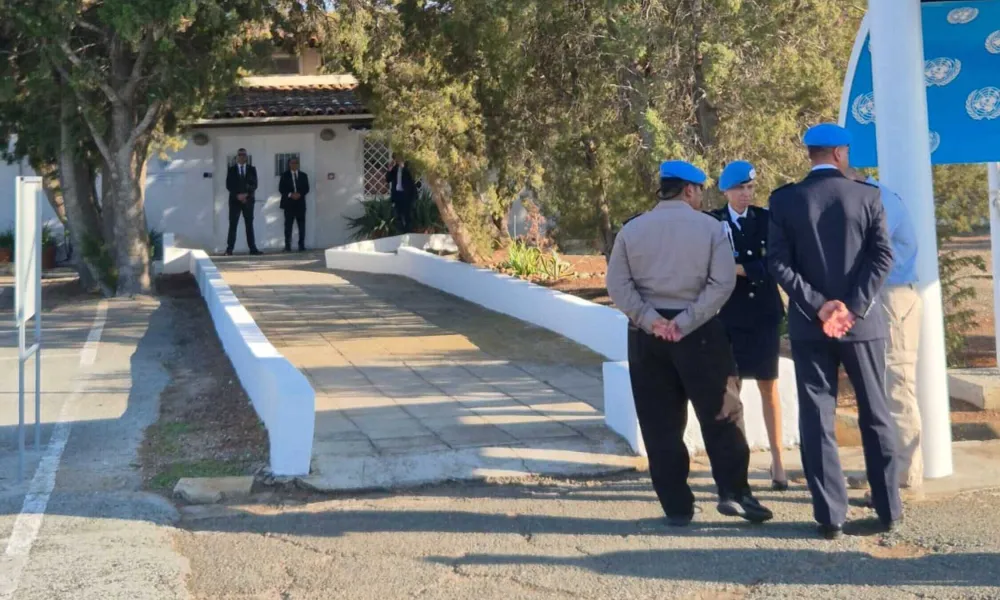
The leaders spent most of Wednesday’s meeting alone at the offices of the UN Good Offices mission in the Nicosia buffer zone. They reviewed the way forward outlined by UN Secretary-General António Guterres during his visit to Cyprus last month.
Guterres had made clear before leaving the island that he would convene a new enlarged meeting involving the two Cypriot sides, the three guarantor powers, Turkiye, Greece and Britain, and the United Nations only after “adequate progress” had been achieved in three areas: confidence-building measures, methodology and substance.
Wednesday’s encounter was the first substantial test of that assignment. The result showed that the sides remain divided in all three areas and, most importantly, over the relationship between them.
The brief UN statement described the meeting as “constructive.” Christodoulides also struck an upbeat tone, saying preparations had begun, the discussion had been good and the process was “on the right track.” Sources close to the Greek Cypriot side suggested that he believed the meeting had gone better than expected and preferred future encounters to retain the largely tête-à-tête format.
Erhürman’s assessment was considerably more cautious. His remarks exposed the depth of the methodological divide concealed behind the diplomatic language.
Political equality is not a bargaining chip
Erhürman summarised the Turkish Cypriot position in unusually explicit terms:
“Regarding methodology, we explained that political equality, together with its substance, constitutes the essence of the Cyprus problem; that it cannot be subjected to bargaining or a ‘give-and-take’ with other issues; and that unless clarity is achieved on this matter, it will not be possible to make progress on the remaining aspects of methodology, including the ‘convergences,’ or on substantive issues.”
That statement captured the essential result of Wednesday’s meeting.
For the Turkish Cypriot side, political equality is not one negotiating chapter among many. It is the constitutional and political foundation upon which negotiations must be built. It cannot be something the Greek Cypriot side grants in return for a concession on territory, property, security or guarantees.
Nor, from the Turkish Cypriot perspective, can political equality remain a sufficiently elastic expression that each side interprets differently until the final stages of negotiations. Erhürman wants its practical content clarified at the outset.
That content includes effective participation in federal decision-making, a rotating executive arrangement and the requirement that specified decisions include at least one affirmative Turkish Cypriot vote. Without prior clarity on those elements, the Turkish Cypriot side fears that a new process would once again become an open-ended exercise in which political equality is acknowledged rhetorically but diluted during institutional negotiations.
Erhürman’s four-point methodology goes beyond political equality. It also calls for past convergences to be preserved in principle, negotiations to be conducted within a defined timeframe and safeguards to ensure that another failure does not simply return the island to the existing status quo.
The logic is straightforward. If the two sides are to enter another high-stakes negotiation after decades of inconclusive diplomacy, they must know where the process begins, how long it will last and what happens if it fails.
Christodoulides does not accept all those premises.
He argues that the Greek Cypriot side has already demonstrated flexibility on political equality, including through a position paper on a rotating presidency submitted at Crans-Montana. Technically, Greek Cypriot acceptance of a rotating presidency could satisfy at least part of Erhürman’s demand for prior recognition of political equality. Yet Christodoulides did not publicly present it in those terms after Wednesday’s meeting.
On Erhürman’s demand for a limited timeframe, Christodoulides said the duration of negotiations would depend on whether the sides resumed from where they left off and attempted to complete the “final mile,” or effectively restarted the process.
He was more categorical in rejecting the demand that another failure should not result in a return to the status quo. From his perspective, such a provision would introduce a predetermined outcome and might become a disincentive to reaching a settlement.
From the Turkish Cypriot perspective, however, the absence of such a safeguard is itself a disincentive. It risks creating yet another process in which the side more comfortable with the status quo pays no price for delay or failure.
Cross-negotiation or political foundations first?
The methodological disagreement became clearest in Christodoulides’ proposal for “cross-negotiation.”
The Greek Cypriot leader argued that individual issues could not be negotiated in isolation. He suggested pairing interrelated chapters, including territory with property and governance with security and guarantees.
This method is not new. Versions of it have been used in previous rounds of Cyprus negotiations. Its purpose is to make compromise possible by allowing a concession in one chapter to be balanced by a gain in another. An agreement on territorial adjustment, for example, might help resolve elements of the property question. Governance arrangements might, in turn, be assessed alongside security concerns.
In theory, the method offers a rational way to manage a complex settlement in which almost every component affects another.
In practice, the Turkish Cypriot side sees a fundamental danger. Political equality could be treated as part of the general bargaining pool rather than as the organising principle of the future partnership.
For Erhürman, effective Turkish Cypriot participation cannot be exchanged for a territorial concession, a property arrangement or a change in the security system. It is not a privilege to be extended by the majority community. It is a constituent principle arising from the political equality of the two communities.
The two sides are therefore proposing opposite sequences.
The Turkish Cypriot side says: first establish what is meant by political equality, then agree on the methodology and proceed to the substantive chapters.
The Greek Cypriot side says: preserve the negotiating acquis, place interconnected issues on the table and search for an overall balance through cross-negotiation.
One side wants to agree on the foundations before opening the files. The other wants to open the files and establish the final balance through bargaining across chapters.
Both approaches possess an internal logic. But they are not presently compatible.
In colloquial Turkish, it is as though one side says “the week of the holiday” and the other replies “the barbecue board.” The words may sound vaguely adjacent, but the participants are not having the same conversation.
The Cyprus problem can therefore be summarised in one bleak sentence: the leaders are not yet discussing what will be negotiated at the table; they are discussing how they will speak once they get there.
The convergences dossier is itself contested
The UN is expected to complete its record of past convergences in early September, possibly around the time the secretary-general’s personal envoy, María Ángela Holguín, returns to the island.
Yet there is no firm understanding on how this record will be defined or used.
The Greek Cypriot side insists on preserving the negotiating acquis up to the early hours of July 7, 2017, when the Crans-Montana conference collapsed. Christodoulides’ position is that talks should not restart from zero. The extensive work conducted over previous decades, particularly the convergences reached before and during Crans-Montana, should remain the foundation for resuming negotiations.
The Turkish Cypriot side agrees in principle that past convergences should not be discarded. But it appears less enthusiastic about receiving a compiled document that could become a rigid or quasi-binding catalogue.
It prefers a commitment in principle to preserve convergences, leaving room for mutually agreed adjustments, bridging formulas or new ideas.
That distinction is not merely technical. A fixed dossier could freeze selective parts of the previous process while also provoking arguments over what actually constituted a convergence. A more flexible political commitment could preserve past progress while allowing the parties to adapt it, though it might also invite accusations that previously settled matters were being reopened.
There is also uncertainty over what the UN record will contain. Will it include only positions on which the two sides clearly converged? Or will it also record written and oral positions submitted during the final days at Crans-Montana, including positions that were never mutually accepted?
The answer could determine whether the sides are genuinely resuming from a point close to the “final mile” or merely importing the disputes of 2017 into a new process.
No movement on crossings or demining
There was also no agreement on the two confidence-building areas on which Guterres reportedly requested particular progress: new crossing points and demining.
The Greek Cypriot side says it is ready to open crossings at Mia Milia, known as Haspolat in Turkish, and along the Athienou-Pyroi-Aglandjia route simultaneously, using the UN secretary-general’s compromise proposal for the latter.
Christodoulides argues that the sides agreed at the enlarged Geneva meeting in March 2025 to open four crossing points, with Kokkina and Louroujina-Lymbia forming the other two components of the package.
The Turkish Cypriot side disputes that Kokkina was included in the original package and refuses an approach that selectively removes or rearranges previously discussed locations. It wants all the crossings already placed on the table, including Louroujina (Akıncılar), to be considered as a whole.
The disagreement reflects more than a dispute over roads. Each side counts and defines the proposed crossings differently, while the routes carry practical, political and, in some cases, security implications.
Christodoulides also reiterated proposals concerning Greek Cypriots living in the Karpaz region, missing persons, the Maronite and Armenian communities, and the inclusion of older Greek place names on road signs in the north.
He argued that confidence-building measures must bring the two sides closer to a settlement based on the agreed framework and must not “normalise the current unacceptable state of affairs.”
The Turkish Cypriot side approaches the matter from a different direction. It argues that measures intended to improve daily life and cultivate habits of cooperation should not be held hostage to recognition disputes. In its view, refusing practical cooperation because it might enhance Turkish Cypriot visibility turns confidence-building into another instrument of isolation.
Confidence-building under a shadow of mistrust
Wednesday’s meeting took place against the background of growing Turkish Cypriot resentment over Greek Cypriot attempts to restrict their diplomatic, cultural and sporting contacts.
Erhürman raised these grievances directly with Christodoulides.
They included efforts by the Foreign Ministry to discourage foreign diplomatic missions from attending a briefing by Erhürman’s undersecretary, Mehmet Dânâ, at the Home for Cooperation in the buffer zone. The intervention was particularly controversial because Greek Cypriot negotiator Menelaos Menelaou had previously delivered a comparable briefing to diplomats.
Erhürman also raised political pressure surrounding the NEXUS music festival planned in Kyrenia and attempts to prevent a children’s football camp licensed by FC Barcelona from being held in northern Cyprus.
For the Turkish Cypriot side, such interventions are not peripheral irritations that can be separated from negotiations. They are tests of sincerity. A process described as confidence-building cannot easily coexist with efforts to prevent Turkish Cypriots from meeting diplomats, attending international cultural events or participating in sporting programmes.
Christodoulides rejected that interpretation. He described such interventions as natural consequences of what he called the “illegal state of affairs.” The answer demonstrated that the parties do not even share a definition of confidence-building.
The Turkish Cypriot side regards freedom from systematic isolation as a minimum condition for restoring trust. The Greek Cypriot side worries that allowing international contacts in the north could normalise partition or upgrade the status of the Turkish Cypriot administration.
Thus, even ostensibly non-political activities are drawn back into the sovereignty dispute.
The timetable tightens, but the road remains blocked
Holguín is expected to return to Cyprus during the first week of September and may attend leaders’ meetings while she is on the island.
Erhürman and Christodoulides are also expected to meet Guterres separately on the sidelines of the UN General Assembly’s high-level week near the end of September. They will be asked to explain what progress has been achieved since the secretary-general’s visit.
That gives the leaders time for at least three more meetings. Weekly encounters may help them clarify positions, reduce misunderstandings and prevent negotiators from becoming trapped in procedural exchanges conducted at a lower political level.
More frequent meetings are therefore useful. But frequency should not be confused with progress.
Meeting once a week does not mean that negotiations have resumed. Nor does it mean the leaders have agreed on what they are trying to achieve, which previous understandings remain valid or how the most sensitive chapters will be handled.
The road is not necessarily closed, but it is plainly blocked. The two leaders are sitting at the same table while attempting to travel in different directions.
Erhürman said the Turkish Cypriot side would continue working in good faith in accordance with its community’s desire for a settlement. He also promised to raise adverse developments, the risks they created for the process and the resulting tests of sincerity directly with his counterpart.
“The table is a negotiating table, and words are spoken face to face,” he said.
That may be the most honest description of Wednesday’s meeting. It did not resolve the Cyprus problem or bring formal negotiations appreciably closer. What it did was make the line separating the two sides more visible.
The immediate challenge is no longer to manufacture optimism from the fact that the leaders will meet every week. It is to determine whether those meetings can produce a common road map before another enlarged conference is convened.
Otherwise, Cyprus will have acquired a busier diplomatic calendar without moving any closer to a settlement.