
Opinion polls ahead of Israel's 27 October election suggest that the country's longest-serving prime minister, Benjamin Netanyahu, is no longer politically unassailable. The opposition bloc has gained momentum and, if current polling trends continue, could secure a parliamentary majority, with former Israel Defense Forces chief Gadi Eisenkot emerging as a credible alternative.
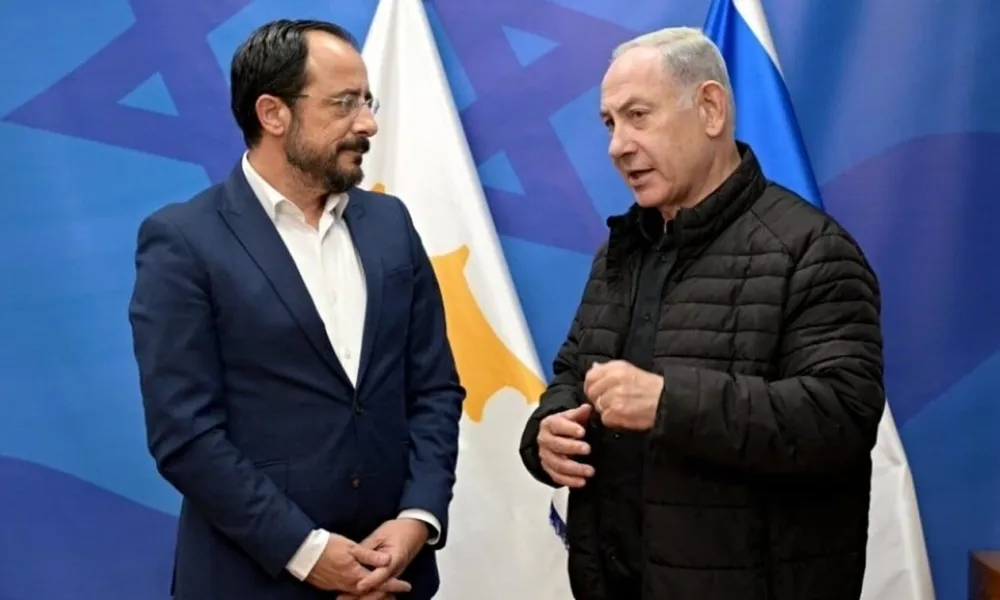
A Netanyahu defeat would be an unexpected and unwelcome development for Cypriot President Nikos Christodoulides, who cultivated a particularly close relationship with him. He viewed him as a permanent fixture in Israeli politics and indispensable to the United States.
An existential dilemma
In what may be the final phase of his political dominance, after serving three terms as prime minister over a total of 18 years since 1996, Netanyahu finds the ground shifting beneath him. His decision to keep Israel in a prolonged state of war no longer appears to convince enough voters.
Sweeping military victories have not made him a political hero or rendered him immune to challenge. Serious corruption charges for which he remains on trial continue to hover over his political future.
Eisenkot has not abandoned Israel's hard-line security doctrine, but he presents a more institutional and rational approach to managing the country's existential challenges. Israelis want to know what the "next day" looks like for their country.
He is widely credited with integrity. He has paid a heavy personal price, losing both his son and his nephew in the Gaza war. He advocates institutional normality and has sharply criticised Netanyahu over the events of 7 October and the need to bring the war to an end.
One question continues to trouble Israeli society: how did the army and intelligence services get caught off guard?
Isolation
Netanyahu's long political career may end in the worst possible way. His critics, inside and outside Israel, believe that his political survival has become inseparable from his decision-making.
He played a decisive role in shifting Israeli politics to the right and gradually pushing the two-state solution to the margins as a realistic answer to the Palestinian issue.
During the confrontation with Iran and the Shiite "axis of evil", he even clashed openly with Donald Trump when tensions peaked in the Strait of Hormuz.
"You're crazy. If it weren't for me, you'd be in prison. I'm saving your skin. The whole world hates you now," Trump is reported to have told him, according to Axios, in June.
Internationally, Netanyahu faces unprecedented pressure, regardless of whether Nicosia considers him a privileged interlocutor. He is the subject of an arrest warrant issued by the International Criminal Court over alleged war crimes in Gaza.
The European Union, albeit belatedly, is also increasing pressure to halt the expansion of settlements in the West Bank.
The successor enemy
During the election campaign, Netanyahu has openly invested in intensifying geopolitical rivalry with Turkey, whose influence has expanded significantly in Syria.
Israel has struck Syrian military facilities that could become important to a future Turkish military presence, signalling its intentions to Ankara.
Yet a new geopolitical reality is emerging in the Middle East following the weakening of the Iranian-led Shiite axis. The United States increasingly recognises the importance of Sunni states in stabilising the region.
The Mecca Pact signed in August by Turkey, Saudi Arabia and Pakistan constitutes a new factor and appears, at first glance, to have been received favourably by Trump.
In Syria, the US president acknowledges Turkey's vital role and has sought to restrain Israeli demands regarding territory in southern Syria. Washington is also mediating efforts that could contribute to Lebanon's stabilisation.
A political narrative
Netanyahu promotes his own geopolitical vision, placing Israel at the centre of a "hexagon of alliances" against what he describes as the "radical Shiite axis and an emerging radical Sunni axis".
He has explicitly identified Cyprus and Greece as participants in this framework.
"I see before my eyes an entire system, a kind of alliance, around, from and within the Middle East: India, Arab countries, African countries and Mediterranean countries such as Greece and Cyprus, as well as countries in Asia," he said during a cabinet meeting on 22 February.
A normal country would not wish to become part of a foreign leader's election campaign. Yet this narrative conveniently supports the image cultivated by Christodoulides of a strategic relationship with Netanyahu, who understands well how to use it for his own agenda.
That approach may ultimately prove damaging to vital Cypriot interests, particularly efforts led by the United Nations on the Cyprus issue.
Put simply, if Netanyahu truly believes in this "hexagonal alliance" and Nicosia tacitly accepts the role assigned to it, how can Cyprus expect Turkey to accept the abolition of the unilateral right of intervention established in 1960, as envisaged in the first point of the Guterres framework?
Why would Ankara agree to the withdrawal of occupation troops, the second point of the same framework, and allow negotiations to continue from where they were left?
In the fierce rhetorical confrontation between Recep Tayyip Erdogan and Netanyahu, both frequently exchange accusations involving international crimes.
When Netanyahu invokes Turkey's military occupation of Cyprus, he easily appeals to Cypriot emotions.
In reality, however, few in Nicosia would care to imagine what might happen if tensions between Israel and Turkey were ever to evolve into a real military confrontation and Cyprus found itself caught in the middle.
Strategic calculations
The Republic of Cyprus developed a particular model of Middle East policy through trilateral regional partnerships, always involving Greece.
Those relationships have produced many declarations but far fewer tangible results.
The deepening of ties with Israel accelerated after the collapse of the Crans-Montana talks in 2017. Then-president Nicos Anastasiades, who maintained a close relationship with Netanyahu, invested heavily in ambitious energy projects.
Over time, some failed spectacularly and were abandoned, such as EastMed, while others remain trapped in years of studies and assessments because of geopolitical risk.
The key question is whether Nicosia ever assessed the costs of those choices, and of the prolonged deadlock on the Cyprus issue, with the same diligence.
Or was that precisely what it wanted?
The weak link
When Christodoulides took office in 2023, he built upon another diplomatic concept: Cyprus's geopolitical footprint in the Middle East.
He invested heavily in the relationship with Netanyahu, reasoning that it would strengthen his access to the White House through the powerful pro-Israel lobby in Washington.
As a result, Cyprus expanded cooperation with Israel in security, defence procurement, intelligence sharing, joint military exercises and logistical support, even as the Middle East descended into escalating conflict.
Public opinion was persuaded, at least temporarily, that Israel stood beside Cyprus as an ally and a counterweight to Turkey.
The real question, however, is different: what happens when the counterweight collides with the power it is meant to balance?
Who becomes the weak link?
The Israeli elections raise an uncomfortable question for Nicosia: if Netanyahu leaves office, what exactly will remain of a strategy built around his personal agenda?
This article is also published in Efimerida ton Syntakton.