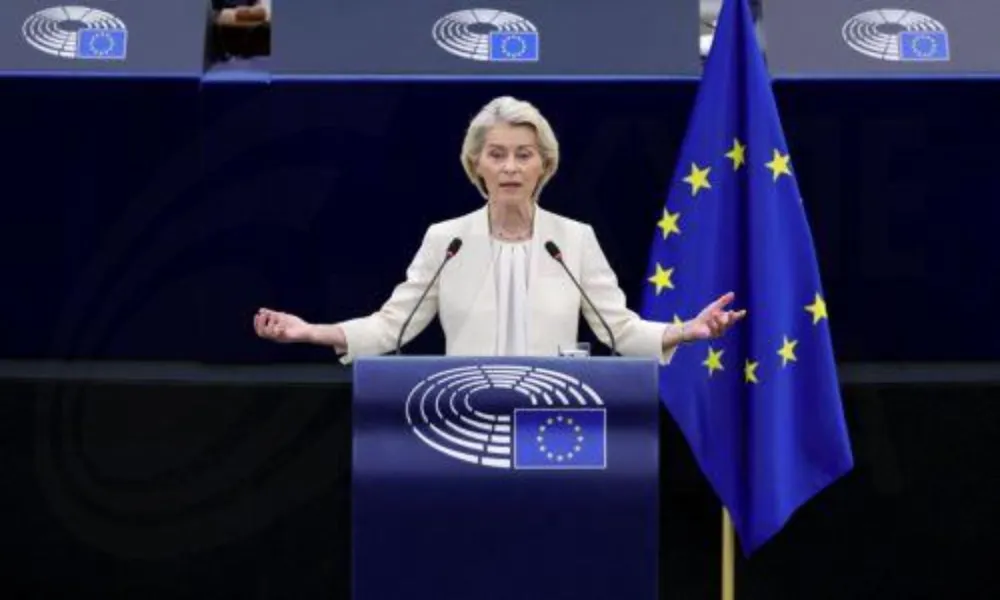

The announcement by European Commission President Ursula von der Leyen that she intends to advance the creation of a European Security Council is a tangible acknowledgement that Europe is confronting a new security reality for which existing mechanisms are no longer sufficient.
In her annual State of the Union address, von der Leyen described a world in which cyberattacks, sabotage, drone incursions and hybrid threats are multiplying. She also proposed a European mechanism for responding to hybrid threats, modelled on NATO's Article 4, under which an attack or serious threat against a member state would trigger coordinated European consultation and action.
The discussion is primarily driven by Europe's need to respond to the consequences of the war in Ukraine, Russia's continued aggression and the uncertainty created by broader geopolitical developments. References to Greenland, increased defence spending and the search for greater strategic autonomy all form part of the same debate.
For Cyprus, the proposal adds a new and interesting dimension to discussions about the security architecture of our region. It does not, of course, provide immediate answers to the Cyprus problem, nor does it automatically create new guarantees for the Republic of Cyprus.
We must remain realistic. Cyprus should not cultivate excessive expectations. European security remains closely tied to NATO, the sovereign decisions of individual member states and the particular geopolitical realities of the Eastern Mediterranean. A new European institution alone cannot overcome those realities.
Nevertheless, the political significance of the proposal should not be underestimated.
Cyprus is a member state of the European Union, yet it remains the only member state with part of its territory under occupation.
What is important, and what Cyprus should build upon, is the apparent recognition within Europe that the Union's security cannot continue to be approached on a case-by-case basis. If Europe wants the outside world, from the United States to China, to take it seriously, then Europe must also treat its own security with greater seriousness.
"Europe will defend every square metre of its territory," von der Leyen said, delivering a powerful statement. Having been made, it is a commitment that cannot easily be walked back.
Cyprus needs a European Union that understands security as a single and indivisible issue. The protection of external borders, maritime infrastructure, energy security, resilience against hybrid threats and stability in the Eastern Mediterranean cannot be treated as separate concerns.
European security is clearly entering a period of reassessment and redesign. As that process unfolds, Cyprus' unique circumstances should form part of the broader discussion.