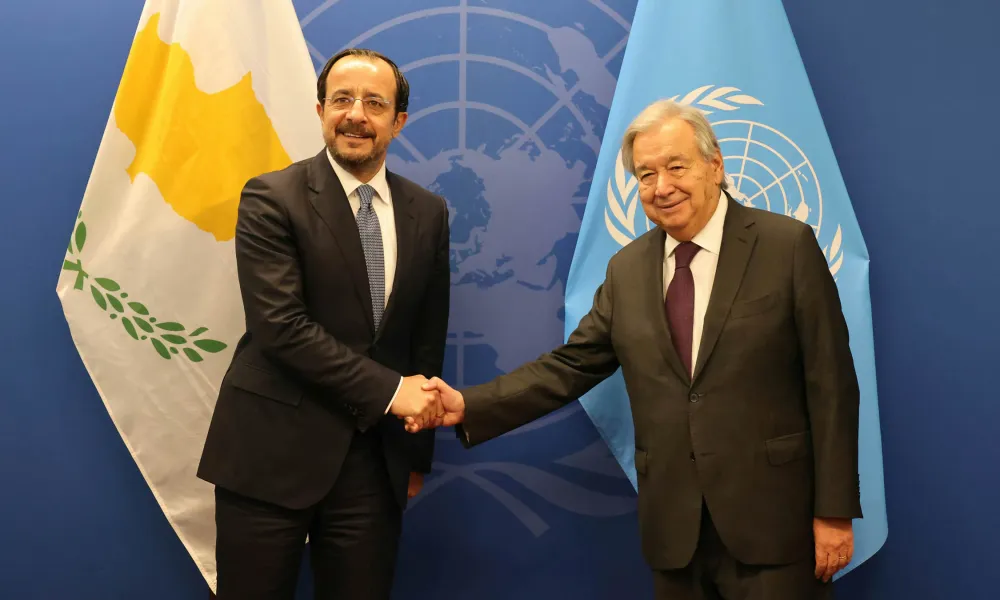

President Nikos Christodoulides has returned to Cyprus from the UN General Assemblyin New York, with the long-running deadlock in the Cyprus problem remaining unresolved and political attention increasingly turning towards the 2028 presidential election.
The latest developments come as UN Secretary-General António Guterres approaches the end of his second term, after repeatedly stressing the need for greater preparation and substantive progress before a new round of negotiations can be convened.
Speaking as he left Cyprus on 29 July, Guterres warned that the continuing division of the island was exposing Cyprus to wider geopolitical risks.
He said that the resolution of the Cyprus problem was critical not only for protecting the interests and peace of the Cypriot people, but also for contributing to stability in a region facing growing instability.
Questions over the negotiating process
The UN secretary-general's comments have added to scrutiny of the efforts to restart negotiations, particularly over whether sufficient groundwork has been completed toallow talks to resume from where they broke down at Crans-Montana nearly a decadeago.
According to the source text, the conditions identified by Guterres for a new expanded conference — including appropriate preparation, progress on substance and methodology, and confidence-building measures — have not yet been met.
Meetings between the leaders have not produced new confidence-building measures ora common understanding sufficient to establish a basis for a renewed negotiatingprocess.
Guterres has also indicated that he would not convene a conference simply for symbolic purposes without preparation, commitments and a realistic prospect of an outcome.
His public comments have increasingly focused on the amount of work still required and the need to avoid repeating what he has described as mistakes of the past.
A comprehensive assessment by the secretary-general, expected to be submitted to the UN Security Council before he leaves office, could provide a further account of developments during the current phase of efforts to restart negotiations.
Geopolitical concerns add to pressure
The continuing stalemate comes against a backdrop of heightened tensions in the wider region.
The source text links the situation to Cyprus's foreign policy and its increasingly close relationship with Israel, while arguing that growing competition between Israel and Turkey could create additional risks for the divided island.
These developments have increased attention on the geopolitical implications of the unresolved Cyprus problem, particularly at a time of wider regional conflict and instability.
Christodoulides has nevertheless continued to emphasise efforts to revive the negotiating process. In New York, he referred to new ideas intended to encourage movement on the Cyprus problem, including 19 proposals whose details were not publicly specified in the comments cited in the text.
Accountability becomes part of political debate
The continuing lack of progress has also prompted questions about political accountability.
The source argues that successive Cypriot administrations have at times attributed thelack of progress primarily to Turkish intransigence, while avoiding a fuller examination of their own decisions and negotiating strategies.
It similarly argues that the Christodoulides administration spent months creating expectations of movement that were not ultimately realised.
These are political assessments rather than established findings, but they form part of a growing debate over how the government's handling of the Cyprus problem should beevaluated.
The issue is particularly relevant as the political system begins to look towards the 2028 presidential election.
Opposition parties face their own scrutiny
The debate has also placed pressure on opposition parties to articulate clearer positions on the government's handling of the Cyprus problem.
DISY leader Annita Demetriou said on 17 September that attention should focus on the substance of the issue and on what needs to be done to achieve genuine developments.
AKEL general secretary Stefanos Stefanou said on 23 September that expectations surrounding Guterres's diplomatic efforts had not translated into a resumption of negotiations.
Neither position, according to the source text, amounted to a full-scale challenge to Christodoulides's approach.
The political calculations of the opposition parties are also being shaped by their own internal processes ahead of 2028. DISY is expected to face an internal contest involvingDemetriou and former leader Averof Neophytou, who has stepped up his criticism of the government.
Within AKEL, the process for selecting a presidential candidate is expected to take time, while former 2023 presidential candidate Andreas Mavroyiannis has also returned to public political activity.
2028 campaign begins to shape political debate
With the presidential election still some time away, the political debate is nevertheless increasingly being framed around the potential candidates and their electoral prospects.
The source argues that this risks diverting attention from substantive questions, including the future of the Cyprus negotiations, responsibility for the prolongedstalemate, the government's record and the cost-of-living pressures facing households.
It also argues that the absence of a clearly defined and forceful opposition has given the incumbent administration greater political space ahead of the next election.
Polling is another element of the emerging political discussion. The source refers to privately circulated surveys whose methodology and sampling details have not alwaysbeen made public, while noting that publicly available polling does not necessarilyprovide a comprehensive picture of how voters assess the direction of the country or the government's record.
Cyprus problem remains a central unresolved issue
The debate comes at a time when the future of the Cyprus settlement process remainsuncertain.
Supporters of renewed negotiations continue to point to the risks associated withprolonged division, while political parties differ over the appropriate strategy for restarting talks and achieving a settlement.
The central question for the coming period will be whether the diplomatic efforts initiated during Guterres's current term can produce sufficient common ground fornegotiations to resume, or whether the existing stalemate will continue into the next phase of Cyprus's political cycle.
With the 2028 election gradually entering the political horizon, the government's record on the Cyprus problem is likely to become an increasingly prominent subject of political scrutiny.