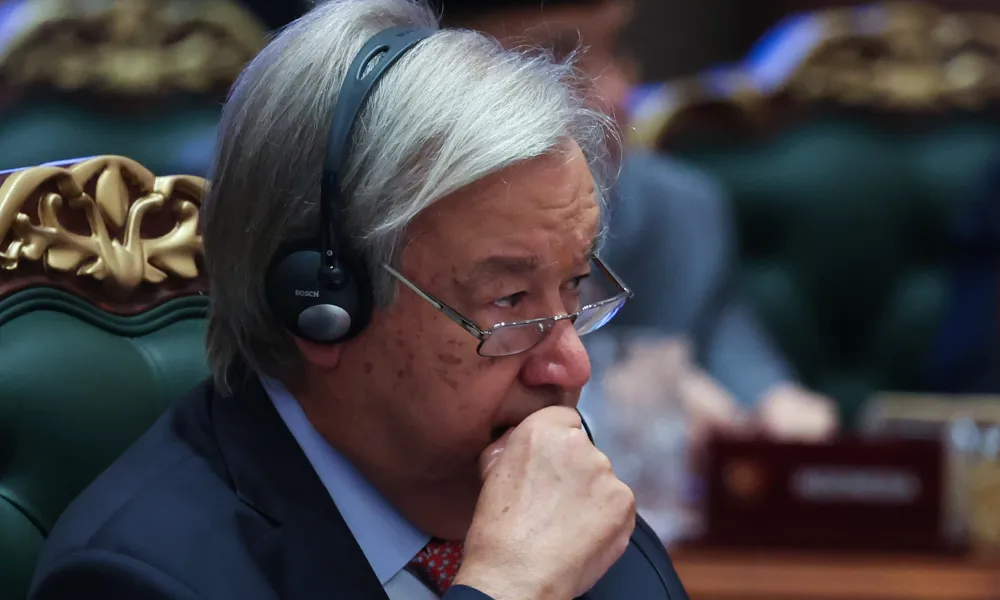

UN Secretary-General António Guterres has not yet said his last word on the Cyprus issue.
After nearly a decade of involvement, Guterres has failed to persuade the island's leaders to take the final steps towards a strategic settlement. However, he has drawn firm conclusions about how such an agreement might eventually be achieved and intends to pass those lessons on to his successor.
According to UN planning, the Cyprus file will be handed over to the next secretary-general together with a consolidated document recording areas of agreement reached by the two sides during negotiations. The document, known as the "convergences paper", is intended to provide a basis for any future effort to restart talks.
Guterres is also expected to submit a comprehensive report to the Security Council outlining the methodology he believes should be followed if the parties decide to pursue a genuine reunification effort in the future. Any substantive revival of the process appears unlikely before Cyprus' presidential election in 2028.
“Clearly, the favourable moment we had over the past year and into the current year is slowly disappearing,” the secretary-general's personal envoy, María Ángela Holguín, acknowledged in an interview with Turkey's ANKA news agency on 28 September.
Holguín is expected to make another visit to Cyprus this month before presenting her conclusions to Guterres.
Although the United Nations has invested considerable time in the effort without tangible results, officials appear determined to ensure that the process leaves behind a structured framework for future negotiations, while avoiding approaches that have proved unsuccessful in the past.
Legacy of the negotiations
The convergences document covering the period from 2015 to 2017 has been compiled by the United Nations through an independent exercise.
Canadian constitutional expert John McGarry prepared the document using joint documents submitted by the two sides and records maintained by the United Nations throughout the negotiation process.
For the first time, the compilation was not made subject to approval by the two parties.
"It will be handed to the parties when negotiations begin and when it becomes useful," Holguín said.
The approach marks a departure from previous practice.
The United Nations rejected proposals to record "divergences" and disagreements alongside areas of convergence, an approach favoured by President Nicos Christodoulides.
The move effectively ends a practice that complicated the process for years, with the two sides often claiming agreement while maintaining separate records and interpretations, arguing that no commitments existed because they had not been formally included in a mutually accepted document.
"If things have always been done this way, that may be precisely why not much has been achieved," Holguín remarked.
No appetite for fruitless conferences
The Colombian diplomat is expected to make one final effort to clarify the negotiating methodology with both sides.
In comments to ANKA, she described a process designed to avoid the creation of premature obstacles and instead help the parties "provide pathways".
While it remains unclear what specific recommendations Holguín will make, she outlined a tightly structured framework with defined “spaces, rules and principles needed to achieve short, medium, and long-term objectives.”
She has previously spoken of timetables as part of such a process.
The message from the United Nations appears to be that, without commitments and clearly defined objectives, it has little interest in repeating what it regards as fruitless conferences, informal meetings and symbolic missions.
Conversely, if the parties commit to a structured process, opportunities for backtracking and delay would become considerably more limited.
Frozen until 2028?
Christodoulides returned from New York with no tangible breakthrough, although he has sought to maintain the impression that diplomatic activity continues.
Critics argue that proposals and ideas promoted through domestic media have produced no concrete progress and that attempts to portray Guterres as sharing the president's assessments have often been followed by UN clarifications presenting a different picture.
In reality, the Cyprus issue appears deeply frozen and is unlikely to move forward substantially as both communities enter electoral cycles.
Turkish Cypriots are due to vote on 7 December in elections that will test support for Tufan Erhürman and for hardline forces opposed to a federal settlement.
At the same time, political manoeuvring is gathering pace among Greek Cypriot parties ahead of the February 2028 presidential election.
Many of Christodoulides' recent references to the Cyprus issue are viewed through the prism of preparations for that contest.
Whether a favourable environment for negotiations can be recreated after 2028 remains uncertain.
In her latest intervention, Holguín warned that developments in the Middle East and Eastern Mediterranean are creating an "increasingly complicated” situation with potentially negative implications for Cyprus.
She also cautioned against taking continued UN engagement for granted.
Negotiations do not come out of nowhere, nor do they emerge from a hostile environment," Holguín said, criticising the lack of confidence-building measures on the island.
Focus on confidence-building measures
In the period ahead, the United Nations is expected to push for at least limited progress on confidence-building measures based on proposals already tabled by the two leaders.
Holguín has identified significant gaps between the sides and a lack of political will, particularly regarding the opening of new crossing points.
In her interview with ANKA, she specifically referred to crossings at Athienou-Aglandjia, Mia Milia and Louroujina-Lympia.
The reference effectively defines the package currently under UN mediation and does not include Christodoulides' proposal for a crossing at Kokkina.
Attention has increasingly focused on the proposed Louroujina-Lympia crossing, where the Greek Cypriot side has reservations.
The Mia Milia crossing is considered particularly significant because it is supported by the chambers of commerce of both communities.
"However, so far, there has been no political will to move forward," Holguín said.
She also cited other pending confidence-building measures, including coordination mechanisms for natural disaster response and irregular migration, as well as cooperation in sports and demining efforts.
According to Holguín, the obstacle is not merely technical but also political, as the two sides have yet to translate previous understandings into practical cooperation.
Everything is feasible, but nothing is moving forward, while the hostile environment aggravates an already highly complex problem, she said.
Guterres is expected to leave his successor with a framework designed to preserve the possibility of renewed engagement on Cyprus until at least 2028.
What the United Nations cannot provide, however, is the political will that many observers believe remains absent from the island's leadership.
Whether another opportunity emerges may ultimately depend on the outcome of the next presidential election and on whether a different political course is chosen.