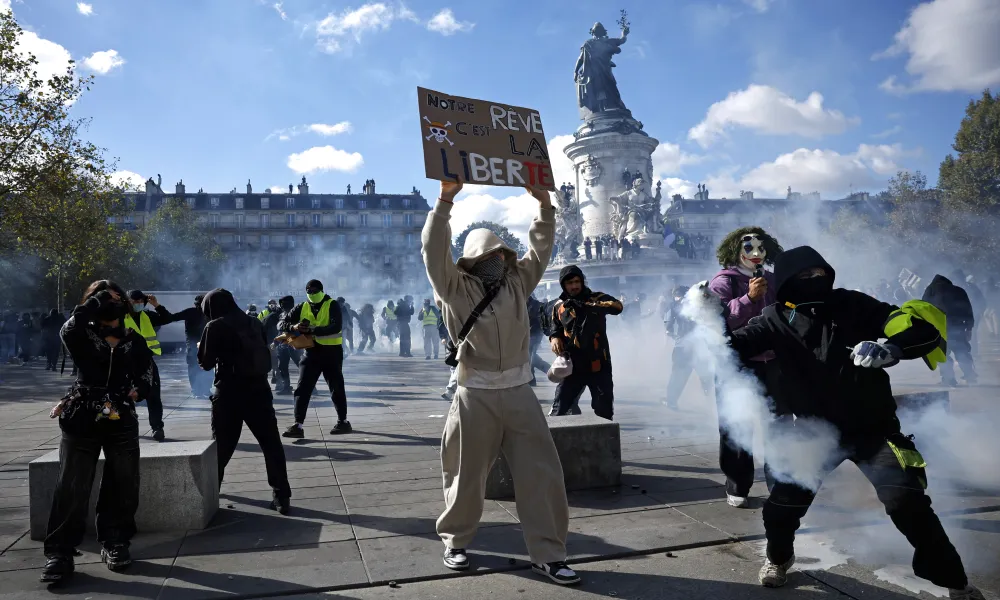

How far is the student uprising in Paris confined to France, and how far is it European, or even global? In an interview with iefimerida, the renowned director and intellectual Costa-Gavras compares today’s circumstances with May 1968. “In ‘68,” he says, “young people were seeking social and ideological liberation, whereas today the battle is being fought for survival itself and for tomorrow. The spark came from education,” which, according to the acclaimed director, “is at its worst compared with any other era. Conditions in schools are dispiriting.” As he puts it, “the causes are much deeper and touch on the complete absence of optimism about the future, and this amounts to a failure of Europe’s leaders, who are lagging behind developments.”
A generation without tomorrow
Let us be more specific. What is causing this enormous unrest? Wars, the high cost of living, the housing crisis and the inability of political leaders to offer any prospects are combining into an explosive mix. The economic crisis is turning into a crisis of trust in democracy, at a time when the far right is investing in fear and social disillusionment. Can the world change course before it is too late? Can leaders see that the demands of the 1970s have been joined by others, which now concern life itself rather than the good life? This observation goes beyond the bounds of a historical comparison. It touches on what may be the most important political and social problem of our time. For the first time in many decades, large sections of the younger generation in developed societies do not believe they will live better than their parents. And when a society stops promising its children a better future, something far deeper than the economy begins to shake.
The revolt of survival
May 1968 was born in a post-war Europe that, for all its contradictions, was enjoying the fruits of a long period of economic growth. The young generation challenged the conservative social order, authoritarian structures, class divisions and the limits on personal freedom. It believed it could change the world. Today the demands are more basic, but perhaps more dramatic. Young people are fighting for more than the right to choose how they will live; they are fighting for the very possibility of organising their lives. Education, once a mechanism of social mobility, risks becoming a path with no guaranteed destination. A university degree does not secure decent work. Work does not secure financial independence. And financial independence is not always enough to secure a home.
This reality is more than an impression. According to research by the European agency Eurofound, published in December 2025, the housing crisis disproportionately affects young Europeans, forcing many to remain in the family home or postpone starting a family. This amounts to a profound social upheaval. Reaching adulthood no longer automatically brings independence. Personal progress is no longer synonymous with financial security. And hope is gradually giving way to uncertainty.
A planet in permanent conflict
At the same time, the world around this generation is becoming ever more dangerous. From Tehran to Palestine, from Damascus to Kyiv, the planet seems to be turning into a vast field of confrontation. Military conflicts, geopolitical rivalries and the erosion of the rules of international law are reviving a logic of power that many believed had been curbed after the end of the Cold War. Russia’s invasion of Ukraine, the war in Gaza and the military confrontation over Iran are not isolated events. They are linked to a broader reshaping of the international balance of power, in which the major powers seek to secure their strategic interests, often at the expense of international stability. The figures are revealing. According to the Stockholm International Peace Research Institute (SIPRI), global military spending reached $2.887 trillion in 2025, the 11th consecutive annual increase. In Europe alone, it rose by 14%.
Defence is, of course, a necessary duty of states, particularly when their sovereignty and security are under threat. The problem arises when military power becomes the main language of international relations and diplomacy retreats. Preparing for war then risks taking the place of the political effort for peace.
The economies of war
The effects of this reality are not confined to the battlefield. They reach households, businesses and the everyday decisions of millions of people. Energy is a telling example. Turmoil in the Middle East and disruption to energy flows are driving up production and transport costs, pushing up the prices of basic goods. In October, the International Monetary Fund warned that prolonged wars and new disruptions to energy infrastructure pose a serious risk to the economies of the wider region. The problem, however, runs deeper than the cost of living. It lies in a gradual shift in political and economic priorities.
When governments are forced to devote ever more resources to defence, social needs risk being pushed into second place. Housing, health, education and public infrastructure now compete with the growing demands of security. This is not an inevitable development. It is also a matter of political choice. A Europe that invests in its deterrent capability but fails to offer prospects to the younger generation may create a dangerous paradox, protecting its borders more effectively while its internal social cohesion weakens.
The crisis of democracy
Here, perhaps, lies the greatest danger. Democracy does not rest solely on elections, the constitution and institutions. It also rests on an unwritten social agreement, a social contract which implies that participation, work and effort can lead to a better life. When that agreement breaks down, trust in the political system gradually falls away with it. At that point, the social crisis becomes political. The young person who works but cannot pay the rent, the graduate who emigrates for lack of prospects and the family watching its income evaporate are questioning more than a government’s effectiveness. They begin to question whether the system itself can respond to their needs. This is where extreme political forces find fertile ground.
The far right exploits insecurity, offering simplistic answers to complex problems. It looks for scapegoats, cultivates fear of the foreigner and presents authoritarianism as an effective alternative to democratic government. This does not mean that every social protest leads to extremism, nor that all anti-establishment choices share the same political content. Historical experience shows, however, that prolonged insecurity, combined with the discrediting of institutions, can leave societies more vulnerable to authoritarianism. What is worrying is that democracy can recede without collapsing spectacularly. It can be weakened through gradual challenges to the judiciary, the independence of the press, rights and the mechanisms that hold power to account.
The great absence of political leadership
Costa-Gavras identifies a critical element in the lack of optimism about the future and the inability of Europe’s leaders to grasp the depth of social change. Indeed, much of political management seems to be consumed by dealing with the next crisis. Governments manage inflation, fiscal pressures, migration and international tensions without always presenting a convincing plan for the society of the coming decades. Politics has become more about managing risk and less about shaping a vision. Yet societies need more than technocratic competence. They need a collective purpose, a sense of justice and the conviction that their sacrifices mean something.
This applies to Cyprus too. High housing costs, young people’s difficulties in buying a first home, pressure on wages and disillusionment with the way institutions work are all expressions of the same European challenge. A country cannot plan its future when its young people struggle to plan their own.
Is there a way out?
The answer cannot stop at denouncing political leaders. Priorities need to be rethought. First and foremost, a new social agreement is needed that places the younger generation at its centre, with meaningful affordable housing policies, decent pay, investment in public education and real opportunities for social mobility. At the same time, Europe needs to strengthen its strategic autonomy militarily, and equally in energy, production and technology. Reduced dependence on unstable international markets is a precondition for economic and social resilience. A return to diplomacy and international law is also needed. Security cannot be built on deterrence alone. It requires rules, cooperation and the political will to resolve conflicts peacefully.
Above all, however, societies themselves must be mobilised. Citizen participation, independent journalism, the defence of institutions and the building of social alliances can prevent disillusionment from turning into resignation or intolerance. In 1968, young people believed they could change the world. Today, many fear that the world is changing without them and against them. This is the historic challenge of our time, which is why the causes of social discontent are not confined to France. They run through the whole of Europe and reach into an international system that is struggling to deliver peace, security and justice.
The greatest danger
The greatest danger reaches beyond the prospect of the planet being drawn into more wars. It is that societies grow accustomed to the idea that war, poverty, insecurity and the retreat of democracy are the norm. In the face of that prospect, the greatest political act goes beyond resisting the present. It is restoring faith in the future. Because a society that deprives its children of hope will, sooner or later, be confronted with its own historical failure.