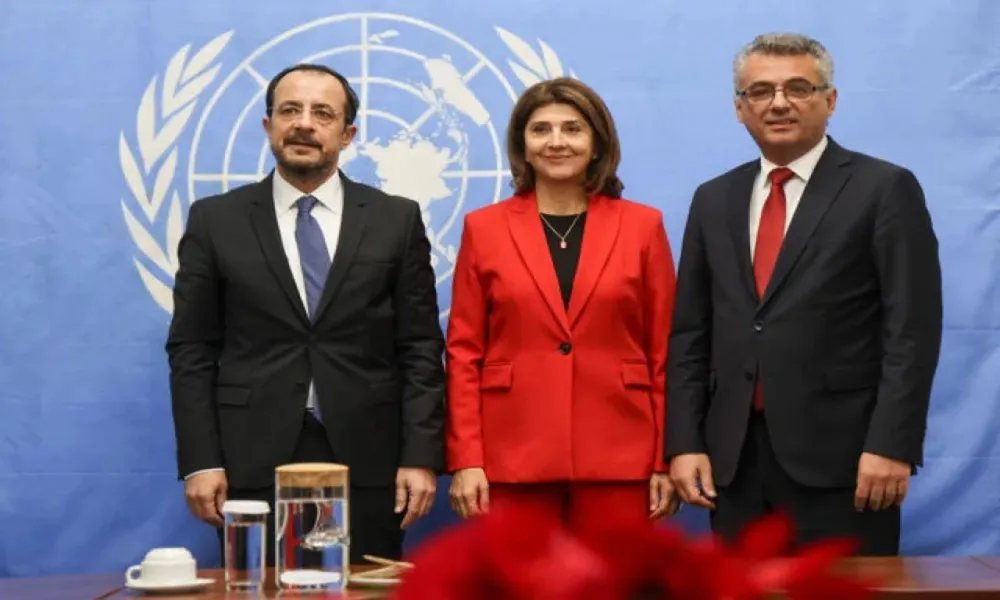

Intensifying diplomatic efforts by United Nations Secretary-General's personal envoy Maria Angela Holguín are putting renewed pressure on the two sides in Cyprus to demonstrate their willingness to make progress, as the international community signals diminishing patience with the prolonged deadlock.
The UN's insistence that agreement on confidence-building measures (CBMs), including the possible clearance of mines from the buffer zone, should be secured before the process can move forward sends a clear message: the scope for diplomatic manoeuvring is narrowing, and the international community is increasingly unwilling to sustain a process that delivers no tangible results.
The latest diplomatic push comes just two months before UN Secretary-General António Guterres' term ends, adding to the urgency surrounding efforts to revive negotiations.
The forthcoming trilateral meeting on Monday, under Holguín's auspices, is therefore seen as a critical opportunity to secure tangible progress. Failure to produce an outcome could risk the Cyprus problem being formally regarded as intractable, with potentially serious consequences for the prospects of a settlement.
Such an outcome would not simply mean a suspension of negotiations, but could further entrench the island's de facto partition. Every day that passes without agreement on a basis for resuming dialogue strengthens the existing realities created by the occupation and widens the gap between the two communities.
The issue, therefore, is not the absence of agreed guidelines for a solution, but the failure to establish a common basis on which negotiations can resume.
A narrowing window for diplomacy
At this critical juncture, the need for a settlement is no longer simply a matter of political aspiration. It is also about managing the risk of permanent partition.
The period of public relations manoeuvring and political tactics aimed primarily at domestic audiences has run its course, while the political leadership is being called upon to demonstrate the necessary realism and willingness to compromise.
The international community's growing insistence on tangible confidence-building measures reflects the need to establish whether both sides are genuinely prepared to take practical steps towards rebuilding trust.
New crossing points as a test of political will
A possible agreement to open additional crossing points should not be mistaken for a final objective or a substitute for a comprehensive settlement.
Nevertheless, it could serve as an important test of political will and a practical step towards restoring a minimum level of credibility with the international community.
At present, agreement on new crossing points is seen as one of the few tangible developments capable of demonstrating that progress remains possible and keeping the window for negotiations open.
The issue also carries significance beyond its immediate practical benefits, as an agreement would signal that the two sides remain capable of reaching compromises on matters of mutual interest.
The risk of making partition permanent
The diplomatic margins are becoming increasingly narrow, and the circumstances demand a realistic understanding of the limits of diplomacy, alongside a willingness to take political risks.
Without such an approach at this critical moment, the absence of progress could gradually turn into an acceptance of partition as the permanent reality.
That would risk cementing the division of Cyprus and prolonging the occupation of a substantial part of the island, with potentially irreversible consequences for future efforts to reunify the country.