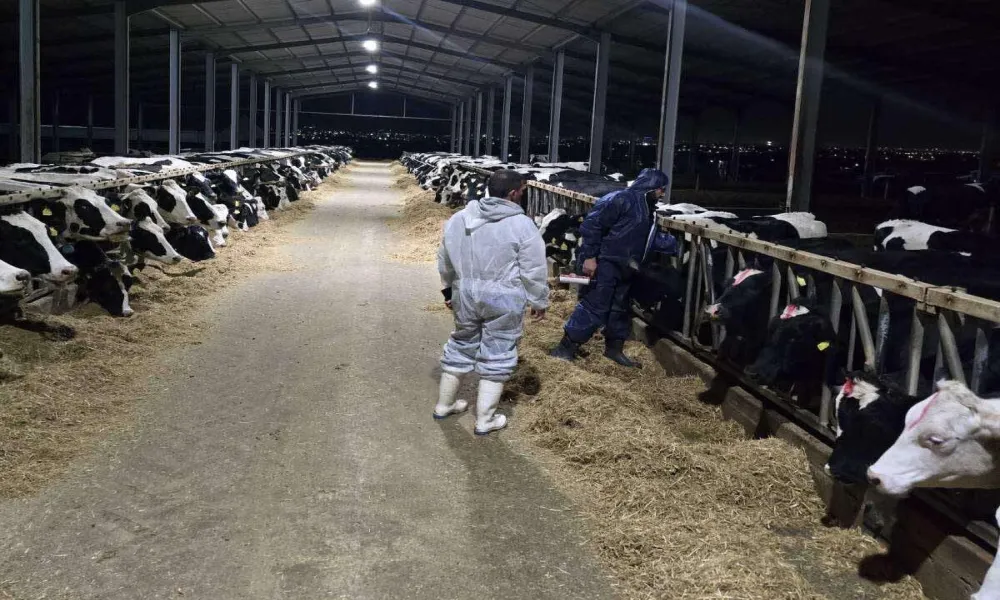
The view that the handling of Foot-and-mouth disease in Cyprus mirrors the wider Cyprus problem is not merely a striking journalistic analogy. It is, rather, an uncomfortable diagnosis. It illustrates with near-clinical clarity how a practical, technical and urgent issue can descend into political deadlock when the island’s two communities cannot - or will not - act with common sense.
At its core, foot-and-mouth disease is a manageable problem. European countries that have faced outbreaks in the past moved swiftly - activating joint protocols, imposing surveillance zones, carrying out targeted culls, launching vaccinations and controlling movement. Within weeks, the situation was brought under control. In the Czech Republic, for example, outbreaks were contained within four to six weeks. In Cyprus, however, debate continues over which farm the first infection originated from.
No high-level political negotiations were required elsewhere - only coordination, trust in institutions and, crucially, acceptance of a shared framework of rules.
Politically complex
In Cyprus, the same issue has persisted for months - not because it is epidemiologically more complex, but because it is politically so. Disputes over protocols, reluctance to adopt common practices and a lack of trust between the two sides have created an environment in which even the management of a zoonotic disease becomes a source of confrontation.
The consequences are doubly damaging. The disease remains active, harming the agricultural economy and food security, while also reinforcing the perception that even the simplest problems cannot be resolved jointly.
This is where the comparison with the Cyprus issue becomes most stark. If two communities cannot agree on practical, technical measures to protect public health and the economy, how can they hope to address a far more complex political dispute involving sovereignty, security, territorial arrangements and power-sharing?
The answer is not reassuring. They cannot - or at least do not appear able to under current conditions.
References to a potential new initiative by António Guterres have brought the issue back into focus. Every renewed effort on Cyprus rests on a basic assumption: that some degree of common ground exists, and that trust can be built through smaller, practical steps.
Here lies the difficulty. The “small steps” are not working.
The opening of new crossing points, for instance, has long been seen as one of the simplest and most symbolic confidence-building measures. It requires no constitutional changes and does not touch on sovereignty. Yet it remains stalled. Discussions recycle familiar disagreements, producing no tangible outcome. If agreement cannot be reached even here, what hope is there for more complex arrangements?
The same pattern is evident in responses to wildfires. Whether fires break out in Troodos Mountains or the Pentadaktylos, the same island is burning. Yet joint action is rarely undertaken - sometimes over disagreements as trivial as symbols on fire engines.
Foot-and-mouth disease follows the same trajectory. European protocols exist. Expertise is available. Clear guidance has been issued. What is missing is the political will to implement these measures jointly.
Disagreements over livestock culling, for example, go beyond technical differences. They reflect deeper mistrust. Each side questions the intentions and practices of the other, even when the stakes are purely practical. Turkish Cypriots raise concerns over compensation, sourcing replacement livestock and the ports through which imports would arrive - issues tied to questions of recognition. Greek Cypriots, meanwhile, argue that cooperation with Turkish authorities risks legitimising an unrecognised entity.
The result is paralysis. The disease persists, and the longer-term risks grow - including potential disruption to the production of Halloumi, a key export for the island’s economy.
In short, the problem is not a lack of solutions. It is a lack of trust - compounded by legalism and political hypocrisy.
The situation takes on an almost tragic irony. The Cyprus issue is often framed as a “big” problem requiring grand solutions. In reality, failure lies in the small, everyday, manageable matters - where basic cooperation could be built.
Water scarcity
Water scarcity provides another example. Cyprus faces a chronic challenge in managing water resources, exacerbated by climate change. This could be an area for cooperation. Instead, it remains fragmented. Each side operates independently, with no unified planning, no data-sharing and no common strategy. In 2026, the situation came close to crisis levels - alleviated only by favourable rainfall.
Reliance on chance, however, is not a strategy.
The same applies to rural depopulation and environmental management more broadly - issues that do not recognise ceasefire lines, yet are addressed through disconnected policies. The idea of a shared plan for revitalising the countryside remains remote.
Electricity supply is another case in point. Each summer, both communities operate at the margins of capacity. There is little appetite for meaningful cooperation that could render the island energy self-sufficient - only limited, ad hoc collaboration when no alternative exists.
Taken together, these examples point to a conclusion that is not merely discouraging but predictable. The absence of cooperation on small issues undermines any prospect of resolving larger ones.
Can it be resolved?
Some may argue that the comparison is unfair - that the Cyprus issue is a deeply rooted political conflict with historical, international and emotional dimensions. That is true. But it is precisely for that reason that practical cooperation is even more necessary. Without it, political negotiations remain abstract.
The management of foot-and-mouth disease could have served as such an example - a test case for limited but meaningful cooperation. Instead, it has become yet another illustration of dysfunction.
The international community, particularly the United Nations, continues to invest in the idea that a new initiative could generate momentum. It is an optimistic - perhaps necessary - outlook. But it clashes with the daily reality on the island.
Because reality is not determined in negotiating rooms. It is determined by whether common protocols can be applied to contain an outbreak, whether new crossing points can open, and whether coordination on water and electricity is possible.
So far, the answer in each case has been no.
This does not mean the situation is irreversible. It means the focus must shift - away from grand declarations and towards practical implementation. Less rhetoric, more action.
Ultimately, states are not reunified through statements. They are reunified through functioning structures, shared policies and everyday cooperation.
If a country cannot coordinate to tackle a virus affecting its livestock, then the notion that it can manage political reunification begins to look less like a plan and more like wishful thinking. Cynical, perhaps - but difficult to dispute.