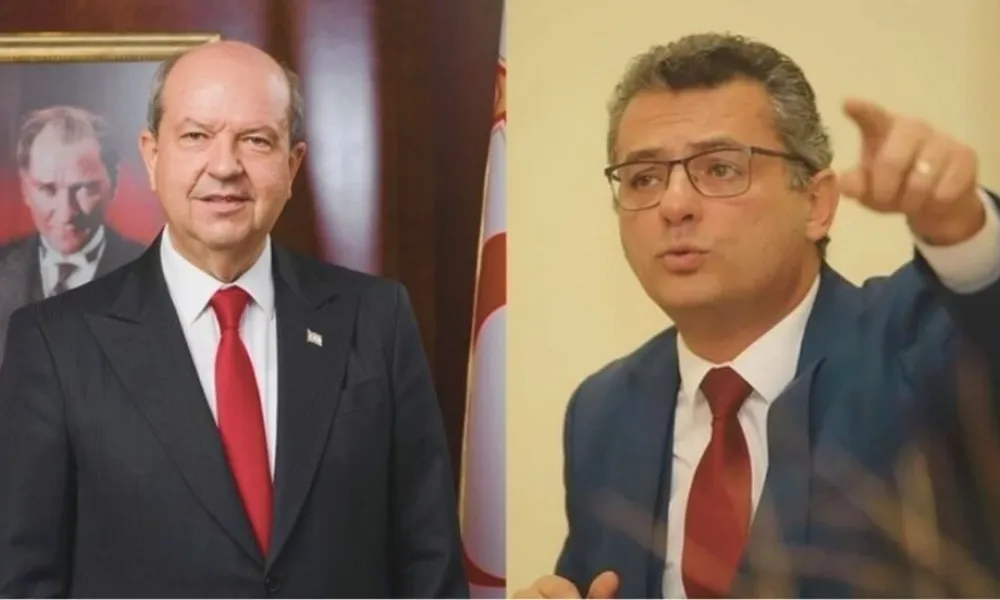
The election campaign in the Turkish Cypriot community for a new leader has entered its final stretch, with the camps of the two main candidates, Tufan Erhürman and Ersin Tatar, battling it out over the true intentions of Turkey. Both sides are trying to interpret Ankara’s “wants,” with each painting a different picture. It appears that a significant portion of voters in the Turkish Cypriot community are taking the Turkey factor very seriously, and the outcome of the 'presidential election' on October 19 will not be determined solely by internal matters, but also by how Ankara views the two leading candidates.
Turkey is the only country that recognizes the Turkish Cypriot state in the north of Cyprus and ensures its existence through financial support and the presence of Turkish occupation forces. What reasonable Turkish Cypriot or Turkish settler with voting rights would risk a rupture in relations with Ankara?
Fear
It is no coincidence that the campaign team of National Unity Party (UBP) candidate Ersin Tatar is trying to intimidate voters, promoting the narrative that Turkey does not want the election of Republican Turkish Party (CTP) candidate Tufan Erhürman. They claim that serious problems in relations between the Turkish Cypriot community and Turkey will arise if Erhürman wins.
In fact, Tatar’s camp has been warning that Turkey will never accept Erhürman’s election, and is trying to stir memories of the period when Mustafa Akıncı was at odds with Turkey. In doing so, they aim to portray Erhürman as an equally undesirable political figure. They invoke Ankara’s turn toward a two-state solution, suggesting that Erhürman’s stance in favor of a federal solution would put him on a collision course with the Turkish government. In this way, current leader Ersin Tatar is using fear politics to cover up the deep weaknesses of his own candidacy — including corruption scandals, mismanagement, division and chaos within his own party, and ongoing Turkish interference not only in the affairs of the Turkish Cypriot community, but also within the “ruling” party itself.
The two-state solution is not a new idea for Turkish Cypriots. It is a policy previously pursued by their historic leader Rauf Denktaş, which ultimately led the Turkish Cypriot community into a deadlock and poverty. Tatar has been in power for five years, and the results of his Cyprus policy are now visible. No country has recognized the state in the north, and it has not even become a full member of the Organization of Turkic States. The Turkish Cypriot community remains isolated and entirely dependent on Turkey. It is at risk of losing its Cypriot identity and continues to suffer from Turkish interference, with the Turkish military looming overhead. The construction of new minarets, headscarves in schools, and the persecution of journalists offer no hope for the future. Inflation in Turkey and economic dependence on Ankara have eroded the purchasing power of Turkish Cypriots, making the European dream feel ever more distant.
Since he cannot offer hope for the future — knowing that the Turkish Cypriot community is deeply tired and psychologically drained — Tatar is resorting to fear and terror over a potential new rupture with Turkey. He tries to present himself as Ankara’s chosen candidate and seeks to frighten Turkish settlers by claiming that Erhürman would send them back to Turkey by boat if he succeeds in reaching a federal solution.
Hope
Tufan Erhürman’s candidacy presents strong momentum because it carries a message of optimism and creates prospects for a better future for a community that remains in international isolation. As the challenger to the current “president” of the Turkish Cypriot community, Erhürman enjoys the advantage of symbolizing change and promising better days for both the economy and the Cyprus issue. He also benefits from the fact that his party is in opposition, while Tatar’s party forms the “government.” It’s no coincidence that Erhürman’s camp is pushing the slogan of a “new era on the horizon.”
The economy and the Cyprus issue are the two main pillars of Erhürman’s candidacy. Polls have shown that these two issues are top priorities for voters in the Turkish Cypriot community. Erhürman regularly criticizes the “government” for its lack of interest in the economy and in people’s purchasing power. He underscores the role of the “presidency” in economic matters and calls for the implementation of the direct trade regulation with the EU. He also emphasizes the need to return to the agreed basis for a solution, framing federation as the only realistic path for resolving the Cyprus problem — one that would also open new economic prospects.
The major challenge facing Erhürman’s camp is convincing voters that Turkey would not oppose his election, and that his positions on the Cyprus issue would not lead to conflict. The fears of Turkish Cypriots must be addressed, and the arguments of the Turkish Cypriot right about Turkey’s “desires” must be countered. It is not accidental that recent statements by Turkish President Recep Tayyip Erdoğan about the “presidential election” triggered a fierce narrative battle.
Panic
The Turkish President said that “Turkey has rights as a guarantor power, legally recognized under international law and UN resolutions.” He added that “these rights guarantee the existence of the 'TRNC' and its maritime jurisdictions in the Eastern Mediterranean, regardless of which political party comes to power.” Erdoğan’s suggestion that cooperation with either candidate is possible undermined Ersin Tatar’s narrative that Ankara opposes Erhürman. This caused panic in Tatar’s camp, which risks losing the fear card. As a result, efforts began to distort Erdoğan’s statements in order to convince voters that Erhürman’s positions on Cyprus would lead to conflict with Turkey. Tatar’s team is now attempting to convey that his stance on a two-state solution is aligned with Ankara’s, and that Erdoğan’s reference to guarantor rights implies support for such a solution.
However, former Turkish Cypriot leader Mustafa Akıncı intervened, denouncing Tatar’s distortion of Erdoğan’s statements. Akıncı noted that the Treaty of Guarantee, which grants Turkey its guarantor rights, refers to the independence, territorial integrity, and constitutional order of Cyprus. Meanwhile, Turkish Cypriot columnist Ünal Fındık, writing in Yeni Düzen on Friday under the headline “Erdoğan’s words need no interpreter,” argued that Erdoğan is a leader known for speaking directly and for sudden 180-degree turns in his political career. “Therefore,” he wrote, “he could easily change his policy on Cyprus.” Fındık also noted that Erdoğan “gave the first signal” in his speech at the July 20th ceremonies. He quoted Erdoğan as saying: “We support Mr. Tatar’s two-state solution policy.” He added that “this policy, which they claimed to have developed together until that day — but which was in fact determined by Turkey — had now become exclusively the policy of Ersin Tatar.”