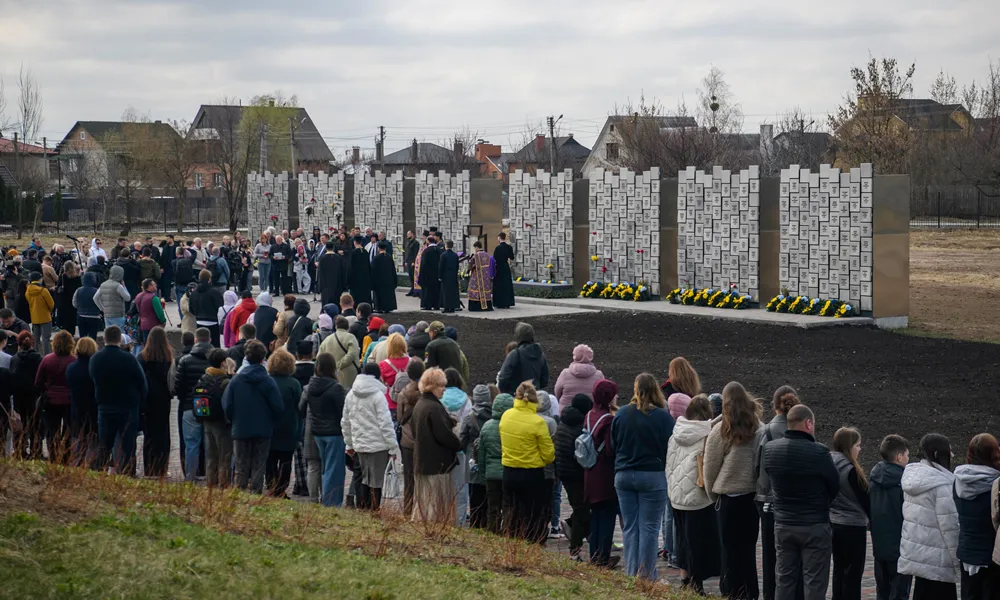

European Union foreign policy chief Kaja Kallas and a group of EU foreign ministers arrived in Kyiv on Tuesday to mark four years since the massacre in Bucha, in a show of political support for Ukraine at a time of growing divisions within the bloc over continued aid. The delegation, which included ministers from Germany, Italy and Bulgaria, travelled to Bucha where Ukrainian authorities say more than 400 civilians were killed during the early phase of Russia’s invasion. Candles were placed at a memorial to the victims, while officials also visited a church hosting a photo and video exhibition documenting the events.
Ukrainian Foreign Minister Andrii Sybiha said the presence of European leaders in Kyiv and Bucha sends a clear signal that accountability for alleged Russian war crimes remains on the international agenda. Kallas described Bucha as a symbol of the brutality of the war, stressing that those responsible must face justice. She reaffirmed that the European Union will continue to support Ukraine across military, financial, energy and humanitarian sectors.
Europe’s support under strain
The visit comes as Europe has effectively become Ukraine’s main backer in its war against Russia, with fighting continuing along a frontline stretching more than 1,200 kilometres. However, internal disagreements persist. A proposed €90 billion EU financial package for Ukraine remains blocked by Viktor Orbán, linked to disputes over Russian oil transit through Ukraine and broader political tensions. Hungary has also slowed progress on Ukraine’s EU accession talks.
Push for accountability
Kyiv is using the high-level visit to advance efforts to establish a special international tribunal to prosecute the crime of aggression against Ukraine. According to Sybiha, eight countries have already signalled readiness to join the initiative, with expectations that more will follow. He argued that the war is not only about territory, but about the future of Europe and the defence of international law, describing the frontline as a dividing line between competing systems of values. Russia has denied responsibility for atrocities in Bucha and rejects the creation of such a tribunal, warning it would consider participating states as hostile.
War overshadowed by global developments
Ukrainian officials also expressed concern that international attention is shifting due to the ongoing conflict involving the United States, Israel and Iran. Peace efforts in Ukraine have stalled, while Kyiv fears that Western military resources could be redirected elsewhere. At the same time, rising global oil prices are adding financial pressure on Ukraine, increasing fuel costs in an already strained wartime economy.
Despite these challenges, European leaders sought to project unity in Kyiv, framing their presence as both symbolic and strategic at a critical moment for Ukraine’s war effort and its long-term position within Europe.
Source: Reuters