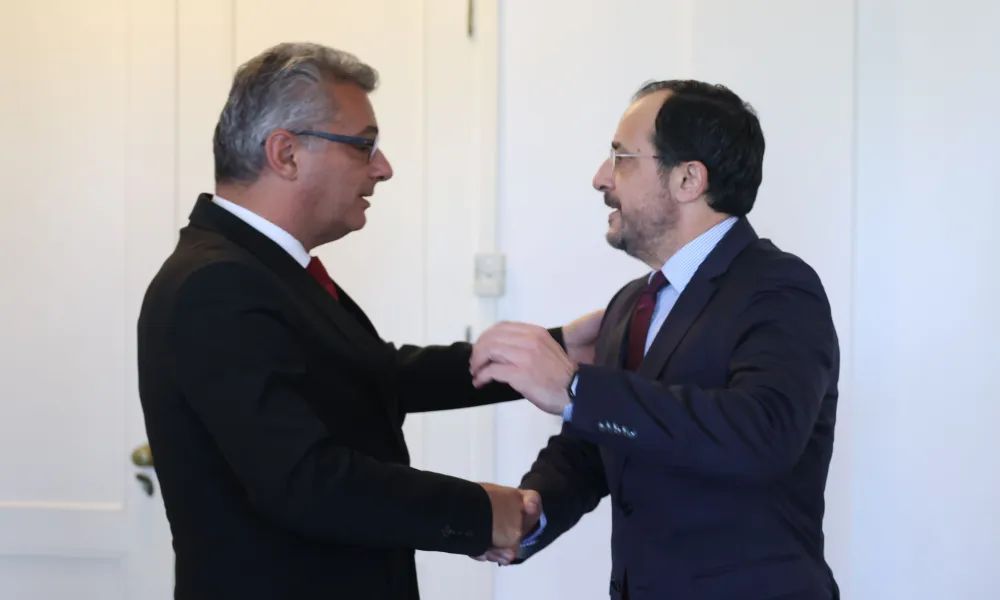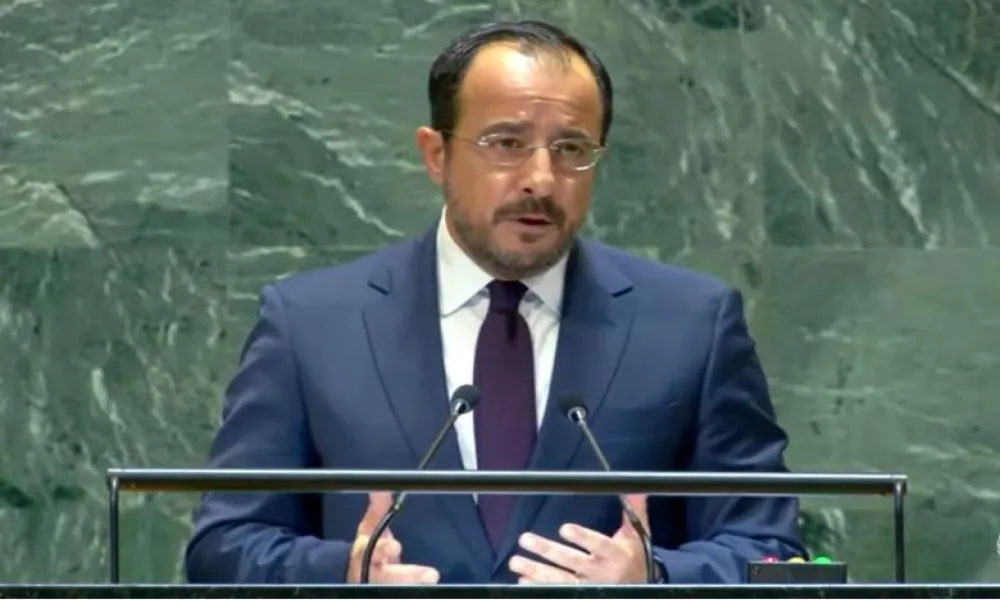

President Nikos Christodoulides on Wednesday called on Turkey to take the path of responsibility, end the occupation of Cyprus, and return to negotiations for a comprehensive solution. From the podium of the 80th United Nations General Assembly, he accused Turkish President Recep Tayyip Erdoğan of hypocrisy of the highest order as he warned the international order is at a crossroads.
“I am ready to assume my share of responsibility to reunite Cyprus,” Christodoulides said, pledging commitment to a bizonal, bicommunal federation with political equality, in line with UN Security Council resolutions and EU law.
Cyprus' role of 'stability and security'
He accused the Turkish President of hypocrisy of the highest order highlighting what he called a glaring contradiction between Erdoğan’s public declarations of peace and responsibility and Turkey’s ongoing violations in Cyprus. “From this very podium yesterday,” Christodoulides said, “Mr Erdoğan spoke of peace and accountability, while his country continues to occupy a sovereign state in breach of the UN Charter.” The Cypriot President underscored that illegality stemming from the use of force can never be accepted, regardless of the identity of the aggressor or the victim.
Framing Cyprus as a consistent and credible partner in the region, Christodoulides emphasised the country's role as a pillar of security and stability in the Eastern Mediterranean and the wider Middle East. He described Cyprus as a country that does not merely speak the language of responsibility but acts accordingly. His government, he stated, is committed to deepening that role and transforming the island’s geographic position into a strategic asset — one rooted in cooperation, shared values, and historical ties with neighbouring nations.
Occupation, displacement, and the parallel with Ukraine
In his speech, Christodoulides drew a parallel between the 2022 Russian invasion of Ukraine and Turkey’s 1974 invasion of Cyprus. “The violation is the same. The suffering is the same. The invasion and the occupation — the same,” he said. He reminded delegates that Cyprus has now been under Turkish military occupation for over 51 years. Tens of thousands of people were forcibly displaced, women were raped, and cultural and religious heritage sites were destroyed — damage he described as irreversible.
He spoke movingly about Varosha, the fenced-off quarter of Famagusta, which remains under Turkish control in violation of UN resolutions that call for the return of the lawful inhabitants. He accused Turkey of continuing its illegal settlement policy with the aim of altering the demographic character of the island, while families of missing persons still await news of their loved ones — a personal memory that, as he said, remains etched in his mind from childhood
Gaza: 'War must end'
Turning to the ongoing war in Gaza, Christodoulides called for an immediate ceasefire and reiterated Cyprus’s commitment to regional responsibility, including post-war reconstruction efforts. He affirmed that “there is no substitute for peace” and called for the unimpeded flow of humanitarian aid, an end to forced displacement, and full respect for international humanitarian law. He also underlined the urgent need for the immediate release of all hostages, while reiterating Cyprus’s support for a two-state solution — one where Israel and Palestine coexist in lasting security and peace. “Hamas, as a terrorist organisation, has no place in that future,” he said.
Looking ahead, Christodoulides referred to Cyprus’s upcoming presidency of the Council of the European Union in January 2026 as a moment of significant responsibility. He described it as an opportunity for Europe to reflect on the realities facing its only divided member state — a country still under foreign occupation. He pledged that Cyprus would carry out this role with full awareness of what is at stake, stressing the need for stronger multilateralism, deeper European integration, and enhanced cooperation between the EU and strategic partners in the region.
Erosion of international law
He highlighted Cyprus’s growing diplomatic footprint, including its recent election to the UN Human Rights Council for the 2025–2027 term, and its candidacy for the presidency of the UN General Assembly’s 81st session. These steps, he said, reflect Cyprus’s steadfast commitment to multilateralism, inclusiveness, and international responsibility.
As he closed, Christodoulides warned that the international order is at a crossroads, increasingly under strain from war, climate change, technological disruption, and the erosion of international law. The world, he said, is changing rapidly, and this is a time when nations must confront their vulnerabilities with courage and resolve. “This is our moment of responsibility,” he said, adding that national and collective duty are inseparably linked.
Quoting the theme of this year’s Assembly, “Better Together”, he added that nations are not only better — but also stronger and more resilient — when they act in unity. He reaffirmed that dialogue and diplomacy remain the only viable path to lasting peace and stability, before ending on a reflective but determined note: “The time has come to turn promises into bold action — into real change. History will look back on this moment, and it will be unforgiving. It will judge us not by the declarations we made, but by the change we made possible.”