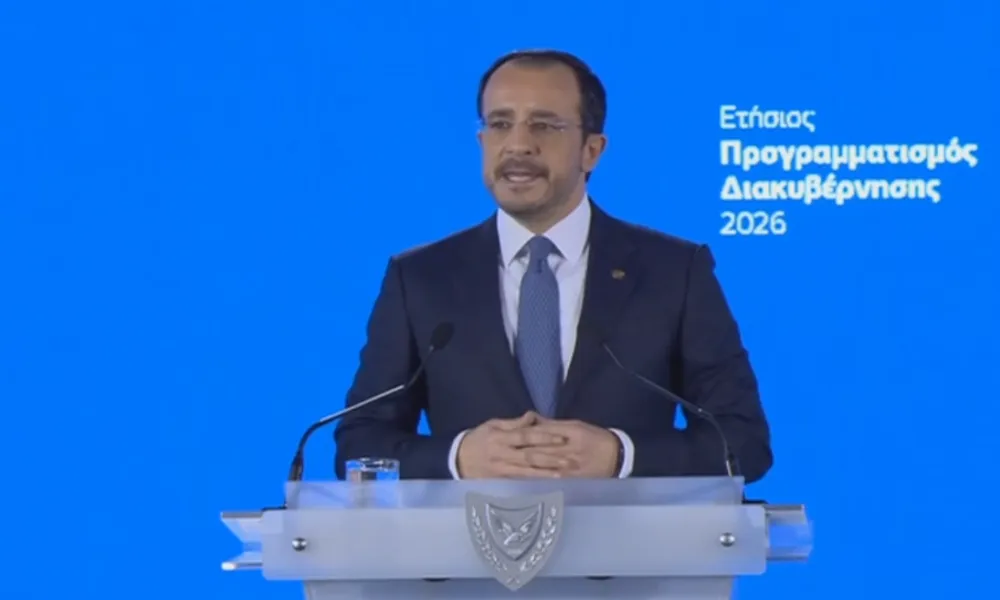

More than 55 policy actions and initiatives that directly affect citizens’ daily lives form the backbone of the government’s programme for 2026, as presented on Wednesday evening by the President of the Republic.
Speaking at the presentation of the annual governance programme at the Presidential Palace, in the presence of Cabinet members, state officials, representatives of the legislative and judicial authorities, institutions, political parties, social partners and diplomatic missions, Nikos Christodoulides said the government has, over three years, strengthened Cyprus’ internal and external pillars of power.
He stressed that these efforts serve what he described as the country’s top priority: ending the occupation, securing liberation and achieving reunification.
Security and stability as a central objective
The President identified security as the overarching goal across the economy, employment, education, health and every aspect of everyday life.
“Tonight, looking you in the eye, I assure you that 2026 finds us at a mature stage of delivering on what we promised,” he said, underlining that the government is faithfully implementing its governance programme, described as a social contract with citizens.
According to the President, this approach is grounded in social liberalism, a human-centred framework that combines individual progress with social solidarity, strengthens the welfare state and activates all drivers of economic and social development.
Five pillars guiding the 2026 programme
Christodoulides said all policies planned for 2026 are fully costed and implementable, and are structured around five core priorities:
- An outward-looking foreign policy with a clear European and Western orientation, alongside strong defence and security
- A resilient and robust economy
- Modernisation of the state, with an emphasis on continuous reforms and digital transformation
- Transparency, accountability and the prevention of corruption
- Citizen wellbeing and improved quality of life, through policies on health, education, housing and the welfare state
1.Foreign Policy, Strong Defence and Security
Gas deal with Israel and Schengen accession on the 2026 agenda
In the field of energy security, the President of the Republic said that 2026 is expected to see the signing of an agreement with Israel for the development and exploitation of the Aphrodite gas field. Detailed planning for the project is also due to be completed within the year, marking a key milestone towards a Final Investment Decision.
Developments are also expected in the coming months regarding the Kronos gas field, particularly in relation to the export of Cypriot natural gas to Europe. The signing of commercial agreements for both the Kronos and Aphrodite fields is scheduled for March.
At the same time, efforts will continue throughout 2026 to complete the technical requirements, in close cooperation with the European Commission, for Cyprus’ full accession to the Schengen Area, a move that would further strengthen the country’s security framework.
Strengthening the National Guard
The President described the reinforcement of the National Guard as an issue of national importance, citing ongoing occupation and growing geopolitical volatility.
He said that in 2026 tenders will be launched for the upgrade of the Evangelos Florakis Naval Base and the modernisation of the Andreas Papandreou Air Base, in cooperation with the European Union and the United States.
At the same time, Cyprus will leverage the European SAFE programme, with total funding of €1.2 billion, to procure modern defence equipment. The initiative aims to strengthen the country’s defensive capabilities while supporting the Cypriot defence industry.
The President also highlighted opportunities arising from Cyprus’ participation in US defence procurement programmes.
Civil Protection, Water Security and the Climate Crisis
The President said Cyprus lies in one of the world’s most climate-vulnerable regions, stressing that the growing impact of the climate crisis, including drought and wildfires, is now a matter of national security.
Within this context, construction of the Solea–Marathasa Helipad is being completed, significantly strengthening aerial firefighting, search and rescue capabilities. At the same time, the Early Warning System is being rolled out, with full operation targeted for 2026.
Civil protection is also a priority of Cyprus’ EU Presidency, with discussions advancing on the European Civil Protection Mechanism and plans, announced by the President of the European Commission, for the creation of a Regional Firefighting Centre in Cyprus.
On water security, three additional mobile desalination units will be installed in 2026, boosting daily water supply by 50,000 cubic metres, while studies are under way for further permanent desalination infrastructure.
Prison Decongestion and Tougher Measures Against Organised Crime
Efforts to ease prison overcrowding will intensify in 2026, with the expansion of electronic monitoring for detainees, combined with new legislation criminalising the introduction, use and possession of mobile phones in prisons, measures that aim to significantly enhance security.
Within the same year, the Directorate for Combating Organised Crime is set to become operational, equipped with specialised capabilities to address modern forms of organised crime in cooperation with foreign law enforcement authorities.
At the same time, Parliament is expected to pass legislation within the month allowing the use of body-worn cameras by police officers, further strengthening efforts to tackle organised crime.
A Resilient and Strong Economy as a Key Pillar
The President announced that 2026 will mark the launch of a major pension reform, with legislation aimed at delivering fairer and more dignified pensions through a simple, sustainable system. The reform seeks to strengthen retirees’ income and reduce the gender pension gap.
Within the same year, procedures will move forward for the privatisation of the Cyprus Stock Exchange, boosting its international competitiveness and improving access to alternative financing for small and medium-sized enterprises.
To support the local economy and expand the productive sector, tenders for construction works at the Vasilikos port will be launched in 2026, while studies for the development of the Larnaca port are nearing completion.
2.Modernising the State Through Reform and Digital Transformation
Expanding digital public services
In 2026, more than 100 new digital services will be introduced, alongside new information systems at the Social Insurance Department, the Road Transport Department and the Police. The Digital Citizen application, already serving over 135,000 users, will be upgraded with additional functions, including sports ticket purchases and a child ID.
Protecting minors online
The President stressed that the safe use of social media by children is a key concern for both society and government. A national action plan will be developed, in cooperation with the European Union, to implement age-verification tools and strengthen the protection of minors online.
Artificial intelligence and supercomputing
Cyprus’ first AI Factory is set to become operational, offering access to advanced computing infrastructure. In parallel, plans are under way for the creation of a national supercomputer, in partnership with a major US technology firm.
Land registry reform and state land management
A comprehensive redesign of Land Registry procedures is being rolled out, accelerating application processing through digital submissions and simplifying the calculation of transfer fees. At the same time, a new legislative framework will promote transparent and equal-use principles for state land, introducing open competitive tenders for high-value properties and expanding its use in the public interest.
In 2026, Cyprus’ urban and spatial planning framework will be modernised to better respond to citizens’ needs, through the following measures:
- Revision of local plans for Nicosia, Limassol, Larnaca and Paphos
- Publication of the first revised chapter of the Policy Statement
- Preparation of the first ten pilot urban land readjustment schemes
- Introduction of a new, simplified system for calculating building permit fees, significantly reducing processing times
- Extension of fast-track licensing procedures to listed buildings
- Modernisation of the transfer of development rights process
3.Transparency, Accountability and Combating Corruption
National Screening Mechanism for Foreign Direct Investment
President Nikos Christodoulides said that following ongoing reforms to the Legal Service and the Audit Office, as well as the strengthening of the Independent Anti-Corruption Authority, the executive will also proceed this year with upgrading the Internal Audit Service.
“Our goal is to establish a strong prevention system that reinforces defence lines and ensures proper risk management across public administration,” he said.
Within 2026, the government will also move ahead with the creation of a National Screening Mechanism for Foreign Direct Investment, aimed at further strengthening transparency and safeguarding national security.
4.Citizen Wellbeing, Health, Education, Housing and the Welfare State
Free breakfast schemes in kindergartens and the placement of social workers in schools form part of a broader push to make education more inclusive and better aligned with the needs of all children. Within 2026, the government will submit the Special Education Bill, following public consultation, with the aim of creating a more inclusive school system and improving support services.
At the core of these efforts is the upgrade of school structures, including:
- Development of modern skills, such as responsible use of artificial intelligence and critical thinking, through updated curricula
- Strengthening links between education and the labour market through the Technical Gymnasium and the reintroduction, after 13 years, of a work placement week
- Creation of 60 additional optional all-day primary schools, alongside qualitative improvements to the scheme
- Pilot rollout of the free breakfast programme in kindergartens, starting in the Larnaca district and Famagusta
- Introduction of social workers in primary and secondary schools, piloted through cooperation with educational psychologists, aiming to reduce violence and delinquency while strengthening children’s mental resilience.
Culture: Increased Funding and Cultural Diplomacy
The President said that in 2026 a total of €15 million will be allocated to culture, a 20% increase, to support cultural organisations and creators. An additional €4.5 million will fund the Cultural Programme of Cyprus’ Presidency of the Council of the EU, effectively marking the launch of the country’s strategy for cultural diplomacy.
Health: Major Investment in Public Hospitals
In the health sector, the President outlined a €145 million development programme aimed at substantially upgrading public hospitals across all districts. Key projects to be completed or launched in 2026 include:
- Renovation and expansion of the Emergency Department and the creation of a new neurology clinic in Nicosia
- Upgrade works at Limassol General Hospital, including new intensive care and haemodialysis units
- Modernisation of the Emergency Department and Radiology Department at Larnaca General Hospital, and the creation of a pulmonology clinic in Paphos
- Launch of the process for the construction of a new hospital in Polis Chrysochous, to meet the needs of the wider area
Ambitious Plan for Affordable Housing
The government has so far invested over €300 million in housing, underlining the strategic importance of the issue. Cyprus will also leverage the housing plan presented by the European Union, following an initiative by Nicosia.
Key measures include:
- Strengthening the role of the Cyprus Land Development Corporation through state funding
- Construction of 258 new affordable housing units in 2026, in addition to 180 already under way
- Development of around 500 housing units on state land, in cooperation with the private sector, with investments exceeding €75 million
- Revision of housing schemes in 2026 to cover more beneficiaries
- Creation of approximately 2,000 new housing units within two years through planning incentives and the Build to Rent programme
- Faster and modernised licensing procedures, already benefiting more than 5,500 families
Motorways and Infrastructure
Major road infrastructure projects will continue to advance, with several key motorways scheduled for completion or tendering in 2026.
Motorways to be completed in 2026:
- Evrychou – Astromeritis motorway
- Nicosia – Palaichori motorway
Motorways to be tendered:
- Denia – Astromeritis motorway
- Polis Chrysochous – Stroumpi four-lane motorway
- Phase two of the Limassol – Saittas motorway
At the same time, road network completion works are under way in major urban centres to ease congestion. In Nicosia, the next phases of the ring road are being implemented, while in Limassol, tenders will be launched for the first phase of the Northern Bypass.
Social Support at Home and Increased Student Grants
The strengthening economy is allowing the government to further expand social policy, supporting citizens at every stage of life. In 2026, social spending will rise by 6%, following a similar increase in 2025.
Key measures include:
- Support for young families: Launch of the Together with Baby and Mother scheme, with a €4 million budget, combining material support with home visits by social workers for families with newborns
- Support for students: Modernisation of the student grant, raising its budget to €62 million, expanding the number of beneficiaries and abolishing income and asset criteria for families with five or more dependent children
- Support for older people: Upgrade of home care services for the elderly, with a €3 million budget, complementing strengthened residential care
- Support for persons with disabilities: Implementation of new legislation expanding access to social services, including the Personal Assistant scheme, increasing benefits and extending eligibility to people currently excluded due to income or asset thresholds