
Cyprus is moving ahead with the creation of a Directorate for Combating Organised Crime, a new police unit inspired by Greece’s corresponding service, Justice and Public Order Minister Marios Hartsiotis announced on Thursday. The development follows high-level talks in Nicosia with Greece’s Minister for Citizen Protection, Michalis Chrysochoidis, and comes at a pivotal moment as Cyprus prepares to assume the Presidency of the Council of the EU in less than a month.
Visit of the Greek minister to Cyprus
Hartsiotis described the timing of Chrysochoidis’ visit as particularly significant for the Republic of Cyprus. He noted that the upcoming EU Presidency places additional weight on security matters that will fall under the Justice Ministry’s portfolio in the months ahead. Beyond European issues, the ministers discussed organised crime, drug trafficking, migration and enhanced cooperation between the two countries’ police academies.
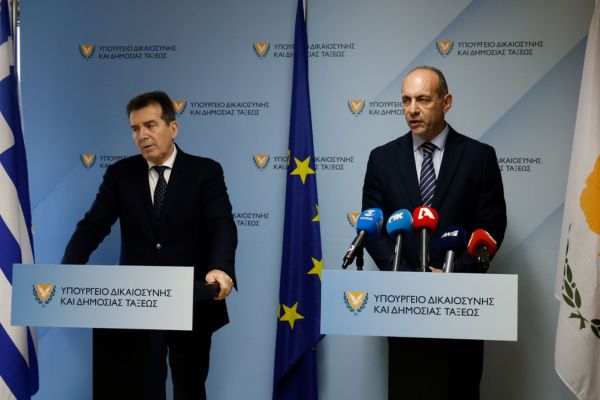
Hartsiotis expressed his thanks to the Greek ministry, noting that an especially close, multi-level partnership has developed between the two sides in recent months, already producing tangible results.
Establishing the new directorate
The Justice Minister confirmed that the Cyprus Police will establish a Directorate for Combating Organised Crime, mirroring the Greek model created about a year ago. Through information exchange, he said, it has become evident that Cyprus and Greece are “communicating vessels” in some aspects of organised crime. The new directorate is expected to strengthen Cyprus’ capacity to respond to this complex threat.
Organised crime, he added, is not a purely Cypriot or Greek phenomenon, but a challenge faced by all EU member states and frequently appears on the agenda of European Councils and summits.
Greek perspective on regional security
Chrysochoidis described the visit as an honour and highlighted the close cooperation developed with Hartsiotis. Security, he said, is a constitutional right and a crucial concern in a region marked by instability and anxiety created by geopolitical developments. He also referred to the longstanding Cyprus problem, expressing the need for a just solution after more than 50 years since the Turkish invasion.

Ahead of the EU Presidency, he emphasised that one of the top priorities at European level is the protection of minors and the fight against online exploitation, noting that Greece will work closely with Cyprus to advance this agenda.
Greek model of tackling organised crime
Chrysochoidis pointed to the Greek Directorate for Combating Organised Crime as a highly effective service. In its first year of operation, the unit carried out 1,500 arrests and secured 550 pre-trial detentions, results he said demonstrate its operational impact. He welcomed the Cypriot decision to create a similar structure, calling it an important step for the security of Cyprus and its citizens.
He stressed that organised crime in the region is transnational and interconnected, involving networks engaged in economic crime, extortion, smuggling, drug trafficking and other serious offences. Greece, he said, will continue to support Cyprus through information exchange and shared expertise.
Migration trends and regional challenges
The Greek minister addressed migration, noting that pressures in the region have eased compared with a year ago, with some exceptions related to the situation in Libya. He added that geopolitical developments in Syria and Gaza require continued vigilance to ensure that migration flows do not re-emerge at previous levels.
Lifelong training for police officers
Chrysochoidis also outlined Greece’s efforts to restructure police training, upgrade the Police Academy and promote lifelong learning for officers. Continuous training, he said, is essential for operational readiness and success against crime. He underlined the importance of open exchanges of political, operational and scientific expertise between the two countries.
Technology as a policing tool
Highlighting the role of technology, he said modern tools help law enforcement agencies combat crime more effectively and take a more proactive role in disrupting criminal networks. This, he added, strengthens both public safety and democratic institutions.
Daily cooperation between services
Responding to questions on possible movements of organised crime groups from Greece to Cyprus, Chrysochoidis said the two police forces cooperate daily. He referred to a direct, live communication line between the police chiefs and key services, facilitating constant information exchange on all matters deemed critical.
Building the Cypriot FBI
Asked whether Cyprus will receive new tools for the leadership of its police, Hartsiotis said the ministry has already worked closely with Greek officials, receiving detailed guidance on what is needed for the new directorate to operate effectively. Cyprus, he said, enjoys the full trust of the Greek side, which has provided key insights on the structure and requirements of the service.
Hartsiotis stressed that there is no rigid timetable for the set-up, as speed alone is not the priority. What matters, he said, is establishing the directorate correctly and effectively. He highlighted two essential foundations identified by Chrysochoidis: a solid legal framework that provides the necessary tools, and appropriate premises and staffing with the right officers.
He added that the issue of premises is being finalised and that all aspects of the directorate are currently in the organisation phase.
Justice Ministry expresses satisfaction
In a later announcement, the Ministry of Justice expressed satisfaction with the outcomes of the visit, reaffirming its commitment to deepening bilateral relations for the benefit of public safety and citizens’ well-being.
The ministry noted that the Greek delegation included senior officials from the Hellenic Police and the Directorate for Combating Organised Crime, underscoring the importance both countries place on police cooperation. Separate operational meetings were held between the Cypriot and Greek teams, including discussions on expanding training programmes through the police academies of both states.