
A new international report places Cyprus among the EU’s weakest performers in English as a second language, with results that continue to lag far behind the European average. The findings appear in the 2025 EF English Proficiency Index, which analysed the skills of 2.2 million adults across 123 countries and regions.
The Netherlands retains its global lead for the seventh consecutive year, followed by Croatia and Austria, both of which posted improved scores since 2024. Twelve EU member states fall into the “very high” proficiency category, where speakers can comfortably handle nuanced social interactions, negotiate professionally with native speakers and read advanced texts with ease.
Cyprus, by contrast, ranks in the “moderate proficiency” band, alongside Italy, France, Spain and Lithuania. This level suggests speakers can follow meetings within familiar professional contexts, write basic work emails and understand most song lyrics, but lack the sophistication demonstrated in higher-ranked countries.
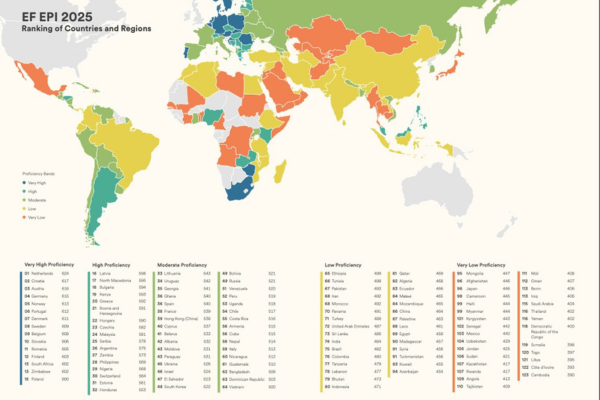
Cyprus vs Greece: A Growing English Proficiency Divide
The EF English Proficiency Index highlights a widening gap between Cyprus and Greece in English as a second language. While Greece maintains a strong position within the EU’s upper proficiency levels, Cyprus remains in the moderate tier and among the lowest-performing EU member states. The divergence is consistent across skill areas, demographic groups and long-term trends.
Proficiency category:
Greece: High proficiency
Cyprus: Moderate proficiency
Overall score movement:
Greece shows stable or slightly improving long-term performance.
Cyprus shows no upward trend and declines compared with last year.
Skills (reading, listening, speaking, writing):
Greece scores higher in all four skill areas.
The largest gap appears in speaking and writing, where Cyprus records its weakest results.
Young adult performance (18–20):
Both countries experience lower post-pandemic scores, but Greece’s young adults still outperform Cypriot learners.
Cyprus’ younger cohort remains noticeably below the EU average.
Gender differences:
Greece follows the European trend of men improving faster, with both genders scoring higher than their Cypriot counterparts.
Cyprus shows a wider internal gender gap with overall lower proficiency.
EU standing:
Greece positions itself among countries progressing in English competency.
Cyprus remains clustered with the lowest five EU performers.
Insights from the full EF report
A closer look at the complete dataset, including the charts and maps, offers more granular observations relevant to Cyprus:
Southern Europe continues to trail: The regional comparison shows Northern and Western Europe scoring significantly above the global average, while Southern Europe — including Cyprus — forms the lowest-scoring cluster within the EU.
English skills stagnating: The trend line highlights that English proficiency in Europe rose over the past decade but has plateaued since the pandemic. Cyprus is among the countries not showing notable improvement in recent measurement cycles.
Younger adults not improving: The age-group comparison shows Europeans aged 18–20 are the only demographic whose proficiency has declined over the past decade. For Cyprus, this reflects concerns also captured in Eurostat data, where exposure to English in school is high but productive skills remain weaker.
Writing and speaking skills lag: The skills breakdown reveals that while Europeans perform well in reading and listening, speaking and writing scores fall sharply. This imbalance mirrors the Cyprus profile as described in the report and in Eurostat’s education statistics.
Gender differences persist: Men in Europe improved by 40 points since 2014, compared with 20 points for women. Cyprus follows a similar pattern, widening its internal proficiency gap.
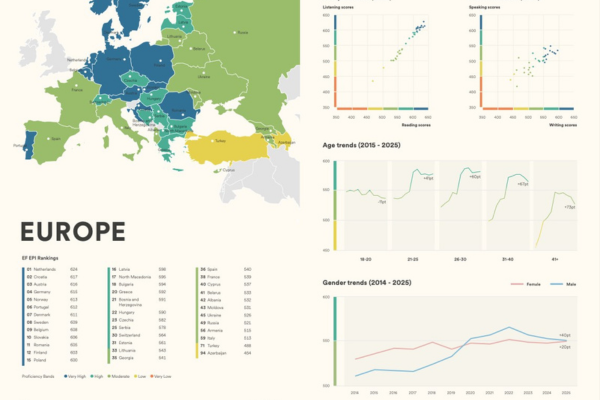
A continent studying English, but results vary widely
Eurostat figures show English remains the most studied foreign language in both general and vocational upper secondary education in the EU. In 2023, 96 percent of students at general upper secondary level and 80 percent in vocational programmes were enrolled in English courses. Yet, the EF report shows that widespread instruction does not necessarily translate into strong performance.
Despite intense exposure to English in daily life and media, the study suggests that classroom learning alone does not produce strong speaking or writing skills, areas where Cyprus in particular continues to struggle.
AI reshaping the way English is learned
The report also highlights the growing role of artificial intelligence in language education. It notes that AI-powered tools are increasingly sophisticated, from automated writing assessment to lesson design and real-time language support.
Experts cited in the report emphasise, however, that responsible use and clear guidelines are essential to ensure that technological progress enhances learning rather than replacing foundational skills.
Source: Euronews