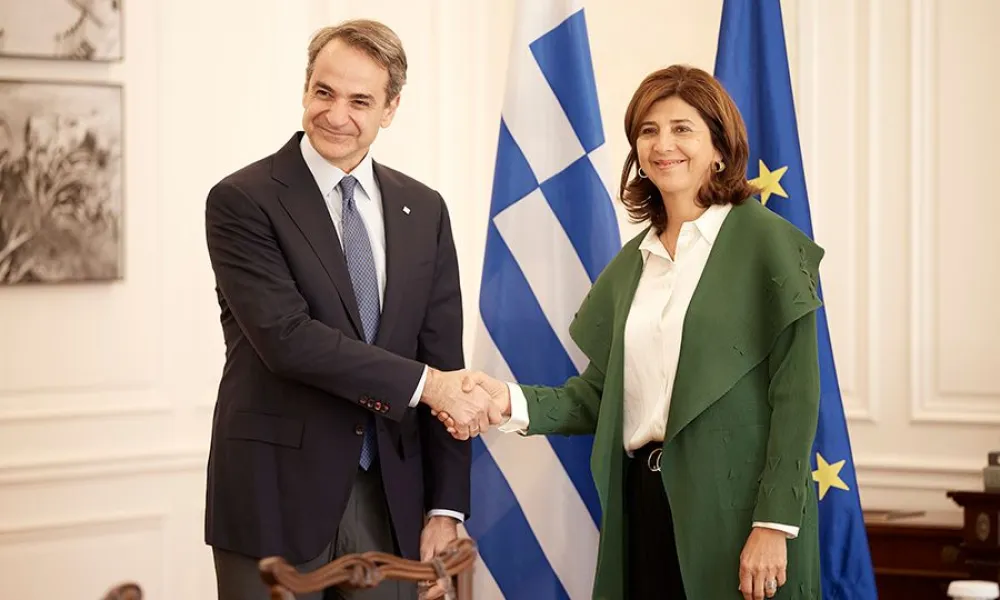
Following a broader assessment of last Thursday’s first trilateral meeting between Christodoulides and Erhürman under the auspices of María Ángela Holguín, the UN Secretary-General’s Personal Envoy is keeping to the timetable she set and was yesterday in Athens, where she held meetings with Greek Prime Minister Kyriakos Mitsotakis and Foreign Minister George Gerapetritis. According to the Greek Prime Minister’s office, Holguín briefed Mitsotakis on Thursday’s trilateral meeting in Nicosia and also discussed the convening of the next informal expanded meeting on the Cyprus problem.
After Athens, Holguín is due to travel to Turkey, where, barring any unforeseen developments, she is expected to meet Turkish Foreign Minister Hakan Fidan in Ankara on Monday.
According to diplomatic sources in Nicosia, Holguín’s contacts, particularly with the Turkish foreign minister, may lead to clarification on certain issues which, while appearing to reflect a shift in Turkey’s stance, cannot be considered a given without Ankara’s explicit endorsement. This concerns the reference in the trilateral meeting’s joint statement to a settlement within the framework of UN resolutions, which also made explicit mention of political equality, despite what appear to be differing interpretations by the Turkish Cypriot leader. Tufan Erhürman argued that although reference was made to the primary objective of resolving the Cyprus problem on the basis of political equality, “no settlement formula has been adopted”.
Emphasis on UN resolutions
As Politis understands it, the Greek Cypriot side assesses that the key outcome of the three-hour meeting between the two leaders was the reference to United Nations resolutions, through which a federal solution based on political equality has been brought back onto the agenda.
'Sovereign equality' phased out
On the Turkish Cypriot side, there appears to be some difficulty in assessing the outcome of the three-hour meeting, particularly within Erhürman’s circle. It is noted that the significant development at this stage is that references to “sovereign equality” are evidently being phased out, although the process going forward is expected to proceed at a slow pace. The Turkish Cypriot leader does not yet consider political equality to be “fully safeguarded”, while noting that a rotating presidency is also part of political equality. Based on these assessments, he believes that the first point of the proposed methodology he has put forward to the Greek Cypriot side has not been satisfied.
Crucial contact in Ankara
However, UN sources note that many issues are expected to be clarified during Holguín’s contacts outside Cyprus, particularly in Ankara. The process will move forward, but there are no indications yet regarding the pace of the new effort, which will depend primarily on the stance of the parties. At the same time, although of low political significance, both sides are placing particular emphasis on the implementation of certain confidence-building measures proposed by the leaders. Progress on these issues will be pursued and will form part of the negotiators’ work in the coming days.
Still searching for common ground
It is also clear that, based on the outcome of Thursday’s three-hour meeting, it remains difficult to set a timeframe for convening a new five-party conference. The most optimistic forecasts suggest such a meeting could be organised during the third ten-day period of January. However, the Turkish Cypriot leader maintains that, under current conditions, “comprehensive negotiations cannot begin”, which complicates the convening of another informal meeting unless it opens the way for a resumption of talks.
Turkish media coverage
Noteworthy are the references in the Turkish press regarding the trilateral meeting on the Cyprus issue. Turkish media place particular emphasis on the wording of the joint statement referring to a “solution within the framework of UN Security Council resolutions”.
Opposition media identify a clear shift in Turkey’s stance which, although present, is not openly acknowledged. Opposition news agency ANKA headlined its report “Signs of a return to a federal solution in Cyprus”, arguing that the joint reference by the two leaders to the UN framework constitutes a clear departure from the “two-state” rhetoric that prevailed during the period of Ersin Tatar.
According to reports carried by the Cyprus News Agency from Istanbul, ANKA notes that established UN parameters point to a bicommunal, bizonal federation, citing diplomatic sources that speak of a significant shift, primarily on the Turkish side. It also highlights that this is the first time in years that both sides have jointly endorsed UN parameters in a common statement. The same framing is adopted by the website Sondakika, under the headline “Return to the United Nations framework in Cyprus”, which republishes ANKA’s report.
Tacit acceptance
In the pro-government press, the approach is more neutral and procedural. Hürriyet, under the headline “First trilateral meeting with the UN in Cyprus”, reports that the meeting focused on Turkish demands for changes to the negotiation methodology, avoiding any reference to a specific settlement model. Other pro-government outlets, such as Akşam and Milliyet, limit themselves to stating that the aim is a solution “based on political equality, as defined in UN Security Council resolutions”, without further interpretation. However, despite the differing interpretations offered by government-aligned media, it is clear that, implicitly but unmistakably, a return to a solution based on United Nations resolutions is beginning to take shape.
This article was originally published in the Politis daily newspaper.