
The working day in Strasbourg began very early, encompassing the full range of current affairs. Even before dawn - in fact, from the previous evening - around 700 farmers gathered outside the European Parliament, where the first Plenary Session under the Cypriot Presidency is under way and where yesterday the President of the Republic outlined to MEPs his vision for a Strategic Europe, as well as the pillars of the Presidency.
Beyond concerns over the EU–Mercosur trade agreement, the dominant issue in the atmosphere not only of the European Parliament but of the European Union more broadly is the deterioration of transatlantic relations. Indicative of this is the fact that, as European Council sources told P, it remains uncertain what exactly will happen on Thursday, when the leaders of the 27 Member States will convene for an extraordinary meeting to examine recent threats by US President Donald Trump regarding the acquisition of Greenland and the imposition of tariffs on European countries that oppose him. Uncertainty surrounds both the stance European governments will adopt and the potential reactions from Washington, despite a prior coordination meeting at COREPER level.
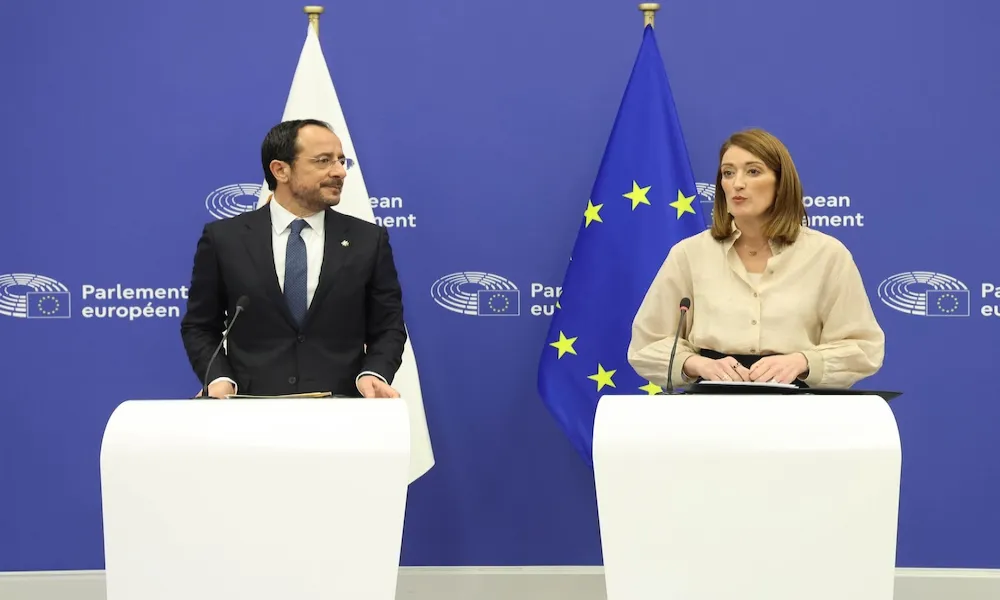
President Christodoulides was welcomed at the European Parliament in the morning by the President of the European Parliament, Roberta Metsola, and during the official welcoming ceremony the national anthem of Cyprus and the anthem of the European Union were played.
A private meeting followed, after which the two leaders entered the Plenary Chamber. Welcoming the President of the Republic of Cyprus, Ms Metsola stressed that this is a critical moment for Europe and the world, noting that we all know the next six months will not be easy. She emphasised that Europe will remain focused on safeguarding its competitiveness and easing the burden on families and businesses, while investing in new realities - particularly in security and defence - and ensuring that Europe’s voice remains strong globally.
She underlined that Cyprus’ unique experience is an asset for Europe’s next steps, including strengthening the Pact on Migration and Asylum, legislative simplification, negotiations on the next long-term budget, enhanced security from defence to energy independence, support for Ukraine, addressing complex issues in the Middle East, and strengthening transatlantic relations.
Enlargement, war and digital transition
President Metsola reiterated that the European Parliament will always stand by Cyprus in pursuit of a unified, sovereign European state: a bi-communal, bi-zonal federation in line with UN resolutions and grounded in our shared values and EU law.
President Christodoulides stated that the Cypriot Presidency begins at a decisive moment for the EU, marked by geopolitical instability, geo-economic competition, war, and pressures arising from the dual digital and green transition, as well as migration. He stressed that the international order can no longer be taken for granted and that Europe must respond with unity, deeper integration and decisive action - choosing cooperation, solidarity and progress.
Reiterating the Presidency’s core objective of a strategic and open Union, he noted that strategic autonomy represents the next stage of European integration, requiring internal strength, competitiveness, security and steadfast commitment to EU values. Citizens, he said, expect Europe to protect its borders, defend democracy and safeguard its way of life, while remaining an open and reliable global partner.
Security and defence
On security and defence, Mr Christodoulides said that Russia’s war against Ukraine has highlighted the urgent need to strengthen Europe’s security architecture and defence readiness. He reaffirmed the EU’s unwavering support for Ukraine and stressed that borders cannot be changed by force - whether in Ukraine, Greenland or anywhere else - lest everything become “negotiable”.
He called for the swift implementation of key defence initiatives, a stronger defence industrial base, enhanced military mobility, maritime security, closer EU–NATO cooperation and a comprehensive approach covering migration management, cyber resilience and hybrid threats.
On competitiveness, he noted that a realistic agenda should focus on investment, innovation, simplification and support for SMEs, alongside completing the single market and deepening capital markets. He stressed the need to retain talent within the EU, modernise industry, strengthen digital and energy autonomy, ensure affordable energy prices and promote a genuine Energy Union for the benefit of all regions.
He also emphasised that a strategic Union must remain open to the world, describing enlargement as the EU’s most powerful geopolitical tool and calling for credible progress with Ukraine, Moldova, the Western Balkans and Turkey.
He highlighted the importance of relations with the Southern Neighbourhood and the Gulf region, an ambitious EU trade agenda, and strong partnerships with the United States and the United Kingdom.
On values and social cohesion, he said the EU must remain a Union that leaves no one behind, with democracy, the rule of law and fundamental rights protected in practice. Priorities in this context include affordable housing, tackling child poverty, protecting young people, strengthening the Health Union and ensuring access to essential medicines.
Finally, he said that the next EU long-term budget must better reflect political priorities and equip the Union to deliver results in security, competitiveness, sustainability, resilience and cohesion, in close cooperation with the European Parliament.
MEPs’ interventions and replies
In their largely supportive interventions regarding both the European Presidency and President Christodoulides, MEPs expressed satisfaction with the emphasis placed on European autonomy, security and unity in a challenging geopolitical environment.
-
Manfred Weber, President of the European People’s Party, said Cyprus is assuming the Presidency at a time when a strong Europe is more necessary than ever, with Cyprus acting as a bridge to the region. Referring to the Cyprus problem, he stressed that it is a European issue: “There can be no united Europe without a united Cyprus. You have the EPP at your side.”
-
Kostas Mavrides, speaking for the Socialists and Democrats, said a holistic approach is required to address current challenges, with the EU assuming a geopolitical role.
-
He added that the Cypriot Presidency is rightly focusing on EU strategic autonomy, meaning strength combined with respect for international law externally and social cohesion internally, starting with housing and energy.
-
Kinga Gál of “Patriots for Europe” said the Migration Pact should be rejected, called for a new narrative on Ukraine and support for US-led peace negotiations, and criticised the Mercosur agreement and the proposed budget.
-
Geadis Geadi of the European Conservatives and Reformists said European autonomy means national autonomy, calling for policies to support the primary sector, competitiveness, affordable housing and energy independence.
-
Dan Barna of Renew Europe said enlargement remains one of the EU’s most strategic tools and stressed the need to begin accession negotiations with candidate countries.
-
Bas Eickhout of the Greens/EFA thanked President Christodoulides for supporting Ukraine and said Europe must act decisively in the coming months.
-
Giorgos Georgiou of the Left (GUE/NGL) said EU priorities are set by larger Member States and the private sector, adding that regional stability cannot be achieved without resolving the Cyprus issue.
-
René Aust of “Europe of Sovereign Nations” referred to the loss of Europe’s industrial base due to past energy policies and called for a return to nuclear energy.
-
Independent MEP Fidias Panayiotou said Cyprus’s territorial integrity must be a top EU priority, stressing that the Cyprus problem is also a European problem.
-
Loukas Fourlas (EPP) said Cyprus can serve as a bridge between Europe and the Middle East and stressed the non-negotiable nature of the right to veto.
-
Michalis Hadjipantela (EPP) said the continued division of Cyprus remains an open wound and a source of instability for Europe, one that can only be healed through the EU’s firm and decisive involvement.