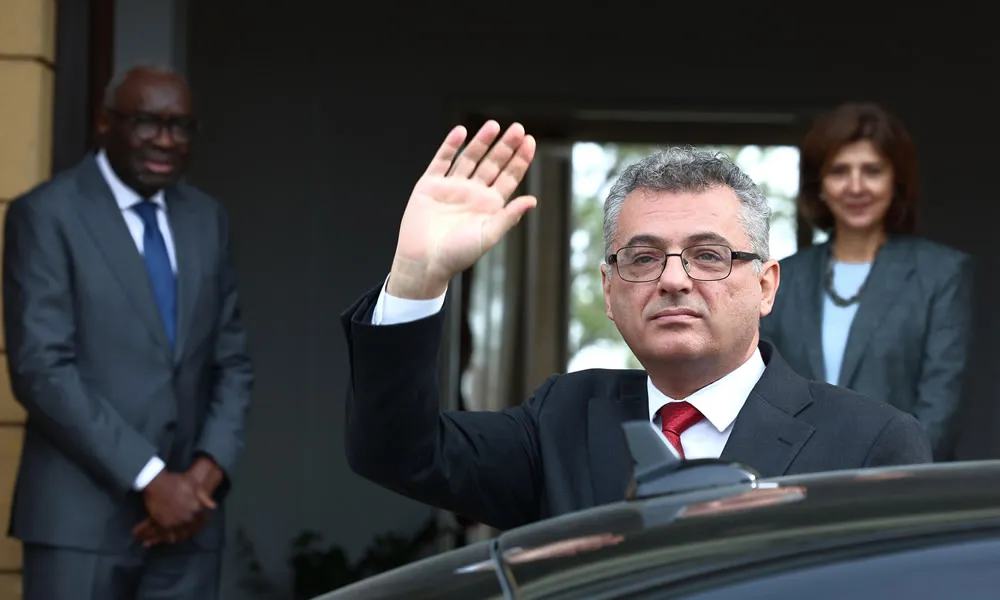
Tufan Erhürman has underlined that the clear will of the Turkish Cypriot people for a settlement constitutes the core of his political legitimacy, while stressing that this mandate also carries a heavy responsibility.
Speaking in an exclusive interview with ANKA News Agency, Erhürman said, “I am the leader of a people who want a solution,” but added that this does not amount to a license to repeat methods that have been tried many times and have consistently failed.
“I cannot once again drag my people to negotiating tables that erode trust, raise expectations, and then end in disappointment,” he said.
According to Erhürman, the real deadlock in the Cyprus problem does not stem from the absence of a settlement objective, but from the methods and mindset through which that objective is pursued.
“Expecting different results by walking the same path over and over again is not rational,” he said, stressing that this approach is damaging not only politically but also in terms of social trust.
“The will for a solution is tested not by intentions, but by method”
Erhürman rejected portrayals of the Turkish Cypriot side as “avoiding a solution,” arguing instead that his administration is focused on building the conditions that would make a settlement possible.
“We are not running away from a solution. On the contrary, we are trying to construct the ground on which a solution can actually be achieved,” he said.
“This island has repeatedly seen that without trust and without a clear method, simply convening a ‘big table’ does not produce a solution. The outcome is obvious.”
In this context, Erhürman emphasized that the four-point methodology advocated by the Turkish Cypriot side does not concern substance, but procedure.
“First, trust must be established. Then the rules of the negotiation must be defined. Only after that can we move to substance. This is what we mean by methodology,” he said.
He illustrated his point with a sports analogy:
“Before a match begins, you know which move is a foul and which is a penalty. If the rules are unclear, the match turns into chaos. That is exactly what we have been experiencing in Cyprus for years.”
Nicosia focus: “Without concrete steps, 5+1 loses its meaning”
Erhürman recalled that following the New York contacts, the Turkish Cypriot side made clear it was ready to work on the remaining issues and submitted a 10-point package of confidence-building measures. He noted that the other side responded with what appeared to be a seven-point framework, albeit with numerous subheadings.
“The problem is not the number of items,” he said.
“The real issue is whether these headings translate into concrete realities on the ground.”
He stressed that crossing points are not a new agenda item, but a long-standing and unresolved file, and pointed to a fundamental question now being asked ever more openly on both sides of the island:
“How can two leaders who cannot even open a single crossing point resolve the Cyprus problem?”
For Erhürman, the only credible answer lies in tangible steps in Nicosia that directly affect daily life.
“Without progress on confidence-building measures in Nicosia, moving to an expanded 5+1 format risks further eroding the process rather than advancing it,” he warned.
“This is not win-lose, it is win-win”
Erhürman criticized what he described as a deeply flawed framing of confidence-building measures as a zero-sum game.
“This issue has long been discussed from the wrong angle. It is almost reflexively reduced to the question of ‘who wins and who loses.’ But there is no such equation here,” he said.
Crossing points and similar arrangements, he stressed, are by nature mutually beneficial.
“This is not win-lose. On the contrary, it is win-win. Not gain-loss, but gain-gain. The winners should be both communities.”
The aim, he said, should not be political or symbolic advantage, but easing everyday life.
“The goal is not for one side to get ahead. The goal is to make people’s lives even a little easier.”
Mia Milia emphasis: “Both communities carry this burden”
Erhürman highlighted that the demand for a second vehicular crossing at Mia Milia would benefit not only Turkish Cypriots but also Greek Cypriots.
“Opening a second vehicular crossing at Haspolat (Mia Milia) is not something that serves only Turkish Cypriots. Greek Cypriots will use it as well. It is an arrangement in favor of both communities,” he said.
Referring to congestion at Ayios Dhometios, he described the situation as chronic:
“The queues at Metehan (Ayios Dhometios) have turned into a real ordeal.”
He underlined that this hardship affects both sides:
“This is not an ordeal suffered only by Turkish Cypriots. Vehicles with Greek Cypriot plates endure the same hardship. Everyone waits there.”
According to Erhürman, daily life has begun to produce improvised solutions, which he described as a clear symptom of dysfunction:
“People now say, ‘Let’s not cross by car.’ They walk across and then take a taxi to their destination. This is a clear sign that the system is not functioning.”
“I do not find it sincere or constructive”
Erhürman also voiced criticism of the Greek Cypriot leader’s recent five-point counterproposal, particularly the addition of Kokkina to previously agreed crossing points and the suggestion that concrete steps be postponed until after a 5+1 meeting.
“Adding Erenköy (Kokkina) to the crossings already agreed upon and then saying ‘let’s take the step after 5+1’ does not strike me as sincere or constructive,” he said.
Such an approach, he argued, postpones what needs to be done in Nicosia and contradicts the logic of the process.
“Our position is very clear: let us do something concrete in Nicosia so that 5+1 becomes meaningful. Constantly postponing steps does not create trust.”
Confidence-building measures, he insisted, should be treated as preconditions, not rewards.
“Confidence-building measures are not things to be discussed as ‘first a big table, then maybe.’ Trust must be created before sitting at the table.”
Why is trust eroding? “The ritual of looking through barrels”
Erhürman argued that the erosion of trust cannot be explained solely by blockages at the negotiating table, but also by problematic symbolic behavior outside it.
He pointed to a contradiction between the reality of international engagement with the Turkish Cypriot side and certain symbolic practices that continue to be staged.
“This is a place that can be visited, seen, and talked to. And they do come. Ambassadors come, representatives come, meetings are held, notes are taken, and they leave,” he said.
He noted that he had recently hosted the EU-appointed Cyprus envoy in his office.
“The EU’s appointed representative came and met me in my office. They listened to the views of the Turkish Cypriot side. This is perfectly normal.”
Against this backdrop, Erhürman questioned the logic of certain practices in the buffer zone:
“If people are coming, talking, and listening, then what is the need for this ritual of looking through a hole?”
He described the practice of taking visitors behind barrels to look into the buffer zone as a deliberate “ritual of being made to look,” not a genuine observation.
“People are taken there and made to look through barrels. I do not call this ‘looking’; I call it ‘being made to look.’ Because it has turned into a ritual.”
He reminded that the Green Line barrels in Nicosia date back to the final period of British rule and asked:
“What is being shown there? An empty space. What historical narrative is conveyed? None.”
Such rituals, he said, contradict positive rhetoric at the table.
“You can make very nice statements at the table. But if what you do outside the table undermines those statements, trust will not emerge.”
U14 example and the “recognition by implication” phobia
Erhürman also criticized an excessive focus on grand political themes, pointing instead to U14 youth sports encounters as one of the clearest and most innocent confidence-building proposals.
“We deliberately limited this to U14. No national teams, no flags, no status. Just children,” he said.
Yet even this, he noted, had been politicized.
According to Erhürman, this stems from a long-standing “recognition by implication” phobia on the Greek Cypriot side.
“Recognition does not happen by implication. Recognition happens through an explicit legal and political declaration. Children from two communities meeting does not amount to recognition,” he said.
“But because of this phobia, confidence-building steps are blocked.”
“With a mindset that is afraid even of children meeting at U14 level, you cannot create a climate of trust between two peoples.”
Such steps, he stressed, are not the solution itself, but the foundations of a climate in which a solution could become possible.
“Patient, calm, but determined”
Acknowledging that the UN Secretary-General’s term ends in late 2026 and that this creates time pressure, Erhürman warned against allowing calendars to dictate method.
“Yes, there is time pressure. I do not deny that. But throwing away decades of accumulated experience simply because of a deadline is not rational,” he said.
He described his leadership approach in three words:
“I will be patient. I will be calm. But I will be determined.”
Dialogue, he stressed, would always remain open:
“Dialogue will always exist. Meetings will always exist. We will never avoid talking.” But he drew a clear line:
“I will not be part of a process that once again lifts us from a huge table with a huge nothing.”
Concluding, Erhürman returned to the source of his mandate:
“I am the leader of a people who want a solution. My people gave me this mandate not to repeat the same mistakes, but to open a path that can genuinely make a solution possible.”