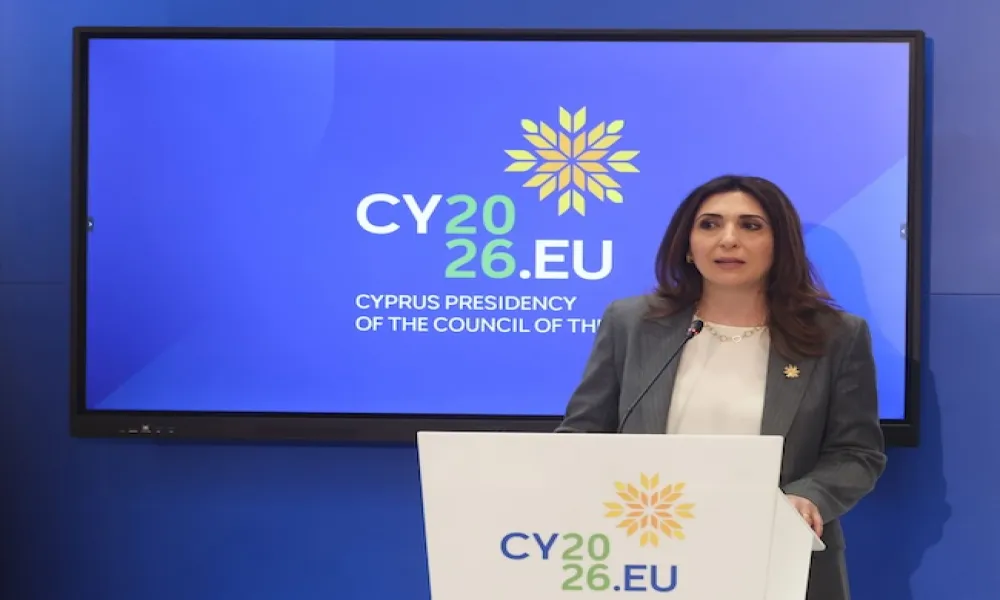
The leaders of Egypt, Lebanon, Syria, and Jordan have been invited, along with the Secretary-General of the Gulf Cooperation Council, at the informal European Council to be held on April 23–24 in Cyprus, Deputy Minister for European Affairs, Marilena Raouna, said on Friday.
Speaking at a press conference held at the "Filoxenia" Conference Center in Nicosia to present the results of the Cypriot Presidency of the Council of the EU so far, Raouna stated that they will announce on Monday which leaders have responded positively to this invitation.
Regional security
When asked why these specific countries were selected to participate, Raouna said that geopolitical developments were taken into account, also noting Cyprus’s geographical position. She added that the Middle East and the Gulf region are the EU’s "neighborhood" and that the security of the region is linked to that of the EU. Referring to the Gulf and Middle Eastern countries, she said that in the current adverse conditions, "it has been proven in practice that they are reliable, predictable partners," noting that it is important to recognize this and use it as a basis to further strengthen cooperation with the EU in tangible ways.
Asked whether Israel had been invited, in light of developments with Lebanon, Raouna noted that the decision which countries would be invited was taken in close cooperation and consultation with the Office of the President of the European Council. However, she stressed that it is important for the EU to support de-escalation in the region and send a message of respect for Lebanon’s territorial integrity, independence, and sovereignty, as well as for the UN Resolution 1701, expressing hope that the current circumstances could provide an opportunity for a definitive settlement of the issue.
Zelenskyy's participation
Initially, she said, the plan had been to invite the 10 countries participating in the Mediterranean Pact to specifically discuss its implementation. However, due to developments in the region, the decision was made to maintain this more limited format of invited participants.
Asked whether Ukrainian President, Volodymyr Zelenskyy, is expected to attend the meeting, she said he has been invited but will not be physically present and will participate via a video call in a meeting before the working dinner on April 23.
Responding to whether any tangible outcomes are expected following the meeting between EU leaders and regional leaders, Raouna said that apart from recent developments and proposals on how the EU can contribute to de-escalation and stabilization in the region, discussions will focus on "how to further strengthen cooperation and support for these countries in tangible ways," including possible trade agreements and other strategic agreements on security issues.
"This expanded meeting of leaders is not only symbolic but carries substantial political weight, as it creates a direct channel for exchanging views on common challenges as well as emerging opportunities for cooperation between the EU and regional partners," she noted, emphasizing that it confirms Cyprus’ role as a bridge between Europe and the Middle East.
Energy crisis
The Deputy Minister also said that the timing and agenda of the upcoming Summit carry particular importance. "The complex and rapidly changing geopolitical environment will be at the center of discussions. Leaders will examine regional developments, placing particular emphasis on the EU’s contribution to de-escalation, peace, and ensuring freedom of navigation," she said.
At the same time, she added, the immediate impact of the crisis on European economies due to high energy prices will be discussed, as well as the tools which are available to the EU to address possible further negative consequences.
According to Raouna, the informal Council will also examine strengthening European preparedness and defence, including better use of the mutual assistance clause (Article 42.7 of the EU Treaty).
She added that there will also be a discussion on the new Multiannual Financial Framework (MFF) 2028–2034, noting that the exchange of views at leaders’ level is expected to provide the necessary political guidance for the Cypriot Presidency to present in June a mature negotiating framework accompanied by indicative figures.
When asked whether the outgoing Hungarian Prime Minister Viktor Orban is expected to attend, she said he will not be present, but representation is expected at the level of a permanent representative, as the new government of Hungary has not yet taken office.
The Presidency in numbers
Having already completed the first half of the Cypriot Presidency semester, Raouna said that so far 73 informal meetings at high and technical level have been held across all districts of Cyprus, hosting around 6,000 participants. Of these, 14 were high-level meetings, including 10 informal ministerial councils. By the end of the Presidency, it is estimated that a total of 260 meetings will be held in Cyprus, hosting around 30,000 visitors.
At the same time, 21 ministerial sessions have been held in Brussels under the Cypriot Presidency, along with two EU–Montenegro intergovernmental conferences, and two informal ministerial meetings on the accession path of Moldova and Ukraine.
In addition, more than 860 meetings have been held at the level of Permanent Representatives, committees, and working groups, while the Cypriot Presidency represented the Council in 26 political trilogues and over 30 interinstitutional technical meetings with the European Parliament.
Key issues
Taking account of the results so far, Raouna said that the central message of the Presidency, "An Autonomous Union, Open to the World," and its key priorities have proven to be "not only timely but also essential for the EU in the current context," stressing the need for a truly autonomous and strategically independent Union.
Regarding the EU’s long-term budget, MFF, Raouna said that the Presidency’s objective for the completion of the technical work and the timely transition of negotiations to the political level has been achieved during the first quarter of 2026. The next goal, she said, is to present "a mature negotiating framework with indicative numerical figures at the European Council in June and to reach agreement at the June General Affairs Council regarding the three main financial components of the MFF."
Regarding security, the first three packages of implementing decisions for SAFE were approved under the Cypriot Presidency, making financial assistance available to 18 member states, including Cyprus. The Presidency is also promoting the regulation on military mobility, aiming at the creation of a “military Schengen zone” within the EU.
Immigration
In the field of migration, negotiations on safe third countries and safe countries of origin were completed, while discussions continue with the European Parliament on the Returns Regulation. In addition, agreement was reached with the European Parliament on the Ukraine Support Loan for 2026, amounting to €90 billion. Council Conclusions were also adopted to strengthen the EU’s capacity to address hybrid threats.
On competitiveness, according to Raouna, the Cypriot Presidency leads negotiations on 7 out of 10 legislative simplification packages, covering 21 proposals, with expected administrative cost reductions of up to €15 billion.
Reforms
A major reform of the Customs Union was agreed, including the creation of a new EU Customs Authority in Lille and a unified data hub, expected to reduce bureaucracy and save up to €2 billion for member states. Progress was also achieved on ETS2, CAP reforms, air passenger rights, critical raw materials, and the Research Fund for coal and steel. Work is ongoing on the "Grids" energy package and digital proposals such as the European Business Wallet and eDeclaration.
On strengthening the EU’s international presence, the Presidency advanced the EU–Mercosur agreement shortly after taking office and secured agreements with Switzerland. On EU–UK relations, it facilitated negotiations on electricity market participation, financial contributions, Erasmus+ participation for 2027, and the EU–UK Gibraltar agreement.
Trade negotiations
According to the Deputy Minister, decisions on an agreement with Mexico are expected, while free trade negotiations continue. A provisional agreement was also reached on a regulation addressing the impact of global overcapacity in the steel market.
Progress was also noted as regards the enlargement policy, including developments with Montenegro, Ukraine, and Moldova, as well as targeted amendments to "The Neighbourhood, Development and International Cooperation Instrument – Global Europe" instrument.
On social cohesion and fundamental rights, Council Conclusions on investing in children were adopted. Initiatives were undertaken on housing policy, employment support through the Globalisation Adjustment Fund for displaced workers, and healthcare, focusing on critical medicines. Institutional changes were also promoted to allow pregnant MEPs and new mothers to vote remotely.
In conclusion, Raouna stressed that the main goal of the Cypriot Presidency remains "to give real substance to the objective of EU strategic autonomy and to turn theory into practice through concrete policies and tangible results."
CNA