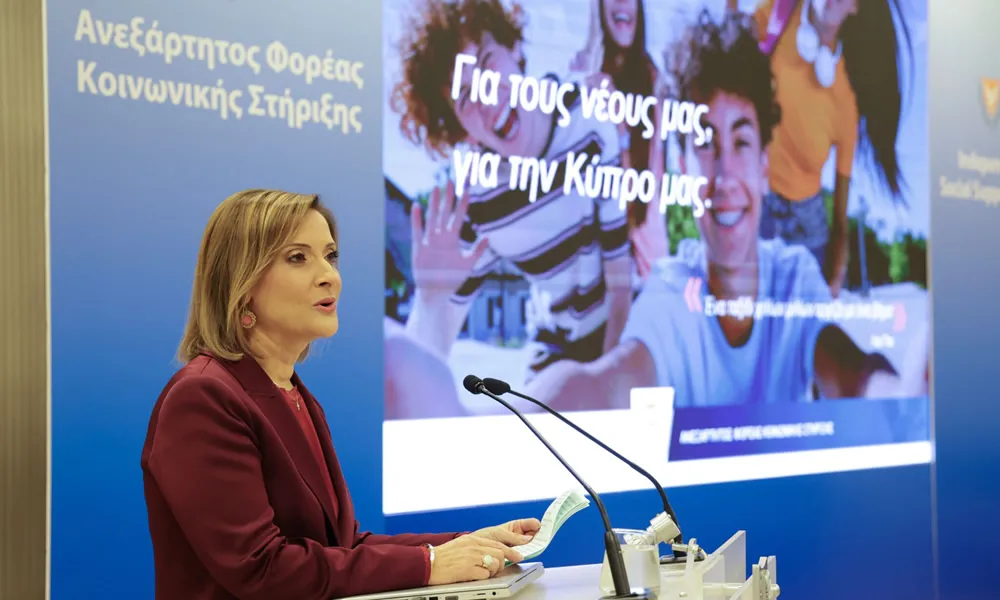

President Nikos Christodoulides has signed into law the legislation passed by parliament abolishing the independent Social Support Fund and transferring its responsibilities, along with the funds held in its accounts, to the Cyprus State Scholarships Foundation (CSSF).
The law entered into force last Tuesday upon its publication in the Official Gazette of the Republic. It provides that within three months of its entry into force – by 14 July 2026 – the Fund’s management committee must complete the examination of pending applications from financially struggling students and disburse the approved financial assistance. From the date of the Fund’s abolition, the CSSF automatically assumes all assets as its legal successor. The Fund’s account currently holds around €2 million, derived entirely from private donations.
The decision removes a major political burden from President Christodoulides, who in recent months had faced sustained allegations of entanglement linked to the Fund’s operation.
The Presidency was effectively forced to agree to the Fund’s abolition following the revelations of the so-called “videogate” involving alleged investors, an episode that caused significant reputational damage and led First Lady Philippa Karsera to resign from her position as chair of the Fund’s management committee.
Transferred to the CSSF, not the finance ministry
The footage and statements involving close associates of President Christodoulides who featured in the controversial video fuelled suspicions that the Fund was being used by the Presidency for electoral purposes. Following intense criticism, the government decided to abolish the Social Support Fund. It initially proposed transferring it to the Grants and Benefits Service of the Ministry of Finance and submitted a bill to that effect, but parliament rejected the proposal.
Instead, the House approved a private members’ bill tabled by AKEL general secretary Stefanos Stefanou, co-sponsored by DISY MP Kyriakos Hadjiyiannis and Volt MP Alexandra Attalidou, providing for the Fund’s transfer to the CSSF.
Allegations of entanglement
Addressing the House plenary, Stefanou said that for AKEL the abolition of the Fund was inevitable, “given that it operates under the Presidency and is funded by donations from businessmen or companies that seek or carry out public works contracts”. He also accused the Christodoulides government of attacking the Audit Office, which had identified what it described as a “peculiar relationship” in its report, and of resisting parliamentary efforts to ensure transparency regarding the Fund’s donors.
End to parliamentary scrutiny
With the dissolution of the Fund, President Christodoulides has also brought to an end mounting parliamentary pressure for scrutiny of the Fund’s finances. The chair of the House Institutions Committee, DISY MP Demetris Demetriou, had written to the Auditor General on 15 January 2026 requesting, as part of parliamentary oversight, a detailed list of all natural and legal persons who donated to or contributed funds between 1 January 2020 and 31 December 2025, broken down by year.
What MPs sought to examine
Members of the institutions committee requested full disclosure of those behind private donations worth several million euros, aiming to determine whether any quid pro quo was granted in return for donations and whether conflicts of interest arose.
The Audit Office investigation identified cases in which individuals and companies made substantial donations to the Fund while simultaneously holding state contracts, seeking renewals or bidding for new public contracts.
A “peculiar relationship”
From March 2023, when Karsera assumed the Fund’s presidency, until the end of 2025, private contributions to the Fund totalled €6.4 million.
In a report published on 4 November 2025, the Audit Office referred to a “peculiar relationship”, noting that the Fund’s chair was married to the President of the Republic, who takes decisions directly or indirectly affecting companies that donated to the Fund.
The Audit Office reached this conclusion after identifying donations it deemed suspicious and which parliament sought to investigate further to establish whether ulterior motives were involved. Among the cases cited were:
– A private individual, identified only by name, who donated a total of €600,000 in 2023 and 2024.
– A company negotiating a large, long-term contract with the state in 2023-2024 that donated €695,750 to the Fund.
– Shipping companies that made no donations between 2018 and 2022 but contributed between €200,000 and €500,000 per year in 2023 and 2024. During the same period, the group to which the largest donor belonged participated in an EU co-financed project worth more than €10 million. In early 2024, the cabinet issued a tonnage tax decree directly affecting shipping companies’ taxation.
– A private individual whose company received a commercial building permit and donated €200,000 in 2023 and a further €200,000 in 2024.
Lingering questions
Citing personal data protection, the Attorney General and the Data Protection Commissioner advised against disclosing the names of private donors to parliament for oversight purposes.
With the Fund’s abolition now a fact, parliamentary scrutiny has come to an end. Nonetheless, questions and political criticism persist, continuing to fuel debate over transparency, conflicts of interest and political influence.