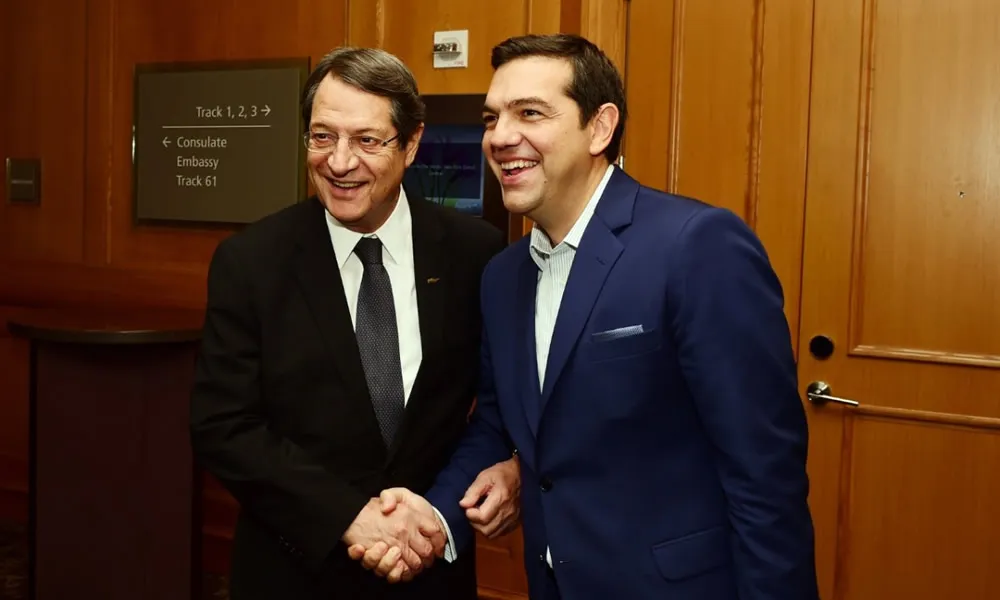
Former Greek Prime Minister Alexis Tsipras argues in his new book Ithaca, released on Monday, that Turkey made an opening on guarantees during the peace process that culminated in the final dinner at Crans-Montana, which former president Nicos Anastasiades failed to capitalise on.
In the chapter titled ‘Cyprus issue: A breath away from a solution’, Tsipras argues that the sides came closer than ever to a solution in those days, and that “a great opportunity was lost”.
The Greek and Greek Cypriot position throughout the talks was “the need for the immediate abolition of the anachronistic, post-colonial system of guarantees and the withdrawal of Turkish occupation troops from the island,” he said, adding that they firmly opposed a ‘sunset clause’ for the abolition of guarantees.
Geneva conference
Ahead of the Geneva Conference in January 2017, Tsipras and Anastasiades coordinated their negotiation strategy and red lines in Brussels. They agreed that, despite Turkish pressure for the meeting to convene at the prime ministers’ level, Tsipras would not participate in the negotiations “until it became clear that there was a realistic prospect of a positive conclusion”.
Tsipras said he waited for the right conditions to travel to Geneva but Turkey stuck to its guns on security and guarantees, possibly encouraged by the US which supported a solution but also accepted the idea of a ‘sunset clause’ on guarantees.
Yıldırım leaves small opening
The former Greek PM says that after talking to the heads of the UN and European Commission, he understood that he needed to assume a more active role in the process. He invited then Turkish Prime Minister Binali Yıldırım to Greece in June 2017. Although Yıldırım insisted on his country’s long-standing positions, he nevertheless “opened a window regarding an EU role in the future security framework of a federal Cyprus”.
Guterres Framework
Tsipras argues in the book that the tabling of the Guterres Framework by the UN Secretary-General on 30 June 2017 at Crans-Montana constituted an important success for the Greek and Greek Cypriot side and could have constituted the basis for a just and viable settlement.
“Particularly important was the Secretary-General’s statement that the Treaty of Guarantee is unsustainable and must be replaced by a monitoring framework on the solution agreement, based on the UN, in which Greece, Turkey and Britain could have a role,” he wrote.
‘Turkey positive then intransigent’
At this point, Tsipras walks a fine line, placing responsibility on Turkey for the collapse of the talks at the final dinner, while simultaneously pointing to Anastasiades for failing to capitalise on the Turkish side’s initial opening on guarantees before the dinner.
He said: “The intransigence of the Turkish side, however, in the final phase of the negotiations – namely, at the dinner of 6 July – to openly accept this framework as a basis for discussion left no room for my participation, nor for that of the Turkish Prime Minister, in the Conference, and effectively cancelled every prospect of a solution, ultimately leading the talks to failure.”
However, prior to that, former Turkish Foreign Minister Mevlut Çavuşoğlu had delivered a message to UNSG Antonio Guterres, that Turkey could, under certain conditions, discuss the abolition of guarantees. Tsipras argued this move “momentarily created positive expectations and great hopes”.
For that reason, just a few hours before the final dinner, Tsipras expressed his desire to travel to Crans-Montana, only to encounter Anastasiades’ reservations.
Anastasiades blocks Tsipras’ arrival
The former PM said, “in those critical hours with a positive glimmer in the negotiations”, Tsipras informed Anastasiades he wanted to travel to Switzerland, “as we had agreed I would do if there was a positive prospect”.
“However, he was extremely cautious. He believed it was a bluff by the Turkish side and did not share my, albeit very restrained, optimism. Perhaps he had also been affected by the course of the negotiations on the internal aspects, which, as he explained to me, were not going well and he was disappointed.”
Tsipras added: “In any case, his negative stance on the possibility of my travelling to Switzerland ultimately left no room for us to explore at the level of Prime Ministers whether the message the Turkish Foreign Minister conveyed privately to the UN Secretary-General regarding the abolition of guarantees had substance or was merely a Turkish negotiating bluff.”
“A few hours later, at the dinner of 6 July, Çavuşoğlu’s official stance was entirely different from what Guterres had conveyed to us. The Turkish side’s intransigence in discussing the timetable for the withdrawal of occupation troops and on openly accepting the abolition of guarantees as a basis for discussion ultimately led to the failure of the Conference,” Tsipras said.
“What history ultimately recorded is that in those days we came closer than ever before to resolving the Cyprus issue. The negative side is that a great opportunity was lost.”
Anastasiades: 'Vindicated'
In a written statement on Monday, Anastasiades noted that Tsipras’ references “regarding what happened in Crans-Montana speak for themselves. They are yet another refutation of those who for so long adopted the Turkish narrative.”
Kyprianou: No doubt who’s to blame
Speaking on Politis Radio 107.6 FM on Monday, former AKEL leader Andros Kyprianou said Tsipras spoke extensively with him on the evening of the final dinner at Crans-Montana, and shared “how Mr Anastasiades should have behaved, which was very different from the way he behaved”.
Kyprianou said he disagreed with Tsipras that the Conference ultimately collapsed because of Turkey’s intransigence.
The UN minutes of the Conference noted that Anastasiades had changed colour when Guterres told him Turkey was prepared to discuss the abolition of guarantor and intervention rights. His response was to suddenly demand the immediate withdrawal of Turkish troops, which he had previously described as ‘unrealistic’, said Kyprianou.
The former AKEL leader said logically speaking, if Anastasiades had approached Çavuşoğlu before the dinner, saying he cannot go all the way in the talks, but wanted to go win re-election, and then continue talks on a two-state solution, “how do you think Turkey would behave at the dinner?”
Kyprianou blamed Anastasiades for not allowing the chance for a serious discussion to take place to test how ready Turkey was to go all the way.
Five days after the collapse, Tufan Erhürman and Cemal Özyiğit asked to meet with Kyprianou, he told Politis, to convey the fact that then leader Mustafa Akıncı had met with Tayyip Erdoğan before Crans-Montana, during which the Turkish President expressed his readiness to discuss the abolition of guarantor and intervention rights at the Conference, as long as the sides could agree on a rotating presidency and political equality.