
Defence needs will not be such a headache of limited options for the National Guard in the new year, with SAFE and the US military equipment agreement opening up a wide ranging horizon of opportunities. This makes the planning much more flexible, adding items to choose from and taking the modernisation and supply of new means process to a whole different level.
Deterrence is now outlined and implemented on four National Guard axes and what's considered of significance is that none of these is dependent to or affected by any other. They are all implemented and utilised independently as defence pillars, aimed at covering all angles of protection to the greatest possible degree.
Through the annual national defence budget, the US military equipment supply programmes that Cyprus is now part of, SAFE and individual military agreements with a number of states, Nicosia now has the capability of medium and long term additions, as well as personnel training.
The importance of these independent axes is even greater, if one considers that right up to a few years ago, the only thing we had to go on, the fundamental pillar of the National Guard's military equipment supply chain were just the national budget funds, which could only cover the maintenance of existing systems.
'Cyprus participation in the SAFE programme means it can borrow up to 1.2 bilion euro for defence spending over the next few years at a low interest rate', defence minister Vasilis Palmas recently told POLITIS radio.
The Budget
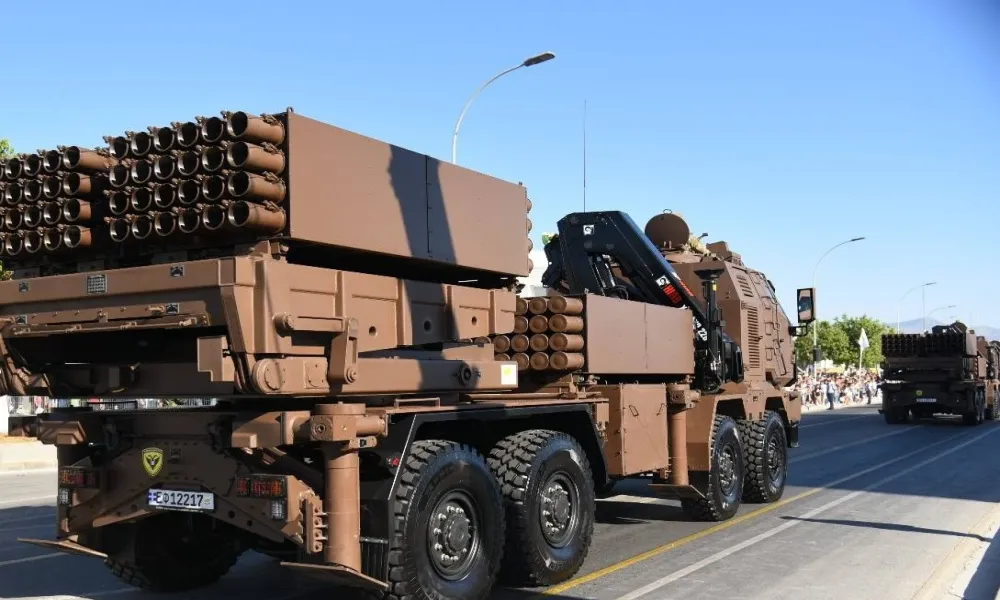
Defence spending budget allocated for 2026 comes up to around 177 million euro, slighly lower to last year, when it was closer to 180. The ministry's budget did see the purchase of major weapons system over the past few years, including the airbus H145M attack helicopters, the Barak MX air defence system, the Green Line monitoring system and the TAMNAVA multiple missile launcher. The next National Guard goal is to purchase new tanks, which will gradually replace the Russian T80s.
SAFE
Through Security Action for Europe regulation-SAFE-the new defence spending framework approved in May last year, the EU aims at boosting the readiness and defence capabilities of member-states. For Cyprus, this means further strengthening the National Guard.
The SAFE support package makes 150 billion euro available to participating countries under varying loan conditions. The terms are highly favourable and coupled with a long grace period, allowing member states to strengthen their armed forces, without burdening their national budgets.
The European Commission has approved 1.2 billion to support the defence and readiness of Cyprus. Nicosia submitted a list of immediate needs and priorities in late November and next year will see developments in the purchase of the military equipment requested. They include an anti-tank missile system, drones and an anti-drone system, tanks and open sea patrol boats. The Cyprus SAFE shopping list might also include a further six H145M attack helicopters.
Defence Agreements
Defence deals and military cooperation with other states also yield significant benefits. A network of cooperation has now been well established and keeps growing, carrying multiple positives for NG personnel too, mostly in experiences and know how.
Joint exercises for example, provide the possibility of participation in activities along with armed forces members from militarily advanced countries.
In coordination, Defence Ministry and National Guard have signed defence agreements with Egypt, Armenia, Austria, France, Germany, the UAE, the US, the UK, Israel, Italy, Jordan, Lebanon, The Netherlands and Serbia. Beyond these bilaterals, trilateral defence agreements are also in place between Egypt, Cyprus and Greece, Armenia Cyprus and Greece, Jordan Cyprus and Greece and Israel, Cyprus and Greece.
US Defence Programmes
2025 was a landmark year for US-Cyprus relations. Following the lifting of the long standing military equipment embargo, Washington additionally opened the door on three defence programmes, namely Foreign Military Sales, Excess Defence Articles and Title 10 Security Assistance Grant Programmes. Nicosia considers access to such programmes as the fruit of its foreign policy and a substantive outcome of the rapid US relations frowth over the past few years.
Now specifically on the FMS programme, Cypriot participation will allow for the purchase of military equipment, services and training, directly from the US government, sidelining private sector defence industries. Simply put, defence supply, government to government.
The Excess Defence Articles programme provides for the supply ofr surplus military equipment, used by American armed forces and then passed on to allied countries for the purpose of modernising their equipment. The US continuously produces military technology, so instead of destroying it, they make it available to countries participating in the programme, either for free or at very low cost.
The third programme in question strengthens the support of participating countries' capabilities through training and materials, mainly involving land and maritime protection as well as anti-terrorism.
Cyprus has already submitted its requests to the Americans on the military equipment needed.