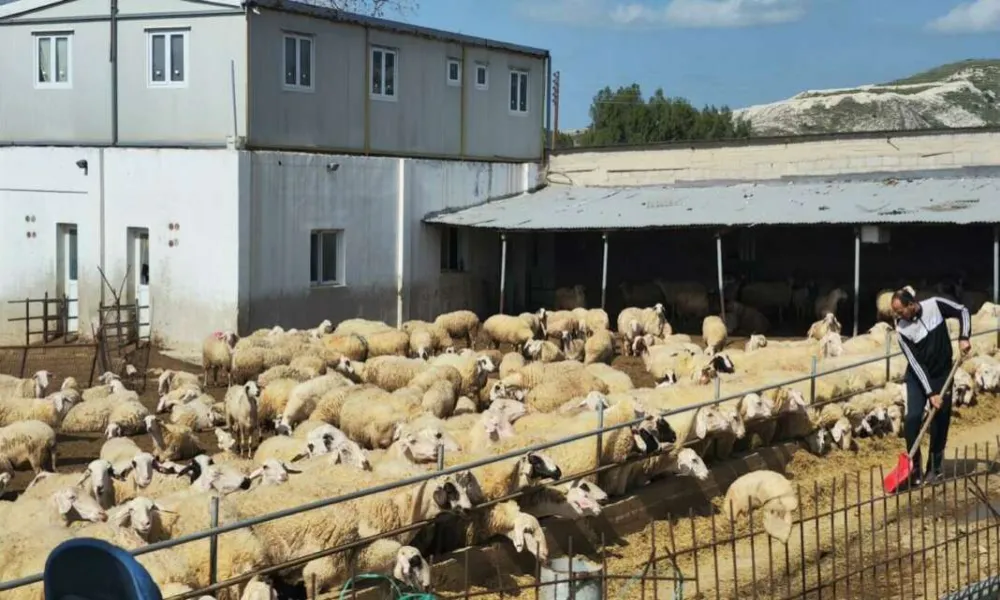
All agricultural organisations and groups of livestock producers are preparing to send a letter of protest, no later than today, Thursday, to the President of the Republic, Nikos Christodoulides, regarding the culling of animals by the Veterinary Services on farms where isolated cases of foot-and-mouth disease have been detected. They are requesting alternative management of the situation.
Referring to concerns about certain aspects of how the Veterinary Services are handling the issue, the General Secretary of the Panagrotikos organisation, Tasos Yapanis, told Politis that the organisations are preparing a letter of protest to the President of the Republic, which will also include specific proposals. He argued that it is inconceivable for an entire herd to be culled on a livestock farm because a single infected animal has been identified.
“Sheep and goats, just as was the case with humans during the coronavirus period (7–10 days), not only recover after 21 days but also develop antibodies,” he said. He noted that so far livestock farms have been recorded for which the Veterinary Services are proceeding with the complete culling of animals because one or two positive cases were detected.
“Mandatory culling”
Following protests by livestock farmers on Tuesday in the Livadia area regarding the same issue, the Veterinary Services stated in an announcement that the culling of all animals in a livestock unit where a positive case of foot-and-mouth disease is detected is mandatory and that no deviation from this measure is permitted.
They emphasised that with the identification of the first cases, the Emergency Plan for Category A diseases in terrestrial animals was activated and that all procedures provided for are being fully implemented, including the obligation to cull the entire herd of the affected holding. This obligation, it was noted, arises from European Union law.
The Veterinary Services added that the actions are being implemented within the framework of an integrated operational plan, with scientific guidance and in coordination with the European Union, based on the European and national regulatory framework. According to the announcement, since 15 December, briefings had been held with agricultural organisations and livestock farmers’ organisations through both letters and meetings regarding the measures for managing the disease. Following the detection of cases in disease-free areas, farmers were again informed about biosecurity measures.
Farmers reject €140–€150 compensation per animal
A second issue raised by the organisations concerns a proposal submitted by the Ministry of Agriculture to the Council of Ministers regarding compensation, without prior consultation with agricultural organisations on the level of payments, despite assurances they had received, according to Mr Yapanis, in Parliament from the Director General of the Ministry of Agriculture, Andreas Grigoriou.
The proposal was expected to be submitted to the Council of Ministers on Wednesday afternoon. Specifically regarding compensation for livestock, Mr Yapanis said that the amounts currently being discussed, €140 to €150 per animal, cannot be accepted. He added that in 2007, during the outbreak in Dromolaxia, compensation exceeded €300 per animal.
According to Mr Yapanis, when organisations requested that the state purchase these animals, as producers themselves are unable to do so, they were told that the state could not take into account the real value of the animals because then all livestock farmers would deliberately infect their animals in order to receive compensation. He described such statements as unacceptable.
Vaccination within the 10 km surveillance zone
At the same time, vaccinations of sheep and goats continue within the critical surveillance zone, with a further 9,800 vaccine doses distributed to private veterinarians by Tuesday evening.
So far, approximately 135,000 vaccine doses have been distributed, of which 35,950 have been used for vaccinations of cattle within a radius of 3 and 10 kilometres. The remaining 99,050 doses were initially used for sheep and goats within a two-kilometre radius around pig farms, and subsequently for all sheep and goats within the critical 3 and 10 kilometre zone. The process is expected to be completed within the week, said senior Veterinary Services official Sotiria Georgiadou on Wednesday.
Concern over rebuilding the sector
Later, speaking to Alpha television, Ms Georgiadou conveyed the concern and strong apprehension of the Veterinary Services about how the primary sector will be rebuilt after the culling of animals that contributed to the production of PDO halloumi.
“It is a very major concern. Meetings have taken place, livestock farmers have been invited, we have received views, and others who still have their animals have also been invited so that we can see how they can help,” she said.
The importation of animals and other measures that could be implemented are also under consideration, she added.