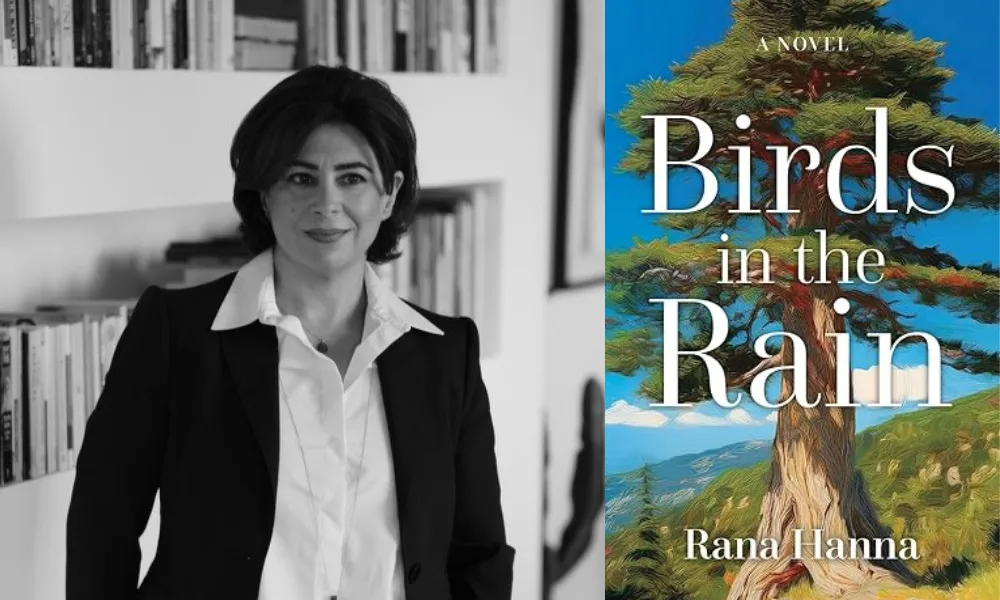

Rana Hanna, a Lebanese author, educational consultant, and writing coach, has long observed her homeland from a distance. Living in Cyprus for several years, she experienced the unique perspective of watching Lebanon while being apart, witnessing both its beauty and its struggles through the lens of separation. This distance gave her a sharper awareness of the country’s complexities, its ongoing challenges, and the ways in which memory and history shape the lives of those who live there and those who have left.
Her professional and creative experiences intertwine seamlessly. In her work as an educational and admissions consultant, and as an effective writing coach, she applies insight and empathy to guide students and writers alike, encouraging clarity, discipline, and reflection. These experiences have enriched her storytelling, allowing her to explore identity, memory, and resilience through the lens of personal and collective histories.
Inspiration needs discipline
In Birds in the Rain, Hanna portrays characters navigating spaces between two worlds, between departure and return, and between vulnerability and strength. The novel was inspired by a profoundly personal moment in her life: her eldest son preparing to leave for university abroad. Hanna reflects, "As a parent, we live with this fear that something should happen to our children, and we live with the fear of letting go of our children and them being able to survive on their own. I believe the book is a meditation on could I live without my children."
The writing process for Hanna combined discipline, intuition, and a recognition of serendipity. "I used to think that inspiration waits for you. And what I learned is that actually it’s a combination of three things. There are days when I wake up with a fully formed idea or the text literally just cruises in. But most days I had to walk into my office, close the door and force myself to stay put until I’ve written 500 or 1000 words." She cites W. Somerset Maugham: "I only write when inspiration strikes. Luckily, it strikes every morning at 9am." Hanna emphasizes that writing is a disciplined practice, yet also requires moments of stepping away. "Nothing cures writing block quite like a walk. When I would get stuck, I would literally just get out and walk, and more often than not, the answer would come."
Serendipity, Hanna adds, is a vital part of the creative process. "You’re in conversation with somebody, and they tell you about a book, and that book has one piece of information that is exactly what you need, or you come across a quote, a piece of art or music that embodies the exact idea that you are trying to convey."
Chance encounters, observations, and small discoveries often guide her writing, allowing ideas to emerge organically while remaining grounded in lived experience. This openness to unexpected inspiration gives her work a layered depth, where ordinary moments can spark profound narrative insights.
Writing amid conflict
The novel is set against the backdrop of the 2006 war in Lebanon, although Hanna notes that writing about the conflict was not a conscious decision. "I don’t think I chose to write about the 2006 war. I had to." Writing about conflict intertwined personal history and national trauma, helping her process memories of Lebanon and the repeated waves of war. She recalls the urgency of protecting her young children during the outbreak of the 2006 war: "When the conflict broke out, I already had two of my boys, and my third was only two months old. Since my husband is Cypriot, the embassy was calling us every day telling us to get on the next boat out. It revived in me the memory of when we had to take boats during the civil war—I’d been on a boat twice during that time—and I think part of me was thinking: I am not reliving this again. I always need time to process things, and I think for me it took a while to process the trauma of that war, which was actually the trauma of the war before it."
The title, Birds in the Rain, captures the fragility and resilience of Hanna’s characters. She explains, "There’s a scene in the book where young Michael goes camping with his grandfather and it rains very hard all night, and Michael finds himself worrying in his tent about the birds and where they are sheltering. So he is worried about the vulnerability of these birds, about them being in danger. He is worried about these birds being hurt and killed by events that they cannot control".
"And in many ways, all the characters in this book are themselves birds in the rain. They are vulnerable to the elements, and they have to be strong and resilient to survive the storm."
Characters as ensemble
Hanna approaches her characters as an ensemble rather than favoring one protagonist. "I don’t think I have a favourite character because for me, they are one character in four pieces, they complement each other. So when you put them all together, they become one person, one being. As writers, without noticing, we infuse characters with traits that we have, or that we aspire to have, or admire in other people." Layla’s story, including her experiences in London, her motherhood, and her moments of grief, draws partly from Hanna’s own history and observations. "Luckily, I didn’t have any of my children disappearing during the war, but I obviously experienced the war. I also experienced the previous war. Layla’s experience in boarding school is very real. Coming back after the Civil War as well. I think a lot in there is inspired, if not necessarily by events happening to me, then by events happening to people around me. I’ve noticed recently that our stories do not only mirror our traumas, but the traumas of the people close to us."
War
The novel also explores the lingering effects of conflict beyond physical destruction. Hanna reflects, "It is such a collective trauma that we don’t talk about enough, and I think we need to be talking about it more and more and more to try to come to these answers." Through her characters, she portrays how war persists in memory, relationships, and the rhythms of daily life, illustrating the subtle and enduring traces of trauma. Her reflections reveal a deep engagement with the psychological and emotional dimensions of conflict, showing how the personal and political are intertwined.
A central theme of the novel is duality, the tension between opposing states of being. Hanna explains, "I think part of being Lebanese is always living between two places. Especially the diaspora, who are living in their country but still live in Lebanon. It is a country that you can leave, but the country doesn’t leave you. Those in the country are always thinking of leaving, and those living abroad are always thinking of returning." She describes this liminal space as central to her creative work, a place where two dots are connected and where writers live, reflecting both internal and external journeys. It is in this space between worlds that Hanna locates much of her literary exploration, capturing the complexity of memory, belonging, and identity.
Through adversity
Ultimately, Hanna hopes her readers take away a sense of growth and possibility through adversity. "At the end of the day, we create through adversity, and when things are not going the way we want them to go, or we are hoping for them to go, there is always a silver lining to these events, because there is always room to learn and grow from the difficult situations we go through." This message of resilience resonates through both her narrative and her broader approach to life and creativity, offering readers insight and inspiration.
Looking ahead, Hanna is actively working on multiple projects, including a TV series and two novels, continuing to explore themes of place, self-realization, love of country, and separation. She notes that while these stories involve similar ideas, they are very different in structure and character, reflecting her ongoing engagement with the complexities of memory, identity, and resilience. Her work continues to bridge personal experience, historical reflection, and imaginative storytelling, making her debut at Artos House a highly anticipated event for readers and literary enthusiasts alike.
Rana Hanna will sign your book at Artos House in Nicosia on 19 November at 18:30.