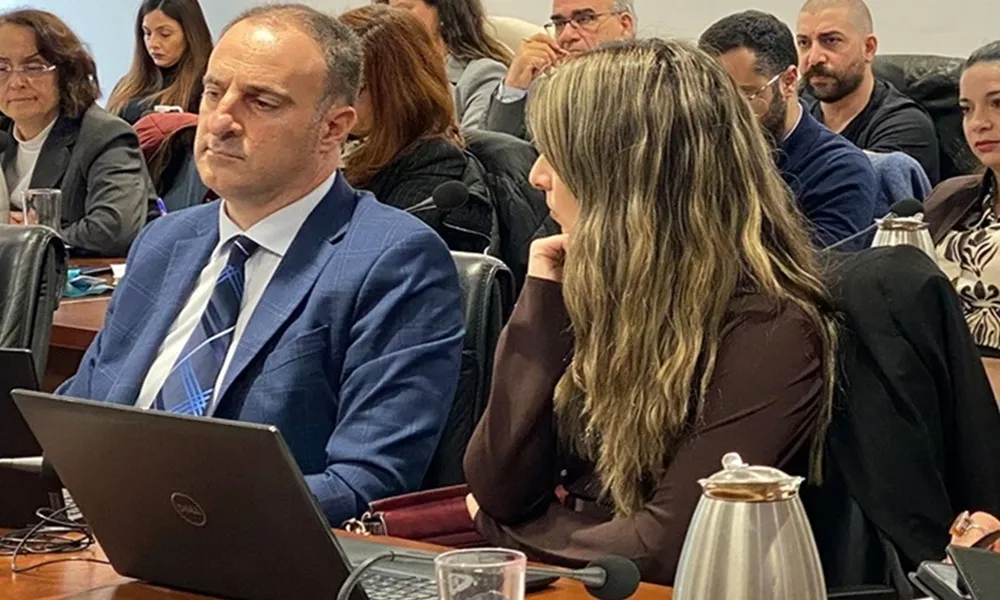

The Independent Social Support Body, widely referred to as the First Lady’s Fund, has been at the centre of political fallout after the so-called Videogate affair. Republic of Cyprus State Accountant Andreas Antoniades, who serves as the fund’s treasurer under the relevant law, attended parliament’s Institutions and Audit committees in recent days, answering questions on governance, funding and oversight. In this interview with Politis, he addresses why donation amounts were not submitted to parliament, how the fund operates, how donations are checked and why the management committee now supports abolishing the body.
Why did you not submit to parliament a named list showing the amounts donated to the Independent Social Support Body, as MPs are requesting? What prevents full publication of names and amounts, given the strong public demand for transparency?
First, I should clarify that I was not asked for the amounts of donations by the chair of the parliamentary Institutions Committee, but for a list of donors by year for the period 2020 to 2025. I have also never refused to submit those details. However, I considered it appropriate to seek a legal opinion from the Law Office on whether to comply and how to comply with parliament’s request, and also to consult the Commissioner for Personal Data Protection for her input.
That is precisely what the public interest requires. Citizens, not MPs providing personal guarantees, would ultimately be the ones paying any compensation to donors that could arise from a breach of the relevant legislation.
Has the Law Office provided guidance on what can be published? What is the legal basis for not publishing names and amounts?
The Commissioner for Personal Data Protection has already expressed her view on the matter, essentially setting certain conditions for disclosure, while the Law Office needs a little more time to prepare its own opinion. The legal basis will be the EU Charter of Fundamental Rights, the Constitution, the General Data Protection Regulation, the 2025 decision of the Supreme Constitutional Court and other case law.
Is a list of donor company logos, without amounts, enough for transparency and for strengthening public trust? How do you respond to criticism that this does not allow citizens to know what was actually given and by whom?
I would like to point out that several steps have been taken in recent years to improve the fund’s governance, including strengthening transparency. Transparency, however, does not mean full information, since the consequences of publishing any data must also be assessed.
As beneficial as publishing donors and donation amounts may be, doing so without prior authorisation for that specific purpose carries legal risks. The Supreme Constitutional Court ruled in 2024 that including donors’ logos in the fund’s annual report, after obtaining their consent, is sufficient, taking into account the principles of necessity and proportionality.
Why would a donor not want their name and the amount of their contribution to be published?
Donor profiles are not limited to one type. I can describe three. First are donors who publicise their donations as part of corporate social responsibility. Second are donors who are neutral and, if asked, have no issue giving consent for their name to be published on the donor list. Third are donors who do not want their donation published, due to modesty, privacy or for their own safety.
I should also note that some donors make a donation, usually small amounts, with or without publication, to feel close to decision-making centres. That does not mean they influence decisions.
Are cash donations paid into the fund?
Under no circumstances.
Is there a cap on how much any donor, individual or company, can contribute?
The legislative and regulatory framework does not define such a cap. It is for the executive and the legislature to introduce such regulation if they wish. In any case, any change in that direction would need to be assessed in light of the existing criteria for student support, because any reduction in donations would make it impossible to implement the policy of supporting students in need.
This is because any financial support of the fund from the Republic’s Consolidated Fund is prohibited, meaning the fund cannot be topped up through the state budget.
The fund accepts donations without prior approval from the finance minister. Should the ministry’s prior approval be required?
The Independent Social Support Body was established by law and operates as a special fund, a legal entity with perpetual succession. It is therefore not a state economic entity and is not included in the state budget. As a result, prior approval by the finance minister is not a prerequisite for accepting donations. It is for the executive and legislature to set terms and criteria for accepting donations if they wish.
Does the fund prepare an annual budget approved by the finance minister, cabinet and parliament?
The relevant legislation does not provide for the preparation and submission of a budget for the fund. Instead, there is an obligation for an annual report, which is presented publicly before applications open for the next academic year.
The absence of a budget provision is linked to the fact that the fund’s revenues come exclusively from donations, contributions or other lawful sources, and any financing from the Republic’s Consolidated Fund is prohibited. The fund generally has no operating costs, aside from the cost of a private auditor, as set by the Audit Office, and possible public information campaign expenses, which arose in 2025.
Therefore, and in compliance with a recommendation by the Auditor General, from 2026 a budget will be prepared and submitted to the finance minister.
Are there donors who do business with the state, or expect to do so? Is conflict of interest examined?
The legislative and regulatory framework does not define such a provision.
Is the origin of the money donated to the fund checked? Who checks it, and what kind of checks are carried out?
The fund accepts donations made by bank transfer or via JCC Smart to its bank account at the Central Bank of Cyprus. The Central Bank’s procedures for accepting receipts are governed by anti-money laundering mechanisms, based on cooperation with all financial institutions in the EU.
Taking into account both the procedures for opening bank accounts for legal and natural persons and the procedures for processing bank transactions, which are governed by EU rules, the conditions for not accepting donations from entities involved in money laundering apply to all donations.
Have you ever refused a donation because the money did not appear clean, particularly large amounts?
We have returned a “suspicious” donation, without wanting to go into further detail. The amount was small.
Why did donations to the fund rise so sharply over the last three years, a period that coincided with a change of government?
I do not wish to link the fund’s trajectory to a change of government, but rather to the change in the composition of the Management Committee. That matters because strengthening governance, control and transparency mechanisms is due not to the government, but to the committee’s leadership and the sustained efforts of the civil servants who provide their services, often in the evenings and on weekends.
I also cannot avoid mentioning the significant role of the First Lady, as a person with the qualities of standing and integrity described in the relevant legislation, as well as the social responsibility shown by prominent donors from the shipping community connected to Cyprus.
How much support does each eligible student receive per year? Is it €1,000, €1,200? Can a student with serious financial hardship manage with €100 to €150 a month?
The assistance provided is not charity, it is supplementary support to help students in genuine need complete their studies. Every child has a right to education and the fund operates within that framework.
The Management Committee, applying equal treatment, has set fixed amounts to minimise discretion. Specifically, first-year student, €2,000, recipient of other student grant support, €1,500, beneficiary under the category for extraordinary circumstances, €2,000. In cases where socio-economic conditions are so serious that further support is needed, an additional €500.
What are the criteria for eligibility? Is it only top students, or also those who are not? Some have hinted at political or party criteria.
The criteria are published on the fund’s website, socialsupport.gov.cy, and were set on the basis of objectivity, equal and fair treatment and transparency. They are not linked to academic excellence, but to socio-economic conditions that place families in hardship.
A key element is the establishment of a subcommittee of civil servants to assess applications. In this way, the final recommendation to the Management Committee is submitted without any personal details of applicants, eliminating the possibility of influence or bias.
Given how things have developed, do you support abolishing the fund, possibly moving the money elsewhere?
I want my position, expressed at three different times, to be recorded, because circumstances matter.
In 2024, before the Institutions Committee, I said that making publication of donors’ names and donation amounts mandatory would lead to financial contraction of the fund, affecting its mission as it has evolved.
In November 2025, given the Supreme Constitutional Court’s relevant decision, I agreed with the Auditor General’s recommendation and with adopting a policy under which donations from natural or legal persons exceeding €20,000 per year would be accepted only if the donor consents to publication of their name and the total annual amount, as part of the annual report.
Today, and this is also the position of the Management Committee, we support abolishing the body and transferring it, without changing the support criteria, to the Grants and Benefits Service of the Ministry of Finance. That is because that service has specialised resources for assessing applications, creates synergies with student support policies served by both bodies, including IT systems.
However, not before the assessment process for 1,800 applications for the current academic year is completed, and also without transferring the fund’s reserve of about €1 million to the Republic’s Consolidated Fund without restrictions. Finally, the donation acceptance procedure for this purpose could follow the existing process requiring approval by the finance minister.
What did you take away from the Videogate affair?
Without linking it at all to the fund’s operation, a general comment is that it confirms that, unfortunately, our culture still cultivates the idea that the most effective and efficient way to achieve a goal is through an indirect route.
This would improve if we adopted structured, simplified procedures for each category of cases, including foreign investment, with clear roles, accountability, audit mechanisms and transparency. I believe the best way to meet a need should be the direct and lawful way.
How much money has been collected in the government account for those affected by the 2025 wildfire in semi-mountainous Limassol, and how will it be used?
Up to 23 January 2026, contributions of €1.7 million have been made by organised groups and citizens into the special government account for those affected by the wildfire. The amounts are announced publicly at regular intervals for public information.
The Treasury will present an analysis of these contributions, along with information on how they will be allocated, after the government announces the relevant decisions.

This article was first published in Politi's Sunday paper