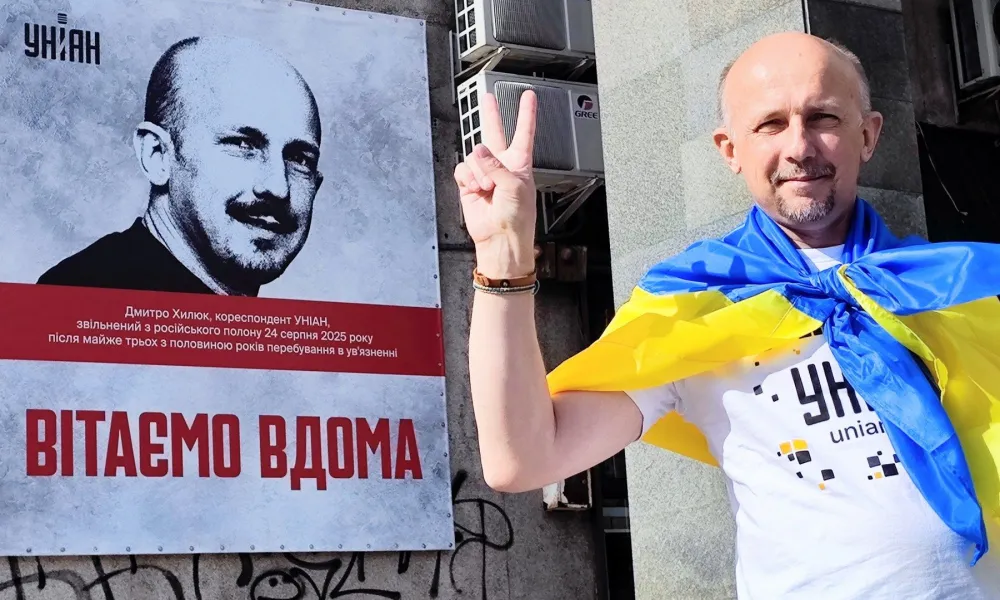

Ukrainian journalist Dmytro Khyliuk has spent nearly two decades reporting on courts, prosecutors, and anti-corruption reforms, but nothing in his career prepared him for the ordeal of being captured during the Russian invasion of Ukraine. Detained alongside his elderly father in March 2022, he spent over a year in harsh Russian prisons, enduring hunger, cold, and psychological pressure while cut off from the outside world.
Now released, Khyliuk continues his work covering judicial and law enforcement topics, but the war has reshaped every aspect of his reporting. He bears witness to the deliberate hostility Ukrainians face in captivity, the failure of even ethnic Russians to receive preferential treatment, and the deliberate propagation of myths that Ukrainians and Russians are “one people.”
In this interview, Khyliuk speaks about the reality of Russian prisons, the existential stakes of the war, and the role of journalism in countering disinformation. He explains why Ukraine’s struggle goes far beyond territory and why the fight is ultimately about survival, sovereignty, and the right of a nation to exist.
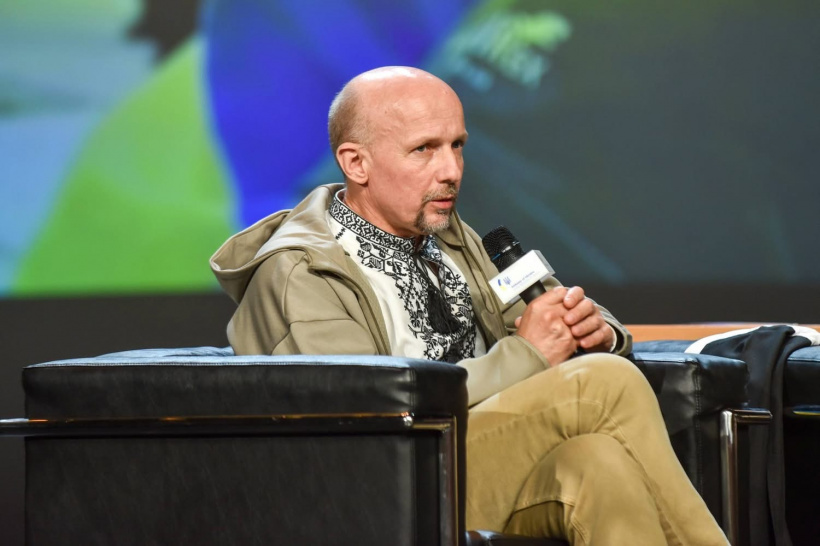
Ukrainians and Russians are one nation and exposing the reality of war and captivity.
Could you tell us how you were captured, what you felt at that moment, and about your work as a journalist?
I have been working in Kyiv for the Ukrainian news agency UNIAN since late 2013, and I have been a journalist since 2005. My focus has been the judicial system, covering courts, prosecutors’ offices, the police, and trials. I also report on election processes when they take place. My work has always been closely connected to law enforcement and legal matters.
I was captured on the eighth day of the full-scale Russian invasion, on 3 March 2022. I live about 30 kilometres from Kyiv, in a small village. By the second day of the war, I could no longer go to work because Russian forces had occupied our area. On 3 March, my father and I were returning from our neighbours’ house when soldiers confronted us. They pointed guns at us, forced us to lie on the ground, searched us, and took our personal belongings. Without explanation, they detained us and held us in a local building for three days. That was the beginning of my captivity.
Can you describe the conditions during your captivity?
There were no humane conditions. Ukrainian prisoners had no rights, and the experience was extremely harsh. The hardest aspects were constant hunger, cold, lack of information, and both physical and psychological pressure. We were cut off from the world, unaware of our family’s situation, and uncertain about our own fate. This uncertainty, combined with deprivation, created enormous psychological stress.
Where were you imprisoned in Russia?
I was held in two locations. First, I spent more than a year in Novozybkov, Bryansk region, near the Ukrainian border. Later, I was transferred to Vladimir region, about 200 kilometres east of Moscow, in the village of Pakino, where I remained until my release.
Were you captured alone or with your family?
I was detained with my father, who was 74 at the time. After nine days, he and several elderly men were released. The rest of us, around 20 men from our village and nearby areas, remained in captivity.
Many Ukrainians have relatives in Russia, and vice versa. Are ties between the two peoples not close?
Not at all. Russians do not treat Ukrainians as their own. They hate us because we are Ukrainian. Prisoners with relatives in Russia received no special treatment. One of my neighbours asked authorities to inform his brother in Russia that he was imprisoned, hoping for help, but these requests were ignored. Even prisoners who identified as ethnic Russian or declared a desire to obtain Russian citizenship were treated harshly. Ukrainians and Russians are not considered one people. Hostility towards Ukrainians is deliberate and systematic.
What are you covering now after your release?
I continue with the same specialisation, but the war has changed everything. My primary focus was Ukraine’s judicial system, including courts, the prosecutor’s office, and police work. With Ukraine’s European integration process, our legislation underwent significant reforms, particularly in anti-corruption. Several new institutions were created: the High Anti-Corruption Court, the Specialized Anti-Corruption Prosecutor's Office, and the National Anti-Corruption Bureau. I reported on investigations, high-profile trials, and reforms. My work was legal and political rather than military. But now, every journalist in Ukraine now deals with war-related issues. I still focus on judicial and law enforcement topics, but the war is unavoidable in every report.
How has the war changed your understanding of journalism?
Journalism provides access to people, information, and even countries. But the core responsibility is to tell the truth. Especially now, it is about explaining what Russia really is. Many people outside Ukraine still believe Ukrainians and Russians are one nation. Russia promotes this idea, claiming the problem is a bad regime in Kyiv, but the reality of the war and the treatment of prisoners shows otherwise. My work aims to challenge this myth.
How difficult is it for journalists to work amid Russian disinformation?
In Ukraine, Russian propaganda has limited effect because people experience the war directly. Internationally, disinformation is more effective. For decades, Russia invested in propaganda, creating a distorted image of Ukraine. Many people abroad saw Ukraine as a small country near Russia and did not understand the war’s causes. Countering this requires consistent information work and personal testimonies. The war is existential, it is about whether Ukraine can survive as a nation.
Could you give an example of explaining the war to outsiders?
Two months ago, a journalist in Israel compared the situation to if Turkey claimed all former Ottoman lands, including Israel, and attempted to eliminate Israeli statehood. This analogy resonated because it shows that the war is not about territory alone; it is about existence, institutions, and sovereignty. This is exactly what Ukrainians understand clearly.
What was the most important interview you conducted during the war?
I resumed work in November 2025 after returning from captivity six months earlier. At this stage, simply being able to work as a journalist again is the most important.
How do you see the end of the war?
A quick end is only possible under two scenarios. First, if Vladimir Putin dies, responsibility for the war might be blamed solely on him, possibly giving Ukraine a temporary pause from further aggression. Second, internal turmoil in Russia could force the state to focus on survival rather than war. These are the only realistic options for a rapid conclusion.
Is a peace deal possible?
Real compromise is possible in traditional territorial disputes, such as historical colonial wars where borders were negotiated. But in this case, Russia’s goal is the elimination of Ukraine as a state. Even if Ukraine ceded territory, future demands would follow. The only conceivable compromise would be a full Russian withdrawal without reparations, allowing Ukraine to rebuild with its partners.
Do you have a message for European readers?
Do not believe Russian narratives. Russia lies about the war, Ukraine, and itself. This is an aggressive state shaped by a long imperial tradition. Its history shows a pattern: it expands and dominates, bringing destruction rather than progress. Europe must understand that this war concerns principles of sovereignty and national existence. Ukrainians are fighting not only for their country but for these principles.
What is a Russian invasion?
Historically, conquerors brought development, but Russia brings only destruction. When Russian influence grows economically, it eventually seeks political control, which can destabilise countries, including Cyprus. Money flows and investments grow, but over time influence leads to domination. This pattern is dangerous and has long-term consequences.
What does this war mean for Ukraine’s identity and future?
This war is about Ukraine’s right to exist as a sovereign state with its language, institutions, and culture. It is not temporary or accidental. The roots of Ukraine’s struggle go back centuries, far before modern independence. Russia sees Ukraine as a former colony that must remain under its influence. Ukrainians are fighting to break free from imperial domination and assert their right to self-determination.
How has captivity affected your perspective as a journalist and citizen?
Being imprisoned revealed the depth of Russian hostility towards Ukrainians. Even those willing to align with Russia received no preferential treatment. Experiencing this first-hand strengthened my commitment to reporting the truth about the war, Russia’s intentions, and Ukraine’s reality.
What should people abroad understand about the war that they might not see?
They should understand that the war is not only about borders. It is about whether Ukraine will exist as a nation. Russia’s actions are deliberate and aimed at eliminating Ukrainian identity. Misunderstanding this can lead to false assumptions about compromise or negotiations. The struggle is existential.
What should readers take away from your story?
Ukrainians are fighting not only for themselves but for the principle that nations have the right to exist. Russia is a threat to these principles wherever it gains influence. European countries and the international community must see the war clearly, resist Russian disinformation, and support Ukraine’s fight for survival.