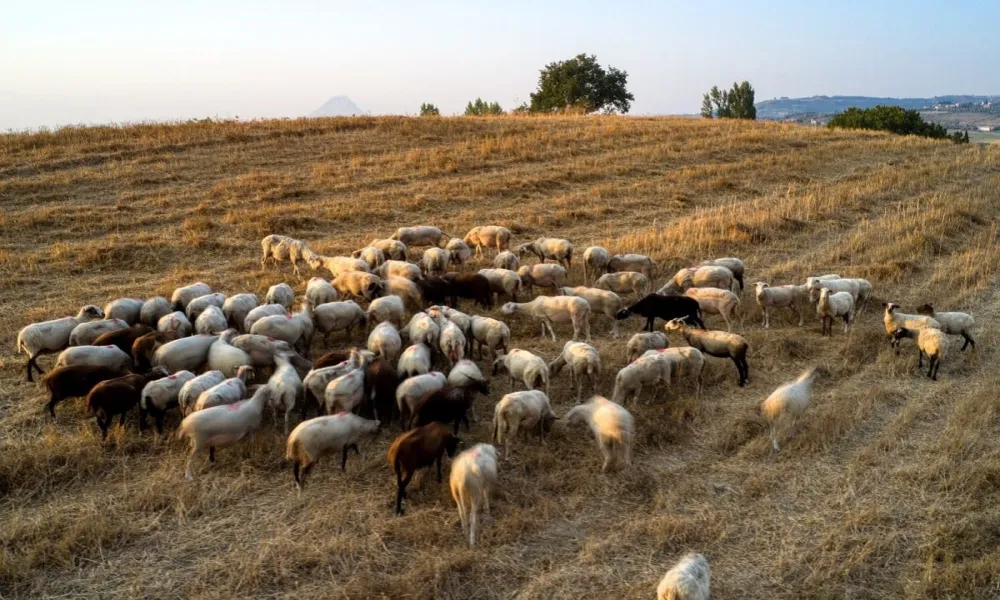
A new case of foot-and-mouth disease has been confirmed, bringing the total number of infected units to 105, as authorities weigh critical decisions on whether to cull animals belonging to rare Cypriot breeds.
According to Veterinary Services, the affected units include 13 cattle farms, 89 sheep and goat farms, and three pig farms across the districts of Larnaca and Nicosia. The latest case concerns a small sheep and goat unit in Dromolaxia.
Senior veterinary officer Sotiria Georgiadou said infected animals represent around 8.1 per cent of the adult sheep and goat population, 2.8 per cent of adult cattle, and approximately 7 per cent of pigs.
Virus shows signs of slowing
To date, approximately 38,900 sheep and goats, 2,247 cattle and 16,500 pigs have been culled. Culling operations at a third pig unit are ongoing and expected to conclude by 1 May.
Georgiadou said sampling continues across all units in affected areas, adding that more cases are expected but likely limited in number.
“The virus has begun to subside and the vaccine is starting to work,” she said.
Vaccination coverage has exceeded 75 per cent in cattle and 62 per cent in sheep and goats. In pig farms, the first round of vaccinations has been completed in all affected zones, with the second phase now beginning. Authorities have not ruled out a nationwide vaccination programme for pigs.
Decisions pending on rare breeds
A key issue remains the fate of animals belonging to rare indigenous breeds, including fat-tailed sheep and red cattle.
In Dromolaxia, a farm housing around 350 fat-tailed sheep, representing nearly half of the breed’s total population in Cyprus, has tested positive. The breed accounts for just 0.44 per cent of the island’s sheep population and faces a significant risk of extinction.
The farm owner has appealed to the President, Veterinary Services and the Ministry of Agriculture for an exemption from culling, citing the breed’s rarity and cultural importance. The total population of the breed stands at approximately 1,100 animals, with around 500 on the affected farm.
A separate case concerns a unit with around 33 red cattle, another rare local breed that has also tested positive.
Georgiadou said any decision to deviate from standard culling procedures would be based on legislation, scientific documentation of breed purity, and consultation with the Department of Agriculture.
Authorities will also consider the proportion of these animals within the total population of local breeds, as well as the risks and benefits of preserving them.
“It is possible that only the infected animals will be culled, but it is also possible that all will be culled. Nothing is ruled out,” she said, expressing hope that a decision will be taken within the week.
Halloumi production under review
On the issue of halloumi production quotas, Georgiadou said no immediate changes are expected despite concerns over reduced milk supply.
However, she acknowledged that continued outbreaks could force adjustments, noting that discussions are already taking place as a precaution.
Farmer reactions and support measures
Authorities also addressed growing tensions among farmers, following reports of extreme reactions amid the crisis.
Georgiadou described the situation as difficult for both veterinary services and livestock owners, noting that many are facing the loss of their livelihoods.
“It is understandable that there will be strong reactions. Their future is at stake,” she said, adding that support is being provided at psychological, financial and advisory levels.
Compensation payments have already begun in part, covering feed, milk and other preliminary costs. Full compensation for livestock will follow once final numbers are confirmed.
President calls for compliance
President Nikos Christodoulides is set to hold an internal meeting on the outbreak, while reiterating the importance of strict adherence to protocols.
“The reason we still face these problems is because some are not following the protocols,” he said, warning that non-compliance risks prolonging the crisis.
He reaffirmed the government’s financial support for farmers and called for cooperation across all sectors to contain the outbreak.