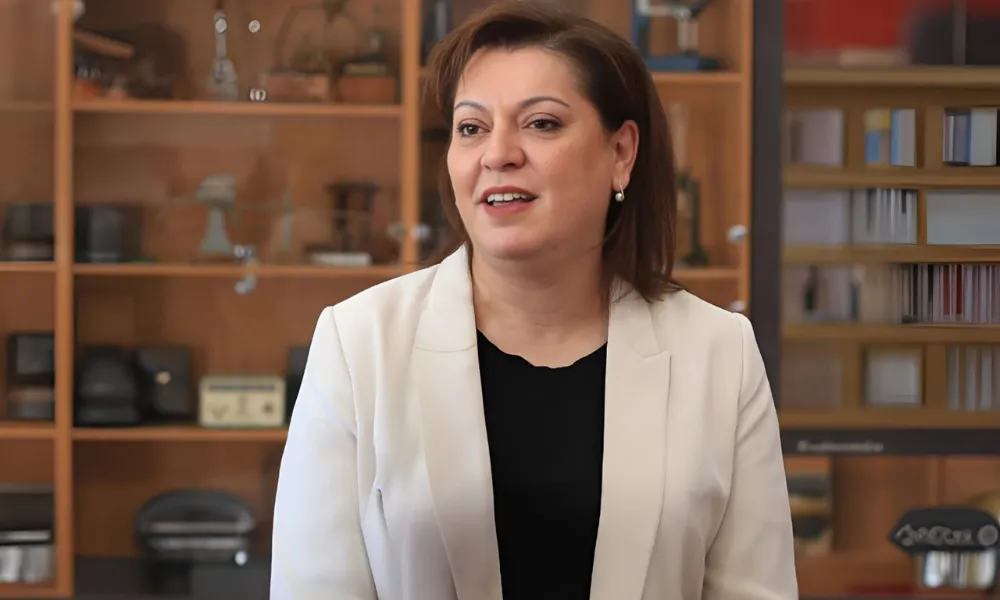
Cyprus’ education system is being reshaped by demographic, social and linguistic changes, with growing pressure on schools to adapt to an increasingly diverse student population, Education Minister Athena Michaelidou has said.
In an interview to Politis, the minister highlighted the need for public education to respond to rising demand for English-language schooling, the integration of children with migrant backgrounds and the teaching of Greek as a second language, while maintaining a balance between internationalisation and Greek-language education.
Rising demand for English-language schools
Private English-language secondary schools in Cyprus have traditionally followed the British system, preparing students for A-Level examinations. However, in recent years there has been a shift, with new and existing schools increasingly adopting the International Baccalaureate (IB) programme.
The trend varies by region. Student numbers remain relatively stable in Nicosia, while Larnaca has seen moderate increases. More significant growth has been recorded in Limassol and Paphos, where demand for English-language education is rising sharply.
The minister linked this increase primarily to the arrival of foreign families from countries including Russia, Ukraine, Israel and China, for whom English-language education is often the most practical option. By contrast, demand from Cypriot families remains broadly stable.
Public sector exploring bilingual options
Michaelidou said the government is examining the potential introduction of English-language or bilingual programmes within public schools, reflecting broader European trends towards multilingual education.
While English is already a core part of the national curriculum, any expansion of English-medium teaching would require careful planning, pedagogical evaluation and consultation with the education community.
Maintaining a Greek and European educational identity
The minister stressed that Cyprus’ education system retains a strong Greek linguistic and cultural foundation, alongside its European orientation as an EU member state.
She described this as a complementary relationship rather than a contradiction, with the system aiming to provide a humanistic, student-centred education that prepares future citizens.
One in four primary pupils from migrant backgrounds
Figures provided by the ministry show that during the 2025–2026 school year, 23% of primary school pupils — 11,778 out of 50,932 — have a migrant background. Excluding students from Greece, nearly 20% do not have Greek as their first language.
Of these, around 5,500 pupils participate in support programmes for learning Greek as a second language.
At secondary level, 19.3% of students — more than 8,100 out of 42,000 — have a migrant background, while participation in Greek-language support programmes remains significantly lower.
Structured language support and assessment
Students are assessed before entering language support programmes, with those below B1 level enrolled in targeted instruction for up to two years.
In primary education, pupils are evaluated using standardised tests and follow a progression from beginner (A1) to intermediate levels. Similar staged assessments apply in secondary education.
Additional diagnostic tools are used to assess students’ knowledge in subjects such as mathematics and science, with materials available in multiple languages.
Integration based on age, with targeted support
Students are placed in classes according to their age, in line with legislation, but receive additional language support where needed.
In primary schools, pupils may spend up to two periods per day in specialised Greek-language instruction. Schools with large numbers of migrant-background students may also receive additional teaching staff.
Across the system, more than 500 primary-level support classes and 84 transitional classes in secondary education are currently in operation.
Teacher training and support networks
Teachers delivering Greek as a second language are required to have relevant training, experience or postgraduate qualifications. According to ministry data, 64% of primary-level teachers involved in such programmes already have prior experience.
In secondary education, Greek language teaching is delivered by philologists who receive ongoing professional development.
Support networks coordinated by the Pedagogical Institute include more than 500 teachers participating in online learning platforms.
Monitoring progress and improving outcomes
Student progress is monitored through continuous assessment, with the aim of enabling pupils to reach at least B1 level and participate fully in mainstream classes.
According to ministry data, around 80% of primary school pupils with migrant backgrounds achieve this level by the end of their schooling.
New action plan for 2026–2028
The government is currently implementing a new action plan for 2026–2028 aimed at improving the integration of students with migrant backgrounds.
The plan includes mapping the student population, supporting newly arrived children, strengthening Greek-language teaching, enhancing teacher training, promoting intercultural education and implementing anti-racism policies.
It also introduces new integration indicators to better identify needs and support targeted policymaking.
Focus on inclusion and equal access
Michaelidou stressed that all children in Cyprus have the right to education, regardless of their background or their parents’ residency status.
She said the goal is not only to support language acquisition but to ensure full participation across all areas of learning, creating a school system that reflects the country’s evolving social reality while safeguarding equal opportunities for all pupils.
This article was originally published on the Greek-language Politis website.