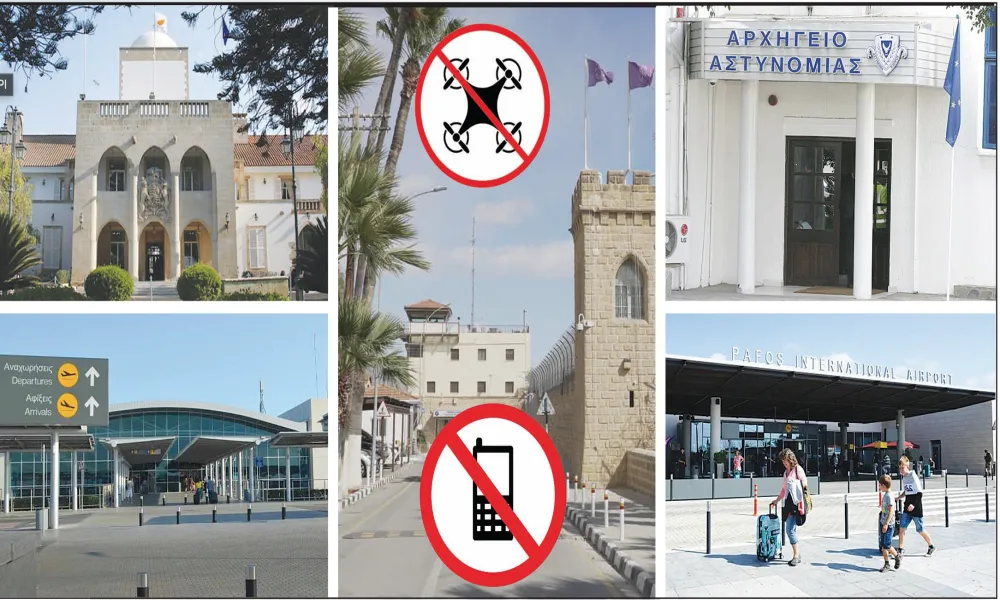
For years, the Republic’s critical infrastructure has been left exposed to the threat of unmanned aerial vehicles. According to a special report published by the Audit Office titled “Audit of Procedures for the Procurement and Installation of Systems Protecting Critical Infrastructure from Unmanned Aerial Vehicle Threats”, Cyprus has yet to acquire or install anti-drone systems, despite more than seven years of efforts and two unsuccessful tenders. The timeline for implementing the project remains unclear.
The tenders concerned the supply and deployment of anti-drone systems intended to secure five critical state facilities, reportedly including the Presidential Palace, the Central Prisons, Police Headquarters and the airports of Larnaca and Paphos. These locations are not named in the Audit Office report.
Two attempts, zero results
According to the Audit Office, two procurement attempts were made without success.
The first attempt began in 2018 under public tender D.O. 28/2018. In 2019, the tender was cancelled by the Contracting Authority on the grounds that the necessary budget credits had not been secured.
The second attempt started in 2021 under tender D.O. 29/2021 but was terminated in April 2025 after the contractor failed to fulfil its contractual obligations. Although part of the system was installed, it showed significant weaknesses and did not meet the required standards.
As a result, after seven years and two failed tenders, the project remains unimplemented, despite its relevance to critical national infrastructure.
Under the Audit Office microscope
The Audit Office examined every stage of both tenders along with the collapse of the final contract. Although a system had been partly installed, it proved inadequate. The Cyprus Police, acting as Contracting Authority, terminated the contract and seized the performance guarantees due to the contractor’s inability to meet contractual obligations.
Lack of planning and no project milestones
The report highlights substantial gaps in project design. No specific milestones were set for each phase, making progress monitoring difficult and hindering the enforcement of delay penalties.
Maintenance and support services were not fully integrated into the financial offer, which meant long-term support of the system at competitive prices was not guaranteed.
The requirement for previous experience exclusively in airports of EU member states or the United Kingdom was also deemed unnecessarily restrictive, excluding companies with relevant experience in technologically advanced third countries.
Evaluation gaps
The Audit Office notes that the contractor’s technical and professional capacity was not sufficiently verified.
Critical elements were not properly checked, including the countries where previous contracts were executed, the actual operational capability of the manufacturer and their ability to provide long-term support. The report also identifies discrepancies between the technical brochures submitted and the manufacturer’s official publications.
Extensions without progress
The report concludes that the project’s implementation was problematic and the monitoring process inadequate.
According to the Audit Office, the contract was marked by repeated extensions without meaningful progress. The most serious finding concerns the absence of systematic monitoring. For nearly three years, the Contracting Authority had no clear understanding of the project’s status and received no interim confirmations regarding system functionality.
This approach proved entirely ineffective. Only when the first acceptance tests were carried out at the final stage was it discovered that the systems did not meet technical requirements, failing even basic drone-detection scenarios.
After the systems failed again during repeat testing, the contract was terminated in April 2025 and the guarantees were seized.