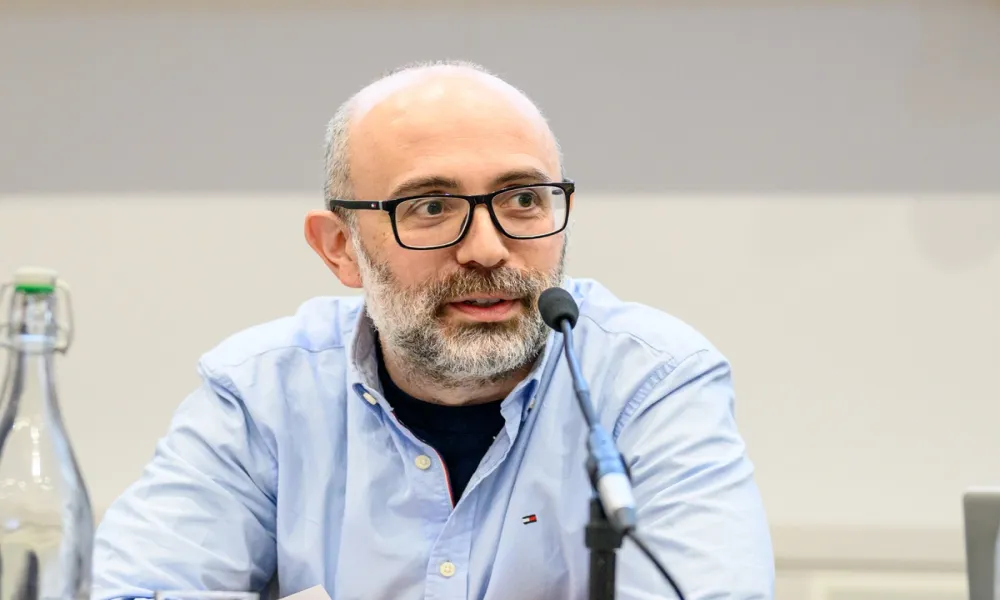
Interview with kateliadi@politis.com.cy
Corporate Social Responsibility (CSR) is often presented as a marker of progress and social awareness in the business world. Videogate, however, has reopened a necessary debate on the intersection of politics and business, and on political–corporate ethics more broadly. At its core lies a fundamental question: are corporate and business contributions to politicians and parties expressions of responsibility, or mechanisms for serving interests?
In the interview that follows, Adonis Pigasiou, Academic Director of the EIMF, deconstructs the way CSR is instrumentalised, challenges the supposedly “voluntary” nature of the contributions referenced in the controversial video, and outlines a political–economic system marked by favouritism, transparency deficits and clientelist practices. He also raises broader questions about institutional resilience, collective tolerance and the role of education in shaping a more demanding civic culture.
Visible, not hidden
What is corporate social responsibility?
As early as the 1950s, American academic Howard R. Bowen posed the question: “What responsibilities to society can businesspeople reasonably be expected to assume?” Since then, the issue has gained increasing prominence, precisely because it resists a definitive answer. During the 1970s and 1980s in particular, corporate scandals, unregulated globalisation and uneven development prompted societies to demand more responsible and ethical behaviour from large multinationals, beyond their legal obligations.
CSR was thus established on a voluntary basis rather than as a mandatory requirement. Well-known examples include Ronald McDonald House Charities, which funds hospital wings and accommodation for families of seriously ill children, and Shell, which finances reforestation programmes to offset emissions linked to fossil fuel use. The ethical dimension of such practices, however, has been legitimately questioned, as they have often functioned as marketing tools that divert public attention from problematic corporate behaviour. McDonald’s, for instance, has been criticised for extensive plastic use, a high carbon footprint, deforestation and poor labour conditions, while Shell remains one of the world’s largest fossil fuel producers.
From this perspective, CSR can also be seen as a hypocritical attempt to sanitise a problematic reality. What is certain is that CSR actions with a positive social impact, regardless of motive, are never carried out anonymously. They are prominently and proudly promoted by the companies themselves.
Close ties
What are we seeing in Videogate? Is it a CSR contribution or something else?
What we see in the Videogate case is not CSR. It is not a voluntary contribution but a verbal “encouragement” that can be interpreted as indirect imposition by the government, in favour of a fund managed, or at least previously managed, centrally and with a degree of secrecy by the Presidential Palace.
Rather, the case confirms that Cyprus’ political–economic model more closely resembles crony capitalism, a term even referenced in the video, where business success is not driven by competition, efficiency or innovation, but by close relationships between business interests and political power.
A clientelist state
What does that mean in practice?
These practices point to what we describe as a clientelist state. According to the literature, the core structural feature of clientelism is the patron–client relationship, in which the patron holds comparatively greater power and influence, as outlined by Mavrogordatos in 1983.
In the case at hand, clientelism operates on two levels. At one level, the client is the businessperson who is expected to contribute financially in order to secure political favour. At another, the government can use a centrally managed fund to satisfy voters, expecting electoral support in return.
If the government genuinely wished to implement a serious investment attraction programme, it should have worked through Invest Cyprus to establish clear conditions and incentives. Imposing a contribution in the name of CSR negates the very concept. If a fee were to be imposed, all potential investors should be transparently informed of a specific contribution requirement, managed by a state institution subject to accountability and oversight.
This also highlights the need to reassess due diligence procedures for evaluating prospective investors, as well as the ease with which current and former politicians appear willing to speak “off the record” to trusted interlocutors.
A recurring pattern
Is Videogate an isolated ethical lapse or a systemic issue?
Unfortunately, it is not an isolated lapse. If faces change but the flawed institutional framework remains intact, the mindset will not change and history is likely to repeat itself. The system is dysfunctional, and the prevailing culture appears to have internalised such practices.
Why change is so difficult
Why did Cyprus not change after the Al Jazeera revelations?
The central challenge is whether politicians are willing to change their mindset, or whether voters will choose leaders with a different culture who are prepared to push through meaningful institutional reforms. Cultural change requires both will and time. It is unclear whether most politicians truly seek such change or are comfortable with a society that remains a passive observer, or even a convenient client, rather than an active civic actor.
Resignation without accountability
What should change when such practices are treated as normal?
Even the resignation of the head of the President’s Office has been framed as a heroic exit, without any acknowledgement of wrongdoing that damages the country’s credibility. From the perspective of the Presidential Palace, what was revealed is treated as secondary to claims of a foreign hybrid attack.
At the same time, the relationship between Mr Lakkotrypis and the President is downplayed, as though he were an unrelated figure speaking arbitrarily on the President’s behalf. The first step should have been an admission that there is a problem. Even that has not happened.
Transparency and accountability could, in theory, limit such situations. The appointment of an independent criminal investigator is, in principle, a correct move. However, it should not be overlooked that the head of the Legal Service, who made the appointment, the President and Mr Lakkotrypis all served together as ministers under the Anastasiades administration, having built personal relationships that inevitably fuel scepticism.
A fleeting spark
What will remain of Videogate in public memory?
We should not assume that most Cypriot citizens are even aware of the video, let alone that they have engaged critically with it. For those who do follow public debate, such scandals often flare up briefly and then fade, leaving many questions unanswered and little expectation of justice. Videogate may well be recorded as yet another systemic failure, reinforcing self-described anti-system movements.
Learning from others
Does corruption exist everywhere?
Of course it does. The key issue is whether we learn from countries that have reduced such phenomena through transparency and strong institutions, rather than taking comfort in the fact that worse cases exist elsewhere.
Education and ethics
What role does education play?
Comprehensive education from an early age is critical. It is troubling that students complete secondary education with minimal exposure to Greek philosophy or fundamental concepts such as ethics, democracy and institutions.
Through multidimensional education that fosters critical thinking and lifelong learning, citizens can gradually grasp the importance of good governance, ethics, institutions and transparency, strengthening civil society. Universities now offer specialised programmes in these areas, and academics have a responsibility to intervene publicly with evidence-based perspectives.
Without a basic understanding of these issues, society will either disengage from politics altogether or gravitate towards unsuitable figures and punitive movements that ultimately harm the country itself.
This article was issued on Politis' Sunday paper