


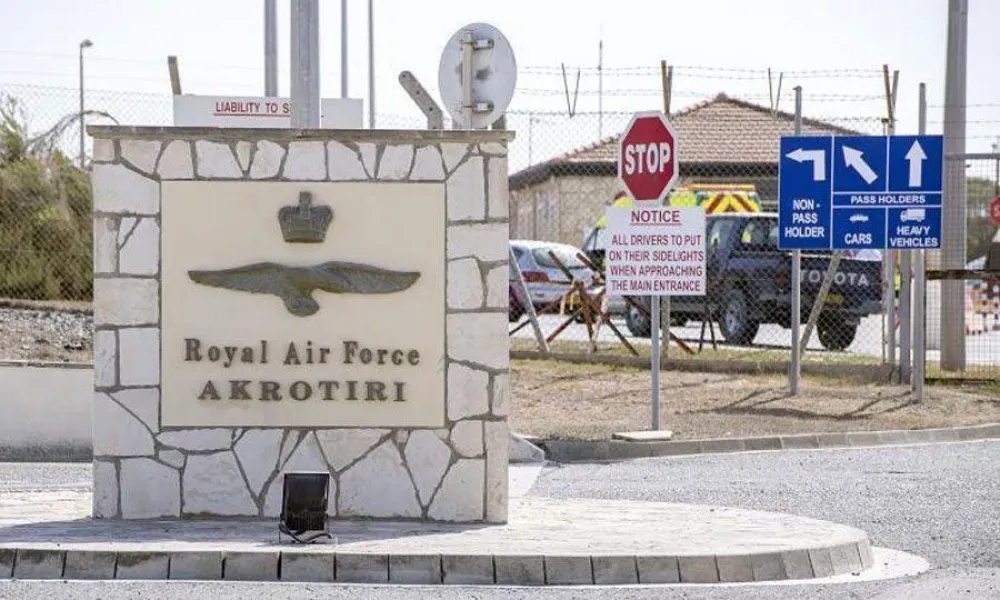

With the deployment of naval, aerial and land-based assets, the air defence umbrella forming over Cyprus is providing strong protection against potential threats. Although it cannot be considered impenetrable, a network of overlapping systems with different capabilities is being created to minimise the possibility of another strike similar to the drone attack on the British bases in Akrotiri last Sunday.
A military source explained that the selection of assets sent to Cyprus or currently heading towards the island is not accidental. In this type of conflict, given the threats involved, the main objective is to establish multilayered protection covering the entire spectrum, from early detection to interception or destruction of incoming threats.
The same source noted that the capabilities of the National Guard’s modern air defence system Barak MX, the anti-drone system carried by the Greek frigate Psara, and the anti-aircraft coverage from the Belharra-class frigate Kimon provide substantial protection against aerial threats such as drones and missiles. However, the presence of additional assets from other countries, including France, the United Kingdom, Spain, Italy and the Netherlands, which are expected to deploy during the week, is also considered necessary.
Coordination already exists among representatives of all countries participating in the coalition supporting Cyprus’ security, defining the role and responsibilities of each asset in order to ensure the highest possible level of protection under current circumstances.
For this reason, the Chief of the National Guard, Lieutenant General Emmanouil Theodorou, visited the British bases in Akrotiri on Saturday. His visit had a dual purpose: assessing the situation and coordinating efforts following decisions to concentrate European naval forces around Cyprus. Defence Minister Vasilis Palmas said the General Staff of the National Guard has overall operational responsibility for intercepting airborne objects and coordinating military actions by the forces deployed around Cyprus.
He added that the countries providing support remain in continuous communication with the General Staff and the National Guard leadership, ensuring full coordination among all forces present on the island.
Destruction rather than interception
A clarification has also emerged during the crisis regarding how unmanned aerial vehicles are handled. A retired air force officer explained that the term “interception” mainly applies to fighter aircraft. When a hostile fighter enters a country’s airspace, local aircraft are deployed to force it to withdraw.
In the case of drones, however, the procedure is different. Rather than interception, drones are destroyed. When a drone is detected approaching Cyprus, it can be shot down either by fighter aircraft or by weapons systems deployed on naval vessels.
The warning sirens
For Cyprus, the repeated alarms sounding at the British bases, particularly during the first days following the Iranian drone strike, caused significant public concern and anxiety. However, according to military sources, such alerts are likely to continue as long as the conflict in the region persists.
Not all alarms are false. According to a military source, whenever an alert is triggered it means that radar systems detected something within their operational range. At the same time, drones such as the Iranian-made model launched from Lebanon are difficult to detect due to their small size and design.
One of the more advanced systems capable of detecting such drones is the Greek-made Kentavros system installed on the frigate Psara. The system has previously been tested during joint operations to protect shipping from attacks by Houthi forces.
Once a suspicious object is detected, the closest fighter aircraft investigates the target. If it is confirmed to be a drone, it is then destroyed.
Detection and interception costs
Radar systems operated by the National Guard, as well as those on naval vessels in the region, are capable of detecting airborne objects from considerable distances. Once a target is detected and its trajectory recorded, the deployed forces coordinate to determine which asset will engage.
In the case of threats such as kamikaze drones, which carry explosives but no conventional weapons, the method of destruction is selected accordingly. Fighter aircraft often use onboard machine guns rather than missiles, since missile launches would involve disproportionate costs.
For this reason, the National Guard’s air defence systems are currently using primarily radar capabilities rather than launching anti-aircraft missiles such as those in the Barak MX system or the Russian-made BUK and TOR-M1 systems.


