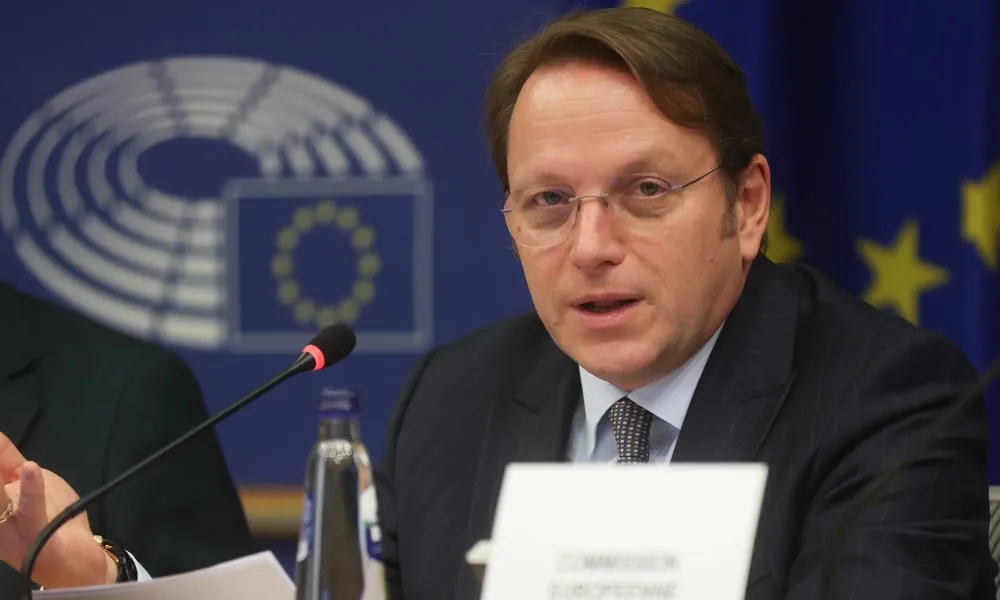

An end to the prolonged uncertainty surrounding the management of the foot-and-mouth disease outbreak is expected today, as European Commissioner for Health and Animal Welfare Oliver Várhelyi arrives once again in Cyprus. The government is seeking to negotiate “flexibility” within the strict framework of mass culling required by European legislation, following strong reactions from livestock farmers.
The tension that erupted between farmers and the Veterinary Services during a press conference organised by the Ministry of Agriculture to brief the public on the disease forced Agriculture Minister Maria Panayiotou, who was present, to outline the approach Cyprus intends to follow in today’s negotiations with the European Commission’s representative. This approach, however, does not appear to move toward halting mass cullings, as strongly demanded by farmers. It is worth noting that, according to the spokesperson of the Veterinary Services, Sotiria Georgiadou, alternative “scenarios” will be discussed by President Nikos Christodoulides directly with the European Commission and will be announced afterwards.
Specifically, tensions rose when farmers who oppose the application of EU legislation requiring mass culling in infected farms asked how many millions of euros the cost would be if Cyprus were to proceed with mass vaccination and avoid culling, and how much the long-term cost would be if the current pace of cullings continues, so that the two options could be compared. At that point, the Veterinary Services stated that they were not in a position at this stage to provide comprehensive figures. The result was a highly charged atmosphere at the conference, with farmers expressing concern and frustration that the authorities are proceeding with animal cullings without having a clear picture of the cost.
Warnings About Halloumi
After questions were raised about what exactly Cyprus has requested from the European Union in this case, Ms Panayiotou intervened and stated that “we do not want to go against the European Commission, because this is not a matter of numerical cost; the consequences are far greater.”
She was speaking in continuation of warnings by the president of the Pancyprian Veterinary Association, Dr Dimitris Epameinondas, who said that if Cyprus does not comply with EU legislation on cullings, the EU will ban the island from exporting halloumi, as well as by senior Veterinary Services official Sotiria Georgiadou, who warned of the possible exclusion of the Republic of Cyprus “from exports and the EU single market, and whatever other measures the European Commission may impose on Cyprus.”
According to Ms Panayiotou, “in whatever course we follow, we want to be aligned with the European Commission, because this will bring specific benefits. What we are trying to do, based on the documentation we have, is to request certain flexibilities.”
Agreeing with the president of the Pancyprian Veterinary Association that the European regulation is strict, she noted that “it has been designed for all EU member states without taking specific national particularities into account.” However, she added that “we have particularities, which we place on the table along with our scientific data and scientific recommendations.”
She further stressed that all proposals submitted to the European Commission, whether by the political leadership or by Cyprus as an EU member state, are based on scientific evidence and documentation provided by scientists and the Veterinary Services.
“Flexibility Based on EU Protocols”
Government spokesperson Konstantinos Letymbiotis also addressed the assurances given by President Christodoulides to farmers during their meeting last Sunday and what Cyprus will request from the EU on the issue. Asked whether the President had committed to requesting an end to culling healthy animals, Letymbiotis said that the President had stated that, “based on a prioritisation of the issues to be raised before the Commission, the aim is to clarify, verify and confirm the flexibility that exists, always within the framework of the European Union’s procedures and protocols.”
He added that the President has committed to and has already taken steps to explore all possible margins within the regulations and procedures, and to do so at the highest level.