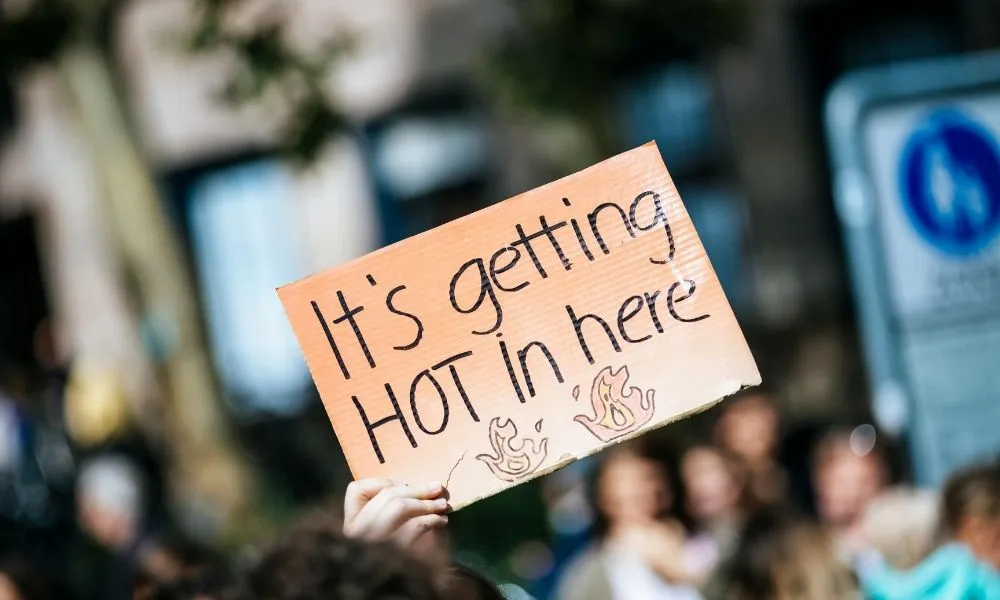

The global climate picture is changing at a pace that leaves little doubt that the planet’s balance has been disrupted to a degree that is difficult to reverse in the short term.
This is the central message of the new report State of the Global Climate 2025, published on 23 March 2026 by the World Meteorological Organization. The report outlines a reality in which global warming, rising sea levels and extreme weather events are creating sustained pressure on natural systems and human societies.
According to ClimateHub, the first national initiative implementing the Copernicus Climate Change Service (C3S) in Greece, the report clearly shows that concentrations of greenhouse gases continue to increase, leading to ongoing warming of the atmosphere and oceans while the melting of ice is accelerating. These developments have taken place within only a few decades, yet their consequences will extend far beyond the present, affecting future generations for hundreds or even thousands of years.
The period 2015–2025 was the warmest decade ever recorded
The period from 2015 to 2025 has already been recorded as the warmest eleven-year span in measurement history. The year 2025 ranks among the two or three warmest years ever recorded, with the average global temperature standing 1.43 degrees Celsius above the levels of the 1850–1900 period. The year 2024 remains the warmest on record, with an anomaly of approximately +1.55 degrees Celsius. These figures are not merely statistical observations but translate into intense heatwaves, heavy rainfall and tropical cyclones that have caused widespread damage, highlighting the vulnerability of both economies and social systems.
Oceans are at the centre of the climate crisis, continuing to absorb large quantities of carbon dioxide. This process is reducing the pH of seawater to levels not seen for at least 26,000 years, directly affecting marine life and food production. At the same time, ocean heat content reached a new record high in 2025, while the rate of warming has more than doubled compared with the period 1960–2005. The impacts are already visible, with ecosystem degradation and biodiversity loss in many regions.
Conditions at the poles confirm the scale of these changes. In 2025, Arctic sea ice extent fell to historically low levels, while Antarctica recorded the third lowest level ever observed. This development is directly linked to rising sea levels, which remained close to the record highs of 2024 and are now about 11 centimetres higher than in 1993. The consequences include damage to coastal ecosystems, salinisation of groundwater and an increased risk of flooding.
The Earth’s energy balance and greenhouse gas data
One of the most critical elements highlighted in the report concerns the Earth’s energy balance. Under normal conditions, the energy the planet receives from the Sun is balanced by the energy it radiates back into space. However, this balance has been disrupted to the highest level seen in the past 65 years. The cause lies in the rising concentrations of greenhouse gases, which are now at the highest levels of at least the past 800,000 years.
Data on key gases such as carbon dioxide, methane and nitrous oxide are particularly striking. In 2024, the concentration of carbon dioxide in the atmosphere reached the highest level in the past two million years, while methane and nitrous oxide concentrations are at their highest levels in 800,000 years. In 2025, the upward trend continued, confirming that the trajectory has not yet been reversed.
Climate change and direct consequences for human health
Climate change is now having direct consequences for human health. Heat stress is increasing and affects more than one third of workers worldwide, while diseases such as dengue fever are spreading more rapidly as environmental conditions become more favourable for mosquito transmission. Experts underline the need to integrate climate data into health systems in order to strengthen prevention and adaptation strategies.
The World Meteorological Organization report is based on scientific contributions from National Meteorological and Hydrological Services, Regional Climate Centres, United Nations organisations and dozens of expert scientists. It provides a comprehensive picture of the situation by combining data from across the globe.
Athens records second warmest winter on record
Within this context, data from Greece confirm that these changes are not distant projections but already observable realities. The historic climate station of the National Observatory of Athens in Thiseio, operating continuously since 1890 on the Hill of the Nymphs, recorded a winter with strongly deviating characteristics.
The winter of 2025–2026 was the second warmest ever recorded in Athens since the late nineteenth century. The average temperature reached 12.63 degrees Celsius, 2.34 degrees higher than the average for the 1991–2020 period. The average maximum temperature reached 16.4 degrees, while the average minimum temperature stood at 10 degrees, both showing significant deviations. The warmest winter on record remains 2023–2024, with an average temperature of 13 degrees.
At the same time, the winter was also among the wettest on record. Total rainfall reached 336.8 millimetres, nearly double the average for the 1991–2020 period, representing an increase of 93%. As a result, it ranks as the third wettest winter in measurement history, behind those of 2012–2013 and 2002–2003.
The number of days with rainfall was also higher. Days with more than 0.1 millimetres of precipitation reached 30 compared with an average of 27.6, while days with rainfall above 1 millimetre reached 22 compared with a climate average of 18.6. These figures indicate that the change concerns not only the intensity but also the frequency of weather events.
The operation and maintenance of this historic station, as well as the management and quality assurance of its data, are carried out by the Institute for Environmental Research and Sustainable Development of the National Observatory of Athens, under the scientific supervision of Dr Dimitra Founda. The station’s long-term archive constitutes a valuable tool for understanding climate change in Greece.
The convergence of international and local data leads to a clear conclusion: climate change is not a distant scenario but a reality that is already shaping the present. The figures document the scale of the transformation, while behind them lie tangible impacts affecting daily life, the economy and the natural environment.