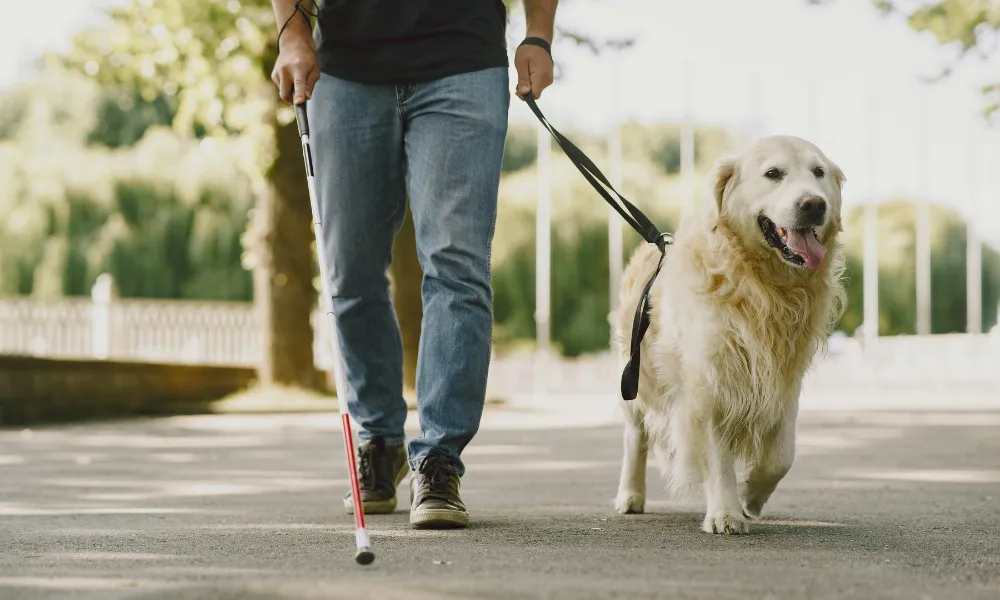

For some people, a dog is not simply a pet. It is their eyes in the street, an alert before a medical episode, and support at every step and obstacle they face in daily life. Until recently, these individuals were largely invisible in the Cypriot legal framework, which did not define what an assistance dog is or under what conditions it is recognised.
A new amendment to the Dogs Law, approved on Thursday by the House of Representatives plenary, aims to address this gap by introducing specific provisions for the definition, training, certification and registration of assistance dogs. The legislation forms part of the broader regulatory framework governing dog registration, ownership permits, owner obligations and the responsibilities of authorities.
The provisions gain particular significance when combined with a recent amendment to the Law on Persons with Disabilities, which establishes the right of people with disabilities to be accompanied by an assistance dog in both public and private spaces. In practical terms, any attempt to prevent access for a person who meets the legal requirements regarding assistance dogs, whether in public areas, public transport, restaurants, medical practices or hospitals, constitutes discrimination against persons with disabilities and may lead to imprisonment following legal proceedings.
Definition of an assistance dog
According to the legislation, which originated from a proposal by the Ecologists MP Charalambos Theopemptou, an assistance dog is defined as a dog specially trained to provide guidance or perform tasks directly related to a disability or a serious or chronic medical condition.
The definition includes dogs trained as:
- guide dogs for people with visual impairments
- dogs for individuals with hearing impairments
- mobility or balance support dogs
- medical alert or response dogs
- psychiatric support dogs
- allergen detection dogs
Training and certification
To be recognised as an assistance dog, the animal must be trained by an organisation that:
- is recognised and affiliated with the International Guide Dog Federation (IGDF), or
- is recognised and a member of Assistance Dogs International (ADI).
Training must be documented through an official certificate, which must be submitted during the application process for a dog ownership permit.
Registration procedure and ownership permit
The owner of an assistance dog must submit an application to the competent authority where the dog resides, namely the local municipality or community council. The application must include the training certificate, details of the dog and the owner.
The ownership permit is issued by the competent authority and remains valid until 31 December of each year, with the possibility of renewal.
Registry and competent authorities
Information about assistance dogs is recorded in a registry maintained by the Director of the Veterinary Services of the Ministry of Agriculture.
Responsibilities are distributed as follows:
- Veterinary Services maintain the registry and provide central oversight
- municipalities and community councils issue ownership permits and monitor compliance
Ownership permits for assistance dogs are issued and renewed free of charge. This differs from other dog categories, for which annual fees of €200 are typically required.
Link to the right of access
The regulation follows a recent amendment to the Law on Persons with Disabilities proposed by DIKO MP Christos Senekis. The legislation establishes the right of people with disabilities to enter both public and private spaces accompanied by an assistance dog.
Refusing entry or service to an individual accompanied by such a dog constitutes discrimination. In such cases, financial penalties and or imprisonment may be imposed following judicial proceedings.
Cost remains a barrier
Although the legal recognition of assistance dogs has now been established, one major issue remains unresolved: the cost of acquiring and training an assistance dog.
The issue was repeatedly raised before the Parliamentary Committee on Human Rights, where it was noted that training a single assistance dog may cost between €10,000 and €50,000, particularly when training takes place abroad. Even the certification process itself can require several thousand euros, making access to these services extremely limited.
As a result, only a very small number of people in Cyprus currently have assistance dogs. Of approximately 2,000 individuals with severe visual impairment, only five have managed to obtain one.
Under these circumstances, MPs and disability organisations have raised the need for state intervention, either through grants or targeted support schemes. They stress that legal recognition of a right does not necessarily ensure that people can exercise it in practice when the financial cost remains prohibitive.
The question now arises whether the government, through the Deputy Ministry of Social Welfare, intends to examine subsidy or co-funding mechanisms for assistance dog training in order to make access to a tool that is essential for many people’s independence more widely achievable.