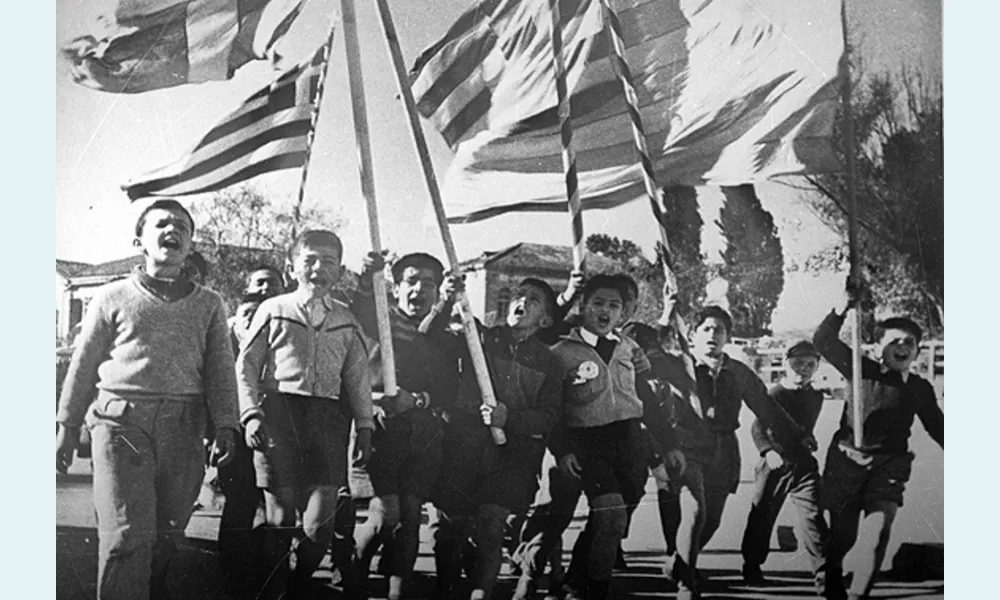
EOKA, a secret military organisation of Greek Cypriots, led the four-year armed national liberation struggle from 1955 to 1959 against British colonial rule, under the leadership of Georgios Grivas, known by the nom de guerre Digenis. The struggle led to the liberation of Cyprus, which became an independent republic in 1960.
Establishment of EOKA
The first ideas for establishing a militant organisation of Greek Cypriots, aimed at promoting the struggle for union of the island with Greece, date back to 1948. During that period the Church of Cyprus was reorganised and staffed with a new leadership after approximately 16 years of institutional weakening.
Following the uprising of October 1931, the Metropolitans of Kition, Nikodimos Mylonas, and Kyrenia, Makarios, had been exiled. After the death of Archbishop Kyprianos III in 1933, it had not been possible to fill the archiepiscopal throne. The authoritarian regime known as Palmerocracy, imposed after the events of 1931, continued until 1940.
Only after the end of the Second World War was the Church able to elect its senior leadership again. Metropolitan Makarios of Kyrenia returned from exile and was elected Archbishop following the death of the locum tenens and, for a brief period, Archbishop Leontios. Cleopas was elected to the See of Paphos, Kyprianos to the See of Kyrenia and Makarios to the See of Kition, who in 1950 became Archbishop.
With the election of the new ecclesiastical leadership, planning for the struggle began and the long-standing demand of Greek Cypriots for union with Greece was reasserted with renewed intensity after the Second World War.
Georgios Grivas wrote in his memoirs (Athens, 1961, pp. 14–15) that the first discussions about conducting an armed liberation struggle in Cyprus took place in Athens from June 1948 between himself, Achilleas Kyrou and others. At the same time, similar ideas were being expressed in Cyprus by Metropolitan Makarios of Kition, who later became Archbishop Makarios III.
Makarios III
In 1950, when Makarios III ascended to the archiepiscopal throne, he intensified the campaign for union and sought to internationalise the Cyprus issue by promoting it internationally.
His secret contacts with the group in Athens were continuous. That same year, Grivas met with General G. Kosmas, then Chief of the Hellenic Army General Staff, who also informed Field Marshal Alexandros Papagos.
In May 1951 the Athens group, composed of Cypriot exiles and Greek nationals, proposed that Georgios Grivas, a retired colonel of the Greek army, assume leadership of the armed struggle in Cyprus. Archbishop Makarios was also aware of these developments.
In July 1951 Grivas travelled to Cyprus as a tourist to assess conditions for an armed struggle on the island. During the visit he met with Archbishop Makarios and established his first network of collaborators in Cyprus.
At the same time, Makarios pursued a diplomatic and political campaign aimed at internationalising the Cyprus question and bringing it before the United Nations. The aim was to compel the governing power, Great Britain, to address the issue more seriously.
Disappointments in the political arena, including Britain’s refusal to recognise the existence of a Cyprus issue, the inability of Greek governments closely aligned with Britain to achieve progress, and the limited results of early discussions at the United Nations, eventually led to the final decision to proceed with the planned armed struggle in Cyprus.
After receiving final approval from Archbishop Makarios, who had also financed many of the preparatory efforts, Grivas secretly departed Greece for Cyprus by boat. He arrived on the island on the evening of 10 November 1954 aboard the vessel Agios Georgios, landing secretly on a remote coast near the village of Chloraka in the Paphos district.
Immediately he began organising a secret military organisation. Recruitment and training began, and the organisation was formed under the name EOKA (National Organisation of Cypriot Fighters). The name was chosen by Grivas, who adopted for himself the pseudonym Digenis, after the Byzantine hero of the frontier epics.
With the agreement of Makarios, who used the pseudonym “General”, EOKA began its activities on 1 April 1955.
The four-year armed uprising of Greek Cypriots, with Archbishop Makarios III as political leader and Colonel Georgios Grivas as military leader, began at midnight between 31 March and 1 April 1955 with bomb explosions placed by EOKA in British government installations.
Political committee
In order to secure the broad participation of the population in the struggle and to organise the internal front more effectively, Grivas established in 1956 the Political Committee of the Cypriot Struggle (PEKA).
Its objectives were defined as:
- Coordination of the political and military struggle
- Maintenance of a unified internal front
- Strengthening the morale of the population
- Countering hostile propaganda
Strategy and tactics
For several serious reasons, an armed revolutionary movement in Cyprus faced considerable obstacles. Among the main difficulties were:
- The island character of Cyprus and its geographical position, which made it difficult to establish insurgent bases or receive assistance from neighbouring countries
- The limited size of the island and its terrain, which provided little concealment for guerrilla fighters
- The lack of military experience among Cypriots, combined with their generally peaceful character
- The overwhelming superiority of British forces in personnel and military resources
When organising EOKA, Georgios Grivas carefully considered these factors and attempted to counterbalance them through several methods:
- A form of guerrilla warfare based on rapid movement, sudden attacks and quick withdrawal
- Avoidance of frontal assaults and large-scale confrontation with the enemy
- Mass participation of the population through demonstrations, general strikes and passive resistance, which kept large numbers of British forces occupied
- Promotion of a strong fighting spirit and the strengthening of morale among both fighters and the wider population
- Strict discipline and severe punishment for those who revealed secrets of the organisation or failed to carry out their duties
This strategy proved relatively effective and made EOKA a significant military force that continuously engaged more than 20,000 members of British security forces.
However, the fighters’ lack of military experience was one of the main causes of losses suffered during the four years of activity. Many casualties occurred due to accidental explosions of bombs being manufactured, transported or placed, inadequate security measures or confrontations with British forces during which insufficient training made the fighters vulnerable.
Despite these difficulties, many EOKA operations were marked by acts of bravery and heroism. Women in Cyprus also participated extensively in the struggle.
Recognition of EOKA
The 1st of April is commemorated by Greek Cypriots as a national anniversary marking the beginning of the EOKA struggle.
In January 1986 a bill was submitted to the House of Representatives of Cyprus recognising EOKA officially as the liberation organisation of Cyprus.